
Quick Answer: What Is Autonomous Robotics in Education?
Autonomous robotics in education teaches students how to design and programme robots that can sense their surroundings, process information, make decisions, and act without continuous human control. Through sensors, motors, coding, and hands-on experimentation, students can connect programming with real physical outcomes while developing practical STEM, engineering, and problem-solving skills.
Why Autonomous Robotics Matters in School Learning
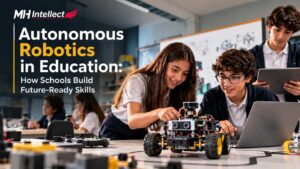
Imagine a student testing a robot that should avoid an obstacle. Instead of turning as expected, the robot stops too late and hits the object. The student checks the sensor, reviews the code, changes a value, and tests the robot again. That simple moment creates a valuable learning opportunity.
Autonomous robotics moves robotics beyond simply making a machine move. Students begin exploring why a robot behaves differently under changing conditions. They learn how sensors collect information, how programmed logic processes that information, and how motors respond to decisions. This connects coding, electronics, engineering, and problem-solving within one practical activity.
How Autonomous Robots Work
The basic concept can be introduced through a simple Sense → Decide → Act cycle. Sensors collect information about the environment, programmed logic processes the information, and the robot performs an appropriate action.
For example, an obstacle-avoidance robot can use a distance sensor to detect an object. When the object reaches a defined distance, the programme instructs the robot to stop, turn, and continue moving. Students can then adjust the sensor position, detection threshold, or motor behaviour and observe how each change affects the outcome.
A Practical Approach to Educational Robotics
Educational robotics can introduce these concepts through projects that are appropriate for different student levels. An obstacle-avoidance robot, for example, allows students to understand the relationship between sensors, programming logic, and physical movement without requiring advanced artificial intelligence.
The most valuable part of the project is often what happens when the robot does not work correctly. Students investigate the problem, change variables, test their ideas, and use the results to improve the system. This encourages an engineering mindset based on experimentation and iteration.
What Students Learn Through Robotics Education
Robotics education can develop several skills within a single learning experience. Students work with code, physical components, testing, design decisions, and teamwork while solving practical challenges.
Through autonomous robotics projects, students can develop:
- Coding and computational thinking through programming robotic behaviour.
- Understanding of electronics and engineering through sensors, motors, and controllers.
- Troubleshooting and debugging through repeated testing.
- Evidence-based problem-solving by changing variables and analysing results.
- Collaboration and communication through team-based projects.
- Persistence and resilience when initial solutions do not work.
From Basic Robots to Advanced Autonomous Systems
Schools do not need to introduce sophisticated AI-powered robots from the first lesson. A progressive pathway can begin with basic coding, movement, electronics, and sensor interaction. Students can then move into multiple sensors, obstacle avoidance, more complex programming, and autonomous navigation.
At advanced levels, students can explore Python, AI, computer vision, IoT integration, and more sophisticated robotic applications. This lets technical complexity grow alongside student understanding, rather than introducing advanced technology before students have built the necessary foundations.
Building Autonomous Robotics Programmes in Schools
Effective Autonomous robots learning requires more than robotics equipment. Schools need a clear progression that identifies what students should learn at each stage, which projects support those outcomes, when advanced technologies should be introduced, and how teachers will develop alongside the programme.
This is where structured STEM Education Programs for Schools can connect robotics with broader learning objectives. Robotics can become part of a progressive STEM pathway rather than an isolated activity.
How MH Intellect Supports Robotics Learning
MH Intellect works with schools to develop hands-on robotics and STEM programmes based on learning objectives, student development, teacher capabilities, and long-term programme goals. Support can include robotics curriculum design, autonomous robotics programmes, teacher training, lab planning, innovation challenges, and ongoing implementation.
Schools can also use STEM Education products as learning tools within structured activities, where students build, programme, test, and improve practical solutions rather than simply using technology without a clear educational purpose.
Seeing Robotics Learning in Practice
The impact of robotics becomes clearer when students are given opportunities to work through real challenges. Building a robot that responds to its environment can turn abstract programming concepts into observable outcomes and encourage students to think like designers, engineers, and problem-solvers.
The Student’s Gallery provides an opportunity to explore examples of hands-on robotics and engineering learning in practice.
Build a Structured Robotics Programme for Your School
Ready to introduce autonomous robotics, coding, and practical STEM learning into your school? Book a free consultation with MH Intellect to explore a structured robotics education pathway aligned with your students’ learning needs.