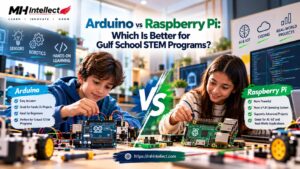

When schools begin developing robotics and STEM programmes, one common question is how to choose between different technology platforms. Arduino vs Raspberry Pi is not simply a hardware comparison. For school leaders and STEM coordinators, the more useful question is which platform matches students’ age, learning objectives, teacher capabilities, and project requirements.
Understanding the Difference Between Arduino and Raspberry Pi
Arduino is a microcontroller platform designed to interact directly with physical components such as sensors, motors, LEDs, and electronic circuits. This makes it particularly useful for helping students understand how programming can control physical systems.
Raspberry Pi is a small single-board computer that supports an operating system and a broader range of programming and computing activities. It can be used for Python programming, networking, data processing, computer vision, IoT, and more advanced projects.
For schools, the technology should support the learning objective rather than become the objective itself. A well-planned programme can introduce students to different platforms as their skills develop.
Arduino for Robotics Education
Arduino can provide a practical introduction to electronics, sensors, motors, physical computing, and beginner robotics. Students can write code, connect components, test their designs, and immediately observe physical results.
For example, a student might programme a robot to detect an obstacle and change direction. The activity connects coding with a physical outcome, helping students understand inputs, outputs, conditional logic, and basic automation.
When considering Arduino vs Raspberry Pi for robotics, schools should first identify what students are expected to learn from the project. Arduino can be particularly useful when the focus is on direct hardware interaction and foundational robotics concepts.
Arduino vs Raspberry Pi for Beginners
The learning experience is especially important when students are new to robotics. Arduino vs Raspberry Pi for beginners should therefore be considered according to the student’s current level rather than the technical capabilities of the device.
Arduino can offer an accessible way to introduce circuits, sensors, motors, and basic programming through hands-on activities. Students can see the immediate relationship between their code and the physical response of a device.
As students become more comfortable with programming and computational thinking, Raspberry Pi can introduce broader computing concepts, including Python, networking, data processing, and computer vision.
Arduino vs Raspberry Pi Projects for Schools
Project requirements can provide a practical framework for selecting a platform. Arduino vs Raspberry Pi projects can range from simple electronics activities to advanced robotics and intelligent systems.
A school might use Arduino for sensor experiments, line-following robots, obstacle-avoidance systems, and environmental monitoring. Raspberry Pi can support Python projects, computer vision, networking, data-focused activities, and more advanced computing applications.
For complex robotics projects, both platforms can also work together. Arduino can manage sensors and motors while Raspberry Pi handles higher-level computing and processing.
Educational Robotics vs Industrial Robotics
Schools should also understand the distinction between classroom robotics and professional automation. Educational Robotics vs Industrial Robotics involves different objectives and learning environments.
Educational robotics focuses on helping students understand programming, electronics, engineering, automation, problem-solving, and robotics through age-appropriate projects. Industrial robotics, on the other hand, involves specialised systems designed for professional automation and manufacturing environments.
For schools, the goal is not to replicate an industrial robotics facility. Instead, students can progressively develop the concepts and skills that provide a foundation for understanding more advanced robotic systems.
Connecting Robotics With AI Education
As students develop stronger programming and computational thinking skills, robotics can become a pathway into artificial intelligence. Raspberry Pi can support projects involving Python, cameras, image processing, computer vision, and selected AI applications, while Arduino can support sensor-based systems and physical interactions.
Understanding the Difference Between AI Literacy and AI Education is also important when schools introduce AI into STEM programmes. AI literacy can help students understand fundamental AI concepts and responsible use, while structured AI education can progressively develop deeper technical knowledge and practical skills.
Building a Progressive Robotics Pathway for Gulf Schools
A strong school robotics programme does not need to depend on a single platform. Students can begin with electronics and sensor activities, progress into Arduino-based robotics, and later explore Raspberry Pi, Python, IoT, computer vision, and AI.
This progression allows schools to match technology with student development. Instead of introducing advanced systems before students understand the fundamentals, each stage can build on knowledge and skills developed earlier.
For Gulf schools, this approach can also help STEM coordinators connect robotics activities with broader curriculum objectives, project-based learning, engineering concepts, and future technology skills.
How MH Intellect Can Support Schools
MH Intellect supports schools in developing practical STEM and robotics learning experiences that can connect robotics, coding, AI, IoT, engineering, and emerging technologies. The focus is on creating structured learning pathways based on student needs, educational objectives, teacher capabilities, and programme requirements.
A progressive approach can help schools move beyond isolated robotics workshops and create continuous learning experiences where students build, programme, test, troubleshoot, and improve their solutions.
Final Thoughts
The question of Arduino and Raspberry Pi should ultimately be considered within the context of student learning. Arduino can introduce foundational electronics, sensors, motors, and physical robotics, while Raspberry Pi can extend learning into programming, computing, IoT, computer vision, and advanced applications.
For school leaders, selecting the appropriate platform is only one part of building an effective robotics programme. The larger objective is to create a structured learning pathway in which every technology, project, and activity contributes to students’ developing STEM knowledge and practical skills.
Ready to develop a structured robotics and STEM learning pathway for your school? Book a free consultation with MH Intellect to discuss your school’s learning objectives and programme requirements.