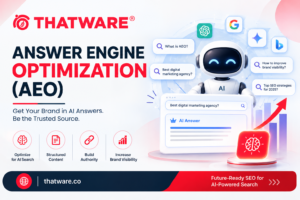

Search behavior is changing rapidly. Users are no longer limited to short keyword queries and traditional search-result pages. Increasingly, people ask detailed questions through AI-powered platforms and expect direct, contextual answers. This shift is creating new opportunities for businesses to rethink how their information is structured, presented, and discovered online.
Answer Engine Optimization (AEO) has emerged as an important component of this evolving search landscape. It focuses on making information clear, relevant, authoritative, and accessible to systems that generate answers for users. Rather than optimizing exclusively for rankings, businesses can use AEO to strengthen their ability to appear within conversational and answer-driven search experiences.
Understanding the Rise of Answer-Based Search
Traditional SEO remains essential, but modern search increasingly involves systems that interpret context and synthesize information from multiple sources. Search engines and AI platforms can analyze webpages, entities, structured information, and supporting references before presenting an answer.
For businesses, this means content needs to do more than include relevant keywords. It should communicate expertise and answer genuine user questions in a logical and trustworthy way.
An effective answer-focused strategy can include:
- Creating clear, question-driven content
- Using descriptive headings and structured sections
- Providing concise answers supported by useful context
- Developing strong topical authority
- Implementing relevant structured data
- Strengthening brand and entity relationships
- Maintaining consistent information across digital properties
These practices can make important business information easier for both users and intelligent systems to understand.
How AEO Complements Modern SEO
Answer Engine Optimization (AEO) does not replace conventional SEO. Instead, it extends the optimization process toward search experiences where users receive synthesized answers rather than simply browsing links.
For example, a company providing professional services can create resources addressing common customer questions, explain complex processes, publish detailed FAQs, and organize information around specific user intents. This gives search systems clearer contextual signals while improving the experience for people researching a topic.
The approach also encourages businesses to think about entities and relationships. A brand should be clearly connected to its services, expertise, locations, products, industry, and supporting information. This broader semantic structure can help establish a more coherent digital identity.
The Importance of AI Visibility
As generative AI becomes part of the discovery journey, businesses are also paying greater attention to AI Visibility intelligence and implementation. This involves understanding how a brand is represented across AI-driven search experiences and developing practical strategies to improve the quality and consistency of its digital signals.
For organizations operating in competitive markets, this can involve monitoring how AI systems interpret their brand, identifying gaps in available information, analyzing relevant entities, and improving content and technical foundations.
ThatWare LLP works across emerging search disciplines, bringing together SEO, AEO, GEO, semantic optimization, and AI-oriented visibility strategies. Its broader approach reflects the changing relationship between search engines, answer engines, and large language models.
Building Content for Answer Engines
Businesses preparing for AI-driven discovery should focus on creating information that is genuinely useful rather than producing content solely for algorithmic visibility.
A strong content framework can include:
- Direct answers: Address the main question early and clearly.
- Supporting context: Explain the subject in enough depth to establish expertise.
- Structured information: Use logical headings, lists, FAQs, and appropriate schema.
- Evidence and authority: Support important claims with credible information.
- Consistent entities: Keep brand, service, product, and organizational information aligned.
This approach benefits both conventional search users and people interacting with conversational AI systems.
Why Businesses Should Adapt
The customer journey is becoming increasingly conversational. Someone researching a product or service may ask an AI platform to explain options, compare providers, identify specialists, or recommend relevant solutions. Businesses therefore need to consider how their digital presence performs across multiple discovery environments.
Answer Engine Optimization (AEO) provides a framework for addressing this transition. When combined with strong technical SEO, authoritative content, entity optimization, and AI visibility strategies, it can help businesses create a more comprehensive foundation for modern search.
ThatWare LLP’s focus on emerging search methodologies demonstrates how optimization is expanding beyond traditional rankings. The emphasis is increasingly on context, relevance, information quality, and the ability of intelligent systems to understand a brand’s digital identity.
Conclusion
Search is becoming more conversational, contextual, and increasingly influenced by artificial intelligence. Businesses that want to remain discoverable need to consider not only where their webpages rank but also how accurately their information can be understood and surfaced within answer-driven environments.
Answer Engine Optimization (AEO) offers a practical way to prepare for this transformation by combining user-focused content, structured information, semantic relevance, and stronger digital authority. With its focus on SEO, AEO, GEO, and AI Visibility intelligence and implementation, ThatWare LLP is contributing to the broader evolution of search strategy and helping businesses prepare for a future where intelligent systems play an increasingly important role in online discovery.