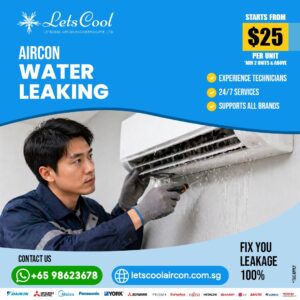

Aircon Water Leaking
Singapore’s hot and humid climate means air conditioners are an essential part of everyday life. During periods of heavy rain, however, some homeowners notice an unexpected problem: aircon water leaking from the indoor unit. While rain itself does not normally cause an indoor air conditioner to leak, heavy rainfall can expose drainage, installation, insulation, or external water-entry problems.
Understanding why this happens can help homeowners identify the warning signs early and arrange professional aircon servicing Singapore before a small issue becomes a costly repair.
At Letscool Aircon and Services Singapore, professional technicians can inspect air-conditioning systems, identify the source of leakage, and recommend an appropriate solution based on the condition of the unit.
1. Why Does Aircon Water Leak During Heavy Rain?
When an aircon is operating, moisture naturally forms on its indoor evaporator coil because warm indoor air passes over the cold surface. This condensation should collect in the drain tray and flow safely through the drainage pipe.
During heavy rain, an existing drainage or installation problem may become more noticeable. For example, a partially blocked drainpipe may struggle to remove condensation efficiently. If the drain tray fills up, water can overflow from the indoor unit.
Heavy rain may also reveal problems around the wall opening, outdoor piping, insulation, or installation area. If rainwater enters through an improperly sealed opening, the water may appear to come from the aircon even though the actual source is external.
This is why identifying the exact source is important before deciding whether the unit needs cleaning, repair, or another service.
See More: How to Fix a Smelly Air Conditioner
2. Can Heavy Rain Cause an Aircon to Leak Water?
Heavy rain does not normally make an indoor aircon produce excessive condensation simply because it is raining. However, rainy weather can contribute to conditions that make an existing problem more obvious.
Possible causes include:
- Blocked or partially blocked drainage pipes
- Improper drainpipe slope
- Damaged insulation
- Cracks or gaps around wall openings
- Poorly sealed trunking
- Water entering from outside
- Dirty evaporator coils
- A damaged or overflowing drain tray
- Installation-related drainage problems
If your aircon water leaking occurs mainly during heavy rainfall, the technician should check both the air-conditioning drainage system and the surrounding installation area.
Professional aircon general servicing can help identify dirt, blockages, and other common maintenance issues.
3. Blocked Drainage Can Make Water Overflow
One of the most common causes of indoor aircon leakage is a blocked drainage system.
Dust, dirt, algae, sludge, and other debris can gradually accumulate inside the drainpipe. When water cannot flow freely, condensation may back up into the drain tray. Eventually, the water can overflow into the room.
Heavy rain can make the situation appear worse because Singapore’s humid conditions may already result in substantial condensation from regular aircon operation.
Regular servicing is therefore important. During aircon servicing Singapore, technicians can inspect the drainage system and clean relevant components where necessary.
If a basic cleaning does not resolve the problem, further investigation may be needed to determine whether the pipe has a serious blockage, incorrect gradient, or physical damage.
4. Dirty Coils, Insulation and Other Hidden Problems
A dirty evaporator coil can affect airflow and cooling performance. When airflow is restricted, the coil may become excessively cold and, in some situations, ice can form. When the ice melts, the resulting water may exceed what the drainage system can handle.
This may occur alongside the familiar complaint of aircon not cold.
Depending on the condition of the unit, a technician may recommend an aircon chemical wash for deeper cleaning. If the system is heavily contaminated or requires more extensive dismantling and restoration, an aircon chemical overhaul may be considered.
Aircon insulation should also be checked. Damaged or deteriorated insulation can cause condensation to form around pipes and potentially result in dripping water.
For systems requiring deeper cleaning, an aircon steam wash may also be considered depending on the equipment and service requirements.
The appropriate treatment depends on the actual condition of the aircon rather than simply the fact that it is leaking.
5. Installation Problems Can Cause Rain-Related Leakage
Sometimes the problem is not caused by maintenance at all. Incorrect installation can create conditions that allow water to enter or prevent condensation from draining correctly.
For example, an improperly positioned drainpipe may not allow water to flow away effectively. Poor sealing around pipe openings can also allow rainwater to enter the wall or trunking area.
If the aircon was recently installed and began leaking during heavy rain, it is worth having the installation inspected.
Professional aircon installation Singapore should include appropriate drainage, pipe routing, insulation, positioning, and sealing. Poor workmanship can create problems that only become obvious during extreme weather.
If the aircon system is old, repeatedly leaking, or no longer performing efficiently, a technician can also advise whether repair or replacement is more practical.
6. When Should You Call an Aircon Repair Technician?
A small amount of condensation can be normal, but water dripping into your room should not be ignored.
You should consider professional aircon repair Singapore if:
- Water repeatedly drips from the indoor unit
- Leakage continues after basic cleaning
- The aircon is not cold
- You notice ice forming on the indoor coil
- There is a blocked or overflowing drainpipe
- The indoor unit produces unusual sounds
- The aircon light blinking indicates a possible fault
- The display shows an aircon error code
- Water appears to come through the wall or trunking
- The problem occurs repeatedly during rainy weather
A technician can determine whether the problem involves drainage, cleaning, refrigerant, electrical components, installation, or another mechanical issue.
If refrigerant levels are suspected to be low, an aircon gas top up may be considered only after proper diagnosis. Refrigerant does not normally disappear simply through normal use, so repeated low-gas problems may indicate a leak that needs attention.
What Should You Do When Your Aircon Leaks During Heavy Rain?
If you notice water dripping from your aircon during heavy rainfall, switch the unit off if the leakage is significant and protect nearby furniture or electrical equipment from water.
Do not attempt to dismantle the indoor unit yourself. Water and electrical components can create safety risks.
Instead, arrange a professional inspection. The technician can determine whether the water is coming from the aircon drainage system or entering from outside.
If the system has been neglected for a long time, routine servicing may also be recommended. Regular maintenance can help prevent blockages and identify potential issues before they become serious.
Does an Aircon Service Contract Help Prevent Water Leakage?
An aircon service contract can be useful for homes, offices, and commercial properties that rely heavily on air conditioning. Scheduled maintenance allows drainage, filters, coils, and other components to be checked at regular intervals.
Although no maintenance plan can guarantee that leakage will never happen, regular servicing can reduce the likelihood of problems caused by dirt, blocked drainage, and poor maintenance.
Customers should check what their specific contract includes before signing up. Some packages may focus on aircon general servicing, while chemical cleaning, repairs, parts, or specialised services may cost extra.
How Can Regular Aircon Servicing Help?
Regular maintenance can help keep drainage paths clear, filters clean, coils in better condition, and the system operating efficiently.
Depending on the system and usage, maintenance may include general servicing, deeper cleaning, drainage inspection, or other specialised work.
For customers looking for the best aircon servicing Singapore, it is important to choose a provider that focuses on proper diagnosis rather than recommending unnecessary services.
Final Thoughts
Aircon water leaking during heavy rain can have several possible causes. The rain itself is not usually the direct reason an indoor aircon leaks. Instead, heavy weather may reveal existing problems involving drainage, installation, insulation, sealing, or internal cleanliness.
Ignoring repeated leakage can lead to wall damage, mould growth, electrical concerns, and further aircon problems. If your unit is also aircon not cold, has an aircon light blinking, or displays an aircon error code, professional inspection is recommended.
From aircon general servicing and aircon chemical wash to aircon repair Singapore, aircon compressor servicing, and replacement of suitable aircon spare parts, the right solution depends on the actual cause.
Letscool Aircon and Services Singapore can help homeowners and businesses identify aircon problems and choose suitable maintenance or repair solutions. Regular servicing is one of the best ways to keep your air-conditioning system reliable through Singapore’s hot, humid, and rainy weather.
Aircon servicing Singapore
11 Mandai Estate,
#05-15 Eldix,
Singapore 729908
Mail ID: info@letscoolaircon.com.sg
Service -WhatsApp Call: +65 9862 3678
Installation – WhatsApp Call: +65 94507178
#AirconWaterLeaking #AirconWaterLeakage #AirconServicingSingapore #AirconRepairSingapore #AirconMaintenanceSingapore #AirconSingapore #SingaporeAircon #AirconLeakage #AirconService #AirconChemicalWash #AirconChemicalOverhaul #AirconGasTopUp #AirconInstallationSingapore #HDBAircon #AirconTips #LetscoolAircon #HomeMaintenance #SingaporeHome