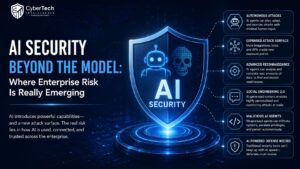

Enterprise AI security is often discussed as though the model itself is the primary target. Prompt injection, model manipulation, adversarial inputs, and insecure outputs deserve attention, but they represent only part of the risk organizations now face.
AI is becoming connected to the rest of the enterprise.
Employees use AI assistants with internal documents. Developers integrate models through APIs. Retrieval systems connect AI applications to proprietary knowledge. Autonomous agents receive permissions to search databases, call business applications, generate code, and execute workflows. Third-party AI services increasingly sit between users and sensitive enterprise information.
As these connections expand, the security question changes. Organizations are no longer protecting only an AI model. They are protecting an ecosystem of identities, data, applications, APIs, models, agents, and external services that interact with one another.
This is where much of the emerging enterprise AI risk now resides.
The organizations best prepared for this shift will be those that stop treating AI security as an isolated model-security problem and begin securing the entire AI lifecycle.
Why Model-Centric AI Security Is No Longer Enough
Early enterprise AI security discussions understandably concentrated on model behavior. Could a model reveal confidential information? Could an attacker manipulate its instructions? Could malicious inputs cause unsafe outputs?
Those questions remain important.
But enterprise AI architectures are becoming much more complex.
A production AI application may depend on:
- Foundation models
- Enterprise data repositories
- Retrieval-augmented generation systems
- APIs and plugins
- Cloud infrastructure
- User and machine identities
- Third-party AI services
- Autonomous agents
A weakness anywhere within that chain can affect the security of the overall system.
For example, a well-protected model provides limited reassurance if an AI agent has excessive permissions to enterprise applications. Similarly, strong application security cannot prevent employees from entering sensitive information into an unapproved external AI service.
Enterprise AI security therefore needs to follow how AI actually operates across the organization.
The New AI Attack Surface Starts With Data
AI systems depend on data, and enterprise AI becomes more valuable as it gains access to proprietary information.
That same access creates risk.
AI applications may interact with internal documents, customer information, source code, operational records, intellectual property, and other sensitive business data. Retrieval systems can make enormous information repositories available through a conversational interface.
The critical question becomes:
What information can this AI system retrieve, and should every user interacting with it be allowed to see that information?
Organizations need controls that preserve existing data permissions when information is accessed through AI.
Security teams should understand:
- Which datasets AI applications can reach
- Whether sensitive information is appropriately classified
- How retrieval permissions are enforced
- Whether prompts and outputs are retained
- Which third parties may process enterprise data?
Without this visibility, AI can unintentionally create a new pathway around established information security controls.
Identity Is Becoming Central to AI Security
AI systems are increasingly acting on behalf of users rather than simply responding to questions.
That makes identity security fundamental.
An AI assistant may access documents using a user’s permissions. A development agent may interact with code repositories. An autonomous agent may receive credentials or tokens that allow it to communicate with multiple applications.
These interactions create both human and machine identity risks.
Control What AI Agents Are Allowed to Do
Agentic AI makes this challenge particularly important.
Traditional generative AI produces an output. An AI agent may take an action.
Depending on its permissions, an agent could potentially retrieve information, modify records, communicate with external services, trigger workflows, or execute other business processes.
Organizations should apply least-privilege principles to agent identities and limit permissions according to specific tasks.
An agent designed to summarize information should not automatically receive the authority to modify the systems containing that information.
Protect Non-Human Credentials
API keys, service accounts, workload identities, access tokens, and machine credentials are becoming increasingly important within AI architectures.
If these credentials are exposed or excessively privileged, attackers may be able to bypass the model entirely and access the systems connected to it.
AI security programs therefore need to include machine identity discovery, credential management, access reviews, and continuous monitoring.
Shadow AI Creates a Visibility Problem
Some of the most important enterprise AI risks may exist outside formally approved AI programs.
Employees can adopt generative AI tools quickly, often without malicious intent. A team may use an external assistant to summarize documents, analyze customer feedback, improve code, or automate administrative work because it increases productivity.
Security teams may never know that information has left the controlled environment.
This is Shadow AI, and banning every unauthorized tool rarely solves the underlying problem.
Organizations need visibility into how employees are using AI while providing approved alternatives that meet legitimate business needs.
A practical Shadow AI strategy should combine:
- AI application discovery
- Acceptable-use policies
- Data protection controls
- Employee education
- Approved enterprise AI services
- Ongoing monitoring
Governance works best when secure AI is also usable AI.
Third-Party AI Dependencies Expand Enterprise Exposure
Most organizations will not build every component of their AI infrastructure internally.
Enterprise AI increasingly depends on foundation model providers, cloud platforms, development frameworks, vector databases, data services, plugins, and specialized AI vendors.
Each dependency introduces questions about data handling, security practices, access, availability, and software supply chain risk.
Organizations should evaluate third-party AI providers with the same rigor applied to other critical technology suppliers.
Security reviews should consider where information is processed, whether customer data is used for model improvement, how access is controlled, how vulnerabilities are managed, and what happens to enterprise information when a service relationship ends.
AI innovation should not bypass established third-party risk management.
Runtime Behavior Matters After Deployment
Passing a security assessment before launch does not guarantee that an AI system will remain secure.
Models change. Data changes. Plugins are added. Permissions evolve. Users discover new ways of interacting with systems. Agents gain additional capabilities.
AI security therefore needs a runtime component.
Organizations should monitor for:
- Unexpected access to sensitive information
- Abnormal agent actions
- Changes in permissions
- Suspicious API activity
- Unusual data retrieval
- Attempts to manipulate AI behavior
The objective is to detect when an AI system begins behaving differently from its intended operational boundaries.
Industry Spotlight: Technology & Telecommunications
Technology and telecommunications organizations are rapidly embedding AI into software development, network operations, customer service, infrastructure management, and security workflows.
The resulting risk extends far beyond the underlying models.
AI development tools may interact with proprietary source code. Network agents may receive access to operational systems. Customer-facing AI applications may connect with account information and internal databases.
For these organizations, AI security requires strong machine identity governance, API protection, data controls, and continuous monitoring of agent behavior.
The faster AI becomes integrated into core technology operations, the more important it becomes to understand exactly what each AI system can access and do.
Industry Spotlight: Government & Public Sector
Government and public sector organizations face a different challenge: gaining the benefits of AI while maintaining strong controls over sensitive information and critical public services.
AI applications may support citizen services, administrative workflows, data analysis, cybersecurity, and internal decision support. These use cases can involve information with strict access, privacy, or security requirements.
Government AI security therefore requires clear data boundaries, controlled identities, approved technology environments, third-party oversight, and accountable human decision-making.
Governance should establish where AI can operate freely, where additional controls are necessary, and where automated actions require human authorization.
Why AI Governance and AI Security Must Work Together
Technical security controls cannot answer every question AI creates.
Organizations also need to determine which AI use cases are acceptable, which information can be processed, who owns each system, and what level of autonomy an agent should receive.
This is where governance becomes part of cybersecurity.
A mature enterprise AI program should establish:
- Ownership for AI applications
- Approved AI services and models
- Data access requirements
- Identity and permission standards
- Third-party security requirements
- Human oversight expectations
- Runtime monitoring responsibilities
- Incident response procedures
Governance defines the boundaries. Security enforces and monitors them.
Separating the two creates gaps that become harder to manage as AI adoption scales.
Building an Enterprise AI Security Roadmap
Organizations do not need to solve every AI risk simultaneously.
They do need visibility into where AI exists and how it connects to the enterprise.
A practical roadmap should prioritize:
- Discover enterprise AI usage. Identify sanctioned and unsanctioned AI applications, models, agents, and integrations.
- Map AI data access. Understand which systems and information each AI application can retrieve or process.
- Inventory AI identities. Identify service accounts, API keys, tokens, and agent identities associated with AI workloads.
- Apply least privilege. Limit AI applications and agents to the minimum access required for their purpose.
- Assess third-party dependencies. Evaluate how external AI providers handle enterprise information and security.
- Monitor runtime activity. Establish visibility into AI access, behavior, and high-risk actions.
- Create AI-specific incident response procedures. Define how teams will investigate compromised agents, exposed data, manipulated AI applications, or unauthorized AI use.
Organizations strengthening their AI Security strategy should focus on securing the complete relationship between models, data, identities, applications, agents, and infrastructure rather than protecting each component in isolation.
The Future of Enterprise AI Security
As AI systems become more autonomous, enterprise security will increasingly focus on controlling what AI is authorized to know and what it is authorized to do.
This will push several capabilities closer together:
- AI security posture management
- Machine identity governance
- Data security
- Agent access control
- Runtime AI monitoring
- API security
- Third-party AI risk management
- Zero Trust principles for autonomous systems
The security architecture surrounding the model may ultimately become just as important as the model itself.
Final Thoughts
The biggest enterprise AI security risks are increasingly emerging from the connections around AI rather than from the model alone.
Data gives AI knowledge. Identity gives it access. APIs give it connectivity. Agents give it the ability to act. Third-party platforms extend its reach.
Every one of those relationships creates value, but every one also creates a security decision.
Enterprises that focus only on protecting models risk overlooking the broader AI attack surface developing across their organizations.
The stronger approach is to follow AI throughout its lifecycle: understand the information it can reach, control the identities it uses, limit the actions it can perform, monitor how it behaves, and maintain governance as its capabilities evolve.
AI security beyond the model is ultimately about maintaining control as intelligence becomes embedded across the enterprise.