
AI is no longer limited to experimental projects. Businesses now use it in customer support, operations, analytics, automation, and software products. Yet building an AI product is very different from adding a standard software feature.
There are questions around data, model choice, accuracy, security, and ongoing costs. That is why understanding AI product development services before starting a project matters. This guide explains the typical process, costs, and timelines you can expect in 2026.
What Are AI Product Development Services?
AI product development encompasses the work required to turn an idea into a usable AI-powered product. It can include strategy, product design, data preparation, model integration, software development, testing, deployment, and ongoing improvement.
The final product can take many forms. It might be an AI assistant for a SaaS platform, a document analysis tool, a recommendation engine, or an intelligent workflow system. The goal is not simply to “add AI.” It is to solve a clear user or business problem.
How Does the AI Product Development Process Work?
Most successful AI projects start small. Teams first confirm the problem, available data, and technical feasibility. They can then build and test the product in controlled stages.
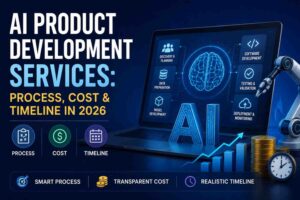
A typical development process looks like this:
- Discovery and planning: Define users, business goals, use cases, risks, and success metrics.
- Data assessment: Review available data and identify quality or privacy issues.
- Prototype or PoC: Test whether the proposed AI approach can deliver useful results.
- Product design: Create user flows and interfaces around the AI experience.
- Development: Build the application, integrations, backend, and AI features.
- Testing: Check accuracy, performance, security, usability, and edge cases.
- Deployment: Release the product and connect monitoring systems.
- Improvement: Use real feedback and performance data to refine the product.
This staged approach reduces uncertainty. More importantly, it helps teams identify weak ideas before investing heavily in full development.
Choosing the Right AI Approach
Not every AI product needs a custom model. In fact, many products can use existing large language models or specialized APIs.
For example, a customer support assistant may use an existing LLM with retrieval-augmented generation (RAG). A forecasting platform may need a custom machine learning model trained on business data. Other products might combine several models.
The right choice depends on the problem. Teams should consider accuracy, privacy, response speed, scalability, and operating cost before selecting an AI architecture.
How Much Does AI Product Development Cost in 2026?
There is no fixed price for an AI product. A focused prototype can cost far less than a production platform handling large amounts of sensitive data.
As a broad planning range, AI development in 2026 may look like this:
|
Project Type |
Estimated Cost |
|
AI proof of concept |
$10,000–$25,000 |
|
AI MVP |
$25,000–$60,000 |
|
Mid-sized AI product |
$60,000–$150,000 |
|
Complex enterprise AI platform |
$150,000+ |
These figures are planning estimates, not standard market prices. Actual budgets vary widely by scope, team location, infrastructure, data requirements, and the models being used.
When comparing AI product development services, businesses should also look beyond the initial build cost. Model usage, cloud hosting, monitoring, data storage, maintenance, and future improvements can create ongoing expenses.
What Factors Affect AI Development Cost?
Complexity is usually the biggest cost driver. A simple AI feature built around an existing API is much easier to develop than a system requiring custom models and complex data pipelines.
Several factors can change the final budget:
- Number and complexity of AI features
- Data volume, quality, and preparation needs
- Custom model training requirements
- Third-party API and model costs
- Web or mobile application development
- Integration with existing business systems
- Security and regulatory requirements
- Expected number of users
- Testing and monitoring requirements
Scope also matters. A narrow first release often costs less and reaches users faster. Teams can then invest further once the product shows real value.
How Long Does It Take to Develop an AI Product?
A basic proof of concept may take a few weeks. A production-ready platform can take several months.
Typical timelines might be:
|
Development Stage |
Typical Timeline |
|
Discovery and planning |
1–2 weeks |
|
Proof of concept |
2–6 weeks |
|
AI MVP |
8–16 weeks |
|
Full AI product |
4–8+ months |
These stages can overlap, so they should not always be added together. A team may begin UX design while technical validation continues, for example.
The timeline also depends on how quickly decisions are made. Clean data, clear requirements, and access to existing systems can speed up development. Poor data or changing requirements usually have the opposite effect.
Should You Build a PoC or an MVP First?
For many AI projects, a proof of concept is worth considering before an MVP. A PoC answers one important question: Can the AI approach actually work? An MVP answers something different. It tests whether users find the product useful enough to adopt.
Suppose a company wants software that extracts information from complex documents. A PoC can test extraction accuracy using a small dataset. If the results are promising, the team can build an MVP with user accounts, workflows, integrations, and a practical interface.
That order can prevent months of development around an AI capability that was never technically reliable.
Why AI Products Need More Testing
Traditional software often follows predictable rules. AI systems can produce variable outputs. That creates a different testing challenge. A feature may work well for common requests but struggle with unusual inputs. Generative AI products can also produce inaccurate or unsupported answers.
Testing should therefore cover more than functionality. Teams may need to evaluate response quality, hallucination rates, latency, data security, bias, and model behavior across different scenarios.
Good AI product development services should treat evaluation as part of development, not something saved for the final week.
What Happens After the AI Product Launches?
Launching an AI product is not the end of development. Real users often expose cases that internal testing never found. Teams need to monitor the system’s performance after release. They may track model accuracy, failed requests, response times, user feedback, token usage, and infrastructure costs.
Models and APIs can also change. User expectations change too. A product that performs well today may need adjustments later. This makes ongoing monitoring and iteration an important part of the product lifecycle.
How to Choose an AI Product Development Partner
A strong development partner should understand both AI and conventional software engineering. AI capability alone is not enough. The product still needs reliable architecture, intuitive UX, secure integrations, and maintainable code.
Before selecting a provider, ask practical questions. How will they validate the idea? How do they choose models? How will your data be protected? What happens if the selected model becomes too expensive? How will accuracy be measured after launch?
The answers can reveal much more than a long list of AI technologies.
Final Thoughts
Building an AI product in 2026 does not have to begin with a large investment. It should begin with a clear problem and a realistic way to test it.
Start by validating the use case. Choose the simplest AI approach that can solve it. Then build, measure, and improve based on real results. This approach makes the development cost and timeline easier to control.
If you are exploring an AI product idea, Tech Formation can help you assess the concept, define an MVP, and plan a practical development path. The important first step is understanding what should be built—and whether AI is truly the right way to build it.