
AI is no longer a concept reserved for Silicon Valley.
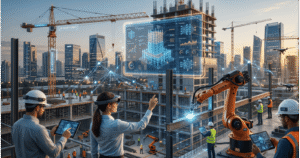
AI now works on construction sites, wearing a helmet and carrying a plan. We have seen many changes in the building and real estate industries, and as we move into 2026, this evolution takes the form of a revolution.
If you are a developer, an engineer, or just someone interested in how our cities are being built, understanding the intersection of AI and physical infrastructure is essential. This article dives deep into the high-tech shift of the construction industry, the visual power of AI, and the countries leading this digital charge.
1. The Visual Brain: How AI Image Recognition Works on Site
The most significant “superpower” AI brings to a construction site is sight. Traditionally, site managers would walk around with clipboards, taking hundreds of photos that would eventually sit in a forgotten folder. In 2026, those photos had become the most valuable data on the project.
From Pixels to Progress
AI image recognition (often called Computer Vision) allows software to “understand” what is happening in a photo. By feeding thousands of images of construction materials into a neural network, the AI can now identify:
- Structural Milestones: It recognises when the rebar is tied, when the formwork is ready, and exactly when the concrete is poured.
- Material Management: It can count the number of bricks delivered or the amount of steel in the yard from a drone shot.
- Technical Accuracy: Systems like DroneDeploy or OpenSpace compare daily site images against the 3D BIM (Building Information Modelling) files. If a pipe is two inches off from the digital design, the AI flags it before the wall is closed up.
The Safety Sentinel
This is the area where AI excels. Now we have something called “Safety AI,” which constantly monitors camera feeds. If the worker has forgotten his safety gear or wanders into a “red zone” housing heavy-duty equipment, an immediate notification is sent to his smart devices or to the on-site manager’s phone.
2. Countries That Are Winning the AI Construction Race?
The adoption of AI Technology in construction isn’t uniform. While the technology is available globally, specific nations have created the regulatory and economic “soil” for it to thrive.
South Korea: The Patent Powerhouse
As of April 2026, South Korea has emerged as a dominant force. Recent reports from Stanford University rank Korea third globally in notable AI models. More impressively, they rank first in AI patents per capita.
The Korean government’s “Framework Act on Artificial Intelligence” has turned the country into a testing ground for automated construction. High-rise projects in Seoul are now using autonomous robots for floor finishing and wall painting, driven by AI that navigates the complex, changing environment of a live site.
The Korean government’s “Framework Act on Artificial Intelligence” has turned the country into a testing ground for automated construction. High-rise projects in Seoul are now using autonomous robots for floor finishing and wall painting, driven by AI that navigates the complex, changing environment of a live site.
Singapore: The Smart Nation Blueprint
Singapore has long been the gold standard for “Smart Cities.” Their Building and Construction Authority (BCA) has made digital twins a requirement for major projects. By using AI to manage the “Digital Twin” of a building, Singaporean developers can predict maintenance issues fifty years into the future before the first stone is even laid.
The United Arab Emirates (UAE): Building the Impossible
Dubai and Abu Dhabi are essentially the world’s laboratories for AI in real estate. The UAE uses AI-driven predictive analytics to decide where to build next based on global migration patterns and economic shifts. On the construction side, they are pioneers in 3D-printed buildings, where AI manages the precise flow of material to ensure structural integrity in extreme desert heat.
India: The Democratisation of Tech
India is witnessing one of the fastest jumps in AI adoption. While large-scale infrastructure projects like the Navi Mumbai International Airport use high-end AI for logistics, the real change is in residential real estate. Developers in hubs like Hyderabad and Bangalore are using AI to optimise building layouts for maximum sunlight and airflow features highly valued by modern Indian homebuyers.
3. Real Estate 2.0: AI as the Ultimate Matchmaker
Real estate has always been a “gut feeling” industry. AI is changing that into a “data-backed” industry.
Predictive Pricing and Investment
In 2026, investors no longer guess which neighbourhood will be the next big thing. AI algorithms analyse a decade of satellite imagery, traffic data, school ratings, and even the sentiment of social media posts to predict property appreciation. If a new metro line is announced, the AI calculates the “ripple effect” on property prices in a five-kilometre radius within seconds.
The Virtual “Human” Experience
We have moved far beyond the grainy 360-degree tours of 2020. AI now powers hyper-realistic, interactive walk-throughs. If you are looking at a flat in a Namishree project in Hyderabad, AI can show you exactly how the sunset will look from your specific balcony on a rainy evening in July. It can even suggest furniture layouts based on your past lifestyle preferences, making the “buying” process feel deeply personal.
4. The Challenges: It’s Not All Smooth Sailing
However, despite the buzz surrounding this concept, there are some challenges facing its realisation.
1. Data Isolation: An AI system requires data for it to be intelligent. Information about the architect, construction team, and owner may not be in compatible formats.
2. The Issue of Jobs: One apprehension associated with AI in the construction industry is that it will take jobs. This could hardly be further from the truth, especially given 2026’s labour shortage.
3. Accuracy & Interference: There is a great deal of dirt, dust, and shadows at construction sites that can interfere with image processing, making older versions of AI unable to work properly. Fortunately, there is now a new “Construction-Specific AI.”
2. The Issue of Jobs: One apprehension associated with AI in the construction industry is that it will take jobs. This could hardly be further from the truth, especially given 2026’s labour shortage.
3. Accuracy & Interference: There is a great deal of dirt, dust, and shadows at construction sites that can interfere with image processing, making older versions of AI unable to work properly. Fortunately, there is now a new “Construction-Specific AI.”
5. Namishree and the Tech-Infused Skyline
In cities like Hyderabad, developers like the Namishree Group are proving that luxury is no longer just about the quality of the marble. It is about the intelligence of the build.
By using AI-integrated project management, developers can ensure that projects like Namishree Trinity or Namishree Vrindavan are delivered with a level of precision that was previously impossible. When AI monitors the curing of concrete or the alignment of a high-rise structure, it adds a hidden layer of “digital quality” that protects the homeowner’s investment for generations. In the 2026 market, the most successful developers are those who treat their buildings as living, data-driven assets.
The Verdict: The Future is Vertical and Intelligent
Looking into the rest of the decade, the separation between the “virtual world” and the “real world” will become increasingly blurred. Artificial intelligence is no longer considered something only for huge construction projects costing billions of dollars, but it’s becoming the norm in the local neighbourhood apartment building.
While those who have accepted this development, such as Korea, Singapore, and the United Arab Emirates, have been blazing the trail, the lesson for the rest of the world is clear. No matter whether you’re constructing your dream house or looking for one to buy, the key tool in the toolbox will be a piece of code.