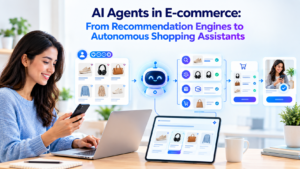

Online shopping used to be a fairly passive experience. A customer browsed categories, used filters, and scrolled through pages of listings until something matched what they had in mind. AI agents are quietly rewriting that process, taking on tasks that once required a person clicking through page after page.
Some of the earliest and most visible examples pair image search techniques with recommendation logic, letting a shopper upload a photo of a product they liked and get a ranked list of close and exact matches from a store’s catalog. That is a fairly narrow use of an agent, but it points at something bigger: systems that can understand intent from more than just a typed query and act on it with minimal hand-holding.
The next step is agents that do not just retrieve results but actually complete parts of the shopping process, comparing prices, tracking a wish-listed item until it drops in price, or reordering something a customer buys on a predictable schedule. This is a meaningful shift in what “search” and “shopping” mean on a retail site.
What Counts as an AI Agent in a Retail Context
An AI agent, in the retail sense, is a system that can take a goal, find a product under fifty dollars that matches a photo, or track a category for a price drop, and carry out the steps needed to get there without a person managing every click. That usually means combining a language model for reasoning, a vision model for anything photo-based, and access to a store’s product data and APIs.
This is different from a basic chatbot, which mostly answers questions. An agent is expected to take action: filtering results, comparing options, and sometimes completing a purchase step, within limits the merchant has defined.
Where This Is Already Live
Visual search agents are the most mature example, letting a shopper snap or upload a photo and receive matching or visually similar products instantly. Some fashion and home goods retailers have pushed this further, allowing a customer to photograph an entire outfit or room and get a curated set of items that would complete the look.
Price-tracking agents are becoming common too, monitoring a wish list and notifying a shopper, or in some cases automatically adding an item to cart, when a target price is hit. Replenishment agents handle the quieter, repetitive side of shopping: household goods, pet supplies, and personal care items that follow a predictable buying pattern. Customer service agents are also starting to blur into this category, handling returns, order tracking, and product questions with the same underlying reasoning ability used for search and recommendations.
Why Retailers Are Investing Here
The business case is fairly direct. Visual and agent-driven search tends to reduce the number of dead-end searches where a customer cannot find the right words for what they want and simply leaves. Reducing that friction has a measurable effect on conversion rate, particularly in categories like fashion, home decor, and furniture where appearance matters more than a text description ever could.
There is also a retention angle. An agent that reliably tracks prices or handles reordering gives a customer a reason to keep using one retailer’s app instead of comparison shopping across several. Businesses offering Agentic AI Development Services are increasingly building these capabilities as a core part of retail platforms rather than a novelty feature bolted onto an existing site.
The Practical Limits
Autonomy has to be bounded carefully in commerce. Few retailers want an agent making purchase decisions with no guardrails, so most systems keep a human confirmation step for anything involving payment, even if everything up to that point is automated. Trust is another factor: shoppers need to feel confident an agent is showing genuinely relevant options rather than promoted or margin-favorable ones, which raises transparency questions retailers are still working through.
There is also a data quality dependency. An agent is only as good as the product catalog behind it. Inconsistent images, missing attributes, or poorly tagged inventory will produce weak recommendations no matter how capable the underlying model is.
Handling failure gracefully matters more than most retailers expect going in. An agent that cannot find a confident match should say so clearly and offer close alternatives, rather than returning a low-confidence guess presented with the same certainty as a strong match. Shoppers tend to forgive an honest “nothing quite matches” far more readily than a confidently wrong result, which quietly damages trust in every future search.
What Comes Next
Expect agents to get more comfortable operating across multiple steps of a shopping journey rather than a single task. Instead of a visual search feature and a separate price-tracking feature, retailers are moving toward a single assistant that can do both, remember prior preferences, and adjust as a customer’s needs change over a season or a life event.
For merchants building this out, the practical starting point is usually the narrowest, highest-friction part of the journey, often visual product discovery, since that is where the technology is most mature and the payoff is easiest to measure.
How to Evaluate an Agent Before Rolling It Out Store-Wide
A useful test before a full launch is running the agent against real, messy search behavior rather than clean demo queries, blurry customer photos, vague descriptions, and edge cases like discontinued products. Retailers that skip this step often discover the gap between a polished pilot and everyday performance only after launch, when customer complaints reveal what a controlled demo never surfaced.
It also helps to measure success beyond simple click-through rate. Return rates on agent-recommended items, time to purchase, and whether a customer trusts the agent enough to use it a second time are better signals of whether the technology is actually working, rather than just novel enough to generate a first click. A retailer partnering with a team that offers AI Agent Development Services can usually shorten this evaluation phase considerably, since experienced teams already know which metrics tend to predict long-term adoption.
Frequently Asked Questions
What is an AI shopping agent?
It is a system that can take a shopping goal, such as finding a matching product from a photo or tracking a price, and carry out the steps needed to reach that goal with minimal manual input.
How do image search techniques fit into AI agents for shopping?
They give the agent a way to understand a photo as a query, so a shopper can search visually instead of typing a description, which the agent then uses to find matching products.
Are AI shopping agents able to complete purchases on their own?
Most current systems keep a human confirmation step before any payment is made, even when the search and comparison steps are fully automated.
What kind of retailers benefit most from this technology?
Categories where appearance is central to the buying decision, such as fashion, home decor, and furniture, tend to see the biggest impact from visual and agent-driven search.
What limits how well an AI shopping agent performs?
The quality of the underlying product catalog matters a great deal. Inconsistent images or poorly tagged inventory will weaken recommendations regardless of how capable the AI model is.
How should a retailer test a shopping agent before a full launch?
By running it against real, messy customer behavior rather than clean demo queries, and measuring return rates and repeat usage rather than just first-click engagement.