
You check your Amazon dashboard on Monday morning and see a familiar problem: sales are up, but ACOS has jumped from 22% to 31%. The obvious reaction is to cut bids. Then a week later, total sales soften and organic orders start slipping. The number you tried to improve looked better, but the business didn’t.
That is the problem with treating one Amazon metric as the whole story. ACOS tells you how efficiently your advertising is converting attributed sales. TACOS puts that spend against your total Amazon revenue, including organic sales. If you’re managing campaigns, you need ACOS. If you’re deciding whether advertising is actually helping the business grow, TACOS deserves equal attention. Amazon itself defines ACOS as ad spend divided by ad-attributed sales, while its seller guidance also recommends looking beyond ACOS rather than treating a low number as the only objective.
What is the difference between ACOS and TACOS?
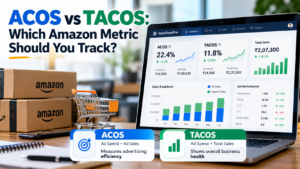
ACOS measures advertising efficiency. TACOS measures the relationship between advertising spend and total business revenue. The practical difference is the denominator: ACOS uses ad-attributed sales, while TACOS uses total sales.
|
Metric |
Formula |
Best used for |
|
ACOS |
Ad Spend ÷ Ad-Attributed Sales × 100 |
Campaign and keyword efficiency |
|
TACOS |
Ad Spend ÷ Total Amazon Sales × 100 |
Overall business health and growth |
|
ROAS |
Ad-Attributed Sales ÷ Ad Spend |
Revenue generated per advertising rupee |
Amazon defines ACOS as ad spend as a percentage of sales attributed to advertising. ROAS is the inverse relationship, showing revenue generated for each unit of ad spend.
TACOS goes one step wider. It includes both advertising-attributed and organic revenue. Amazon sellers commonly calculate it as total advertising spend divided by total revenue, because TACOS is not simply another campaign-level metric displayed alongside ACOS in the Amazon Ads console.
That distinction matters because the same ACOS can represent two completely different businesses. Suppose you spend ₹20,000 on ads and generate ₹80,000 in attributed sales. Your ACOS is 25%. If total Amazon revenue is ₹2,00,000, TACOS is 10%. The ads may look expensive in isolation while representing a much smaller share of the overall revenue engine.
Which metric should you use for Amazon PPC optimization?
Use ACOS to make campaign-level decisions and TACOS to make business-level decisions. Don’t replace one with the other.
If a keyword is spending ₹5,000 and producing only ₹8,000 in attributed sales, its 62.5% ACOS deserves investigation. You can examine search terms, conversion rate, CPC, match type, placement and product economics before deciding whether to reduce the bid or stop the target.
This is where an Amazon Seller Analytics Tool becomes useful. You need to move from “ACOS is high” to “this keyword is expensive because CPC increased, conversion rate fell, and the search term is no longer closely aligned with the product.”
A high ACOS isn’t automatically a failure either. Amazon’s own guidance notes that there isn’t one universal “good ACOS.” Your acceptable number depends on factors including margins, campaign objectives and business circumstances.
For example, a launch campaign may intentionally tolerate a higher ACOS while a mature branded campaign may need much tighter efficiency.
When does ACOS matter more than TACOS?
ACOS matters more when you’re diagnosing advertising performance. Use it when deciding which campaigns, keywords, targets or products deserve more or less advertising budget.
Imagine two exact-match keywords:
- Keyword A: ₹3,000 spend, ₹15,000 ad sales, 20% ACOS
- Keyword B: ₹3,000 spend, ₹7,500 ad sales, 40% ACOS
If both products have similar margins and objectives, Keyword A is clearly the stronger advertising performer. TACOS won’t give you enough granularity to make that keyword-level decision.
The same applies to bid optimization. If one search term is converting at a healthy rate while another is collecting clicks without orders, you don’t want to reduce both because account-level TACOS looks acceptable.
A good Amazon Sales Performance Tracker should therefore let you move from account-level numbers into campaigns, products and search terms. That’s the difference between reporting data and using data to make decisions.
When should you focus more on TACOS?
Focus more heavily on TACOS when you’re evaluating whether advertising is supporting sustainable growth. TACOS is especially useful when organic sales matter to your strategy.
Consider a product generating ₹1,00,000 in total sales. You spend ₹15,000 on advertising, so TACOS is 15%. If next month you spend ₹18,000 but total sales rise to ₹1,50,000, TACOS falls to 12%.
Your ad spend increased, yet the business became less dependent on advertising relative to its total revenue.
That’s a very different signal from simply celebrating a lower ACOS.
Amazon has also highlighted the limitation of looking only at ACOS during high-demand periods. A temporary ACOS increase doesn’t necessarily mean advertising has stopped working because ACOS doesn’t capture the full relationship between ad spend and total sales.
This is why TACOS belongs in your weekly or monthly business review, particularly if your goal is to build organic visibility rather than permanently buy every sale.
What does a good ACOS look like in India?
There is no universal target ACOS for Amazon India. Your break-even point should come from your product economics, not from someone else’s benchmark.
Start with contribution margin. If a product sells for ₹1,000 and you have ₹300 available after product cost, Amazon fees and other variable costs before advertising, a 30% ACOS would roughly consume that contribution. Your true calculation should use your actual fee structure, discounts, returns and fulfillment costs.
That makes a 20% ACOS potentially healthy for one product and damaging for another.
Recent Instatrack Pro benchmark data reports an overall 2026 ACOS average of 22.4%, but the same report warns that category and unit economics matter more than using an industry average as a target. Its reported category ranges vary substantially across electronics, health and supplements, home and kitchen, beauty and other categories.
Treat benchmarks as a diagnostic reference, not as your profitability target.
For a practical bidding framework, your target ACOS should feed into your maximum acceptable CPC, conversion rate assumptions and product margin. The site’s guide on Amazon bid optimization and target CPC follows this margin-first approach rather than treating CPC as an arbitrary number.
Can ACOS go up while your Amazon business improves?
Yes. This is one of the most important judgement calls in Amazon advertising.
Suppose you deliberately increase spend on high-volume generic keywords. Those keywords have weaker conversion rates than your branded terms, so ACOS rises. At the same time, total sales increase, new customers enter the brand, and organic sales start growing.
If you immediately cut those campaigns just to restore the previous ACOS, you may protect a dashboard metric while slowing the actual growth engine.
The opposite can happen too. A falling ACOS can look fantastic while the business gets weaker. You may have reduced bids so aggressively that impressions, ad sales and organic momentum all decline.
That’s why experienced PPC management is less about chasing the lowest possible ACOS and more about understanding why the number moved.
What should you do if ACOS is rising but TACOS is falling?
Don’t panic. First identify what is driving the divergence.
If ACOS rises from 22% to 29% while TACOS falls from 14% to 10%, your advertising is costing more against attributed sales, but total revenue is growing faster relative to ad spend. That can be a healthy situation.
Check these factors before making a bid cut:
- Total sales: Are organic sales growing?
- Ad sales: Is the additional spend producing incremental revenue?
- Conversion rate: Did traffic quality change?
- CPC: Are auction costs increasing?
- Product margin: Can the ASIN absorb the higher ACOS?
- Organic ranking: Are important keywords gaining or losing visibility?
- Inventory: Could stock availability be influencing sales?
- Campaign mix: Did you increase spend on discovery or non-brand terms?
This is where an Amazon Actionable Analytics Dashboard can be more useful than isolated campaign reports. A unified view can connect advertising performance with product and business-level signals rather than forcing you to compare disconnected dashboards. The platform states that it combines Ads, Seller Central, DSP and AMC data and provides visibility into ACOS, TACOS, profitability and product performance.
What should you do if both ACOS and TACOS are rising?
If both are climbing, investigate the account more aggressively. Rising ACOS means advertising efficiency is worsening, while rising TACOS means advertising is taking a larger share of total revenue.
Don’t start by cutting every campaign.
First isolate the source of waste. Look for search terms with significant spend but no sales, campaigns where CPC has increased without a corresponding conversion improvement, and products whose conversion rate has deteriorated.
Keyword harvesting can also help. Auto and broad campaigns can uncover useful search terms, but proven winners should eventually receive more controlled targeting. The site’s Amazon PPC keyword harvesting guide recommends reviewing search-term data regularly, moving proven terms into tighter manual campaigns and adding negatives where traffic is consistently unproductive.
Then examine your product page. Advertising cannot reliably compensate for a weak offer, poor conversion rate, bad pricing or inadequate inventory.
How can an AI Amazon Growth Platform help track ACOS and TACOS?
An AI Amazon Growth Platform can make the monitoring and optimization loop faster, but it doesn’t remove the need for commercial judgement.
The useful workflow is simple: collect advertising and sales data, identify what changed, determine why it changed, recommend an action, then measure the result.
That becomes difficult when Ads data, Seller Central data, profitability information and campaign controls live in separate places. Instatrack Pro’s current platform combines these data sources and includes AI-assisted analysis, automated bid and budget adjustments, campaign optimization and profitability tracking.
Its AI Assistant is designed to answer questions such as why ACOS changed over a given period and can recommend actions such as pausing weak keywords or shifting budgets. Its Autopilot feature allows sellers to set goals around ACOS, TACOS, growth or profitability and automate ongoing campaign adjustments.
The important limitation is that automation should follow a clearly defined business goal. If you tell an AI system only to minimize ACOS, it can make decisions that reduce spend but also reduce growth. A better setup connects advertising efficiency to revenue, margin and growth objectives.
ACOS vs TACOS: Which one should you actually track?
Track both, but give them different jobs.
Use ACOS every time you’re deciding whether a campaign, keyword, targeting method or ad placement is working efficiently. Use TACOS when you’re asking whether your advertising investment is becoming more or less significant relative to the entire Amazon business.
The strongest Amazon Seller Performance Dashboard should therefore show both metrics together rather than making you choose between them.
A simple operating rhythm works well:
Daily: Watch spend, budget pacing, major ACOS changes and obvious wasted spend.
Weekly: Review campaign ACOS, search terms, CPC, conversion rate, product performance and TACOS direction.
Monthly: Compare TACOS with total sales, organic sales, contribution margin and inventory position.
During launches: Accept that efficiency may temporarily differ from mature-product targets, but define the amount you’re willing to invest before the launch begins.
During scaling: Increase spend only when additional traffic produces enough incremental revenue or strategic value to justify the higher cost.
The goal isn’t the lowest ACOS or the lowest TACOS. The goal is profitable growth that you can repeat.
A practical 5-step ACOS and TACOS workflow
Before changing your campaigns, run this sequence:
- Calculate your break-even ACOS. Use real product economics rather than a generic industry target.
- Set a target ACOS. Leave enough margin for the business objective you’re pursuing.
- Set a target TACOS range. Decide how much advertising spend your overall revenue can sustainably support.
- Diagnose changes together. Never interpret ACOS without total sales, organic sales and conversion data.
- Optimize, then wait for enough data. Don’t reverse a strategic decision because of one bad day.
The last step is where many accounts go wrong. Sellers make a bid change in the morning, see a different number in the afternoon and make another change. That creates noise rather than optimization.
Amazon advertising is an auction system. Performance moves with competition, demand, price, placement, conversion rate and inventory. Your job is to distinguish a real trend from normal volatility.
Instatrack Pro’s Amazon advertising insights on AI-driven optimization also emphasizes moving beyond reactive bid changes toward continuous analysis and automation.
The bottom line
ACOS answers, “How efficiently are my ads generating attributed sales?”
TACOS answers, “How much of my total Amazon revenue am I spending on advertising?”
You need both answers.
If you’re optimizing individual campaigns, start with ACOS. If you’re evaluating whether advertising is building a healthier Amazon business, watch TACOS alongside total revenue and organic sales. And if the two metrics move in opposite directions, don’t automatically fix the one that looks worse. Find out what changed first.
If your current reporting makes that analysis a manual exercise across multiple Amazon dashboards, an Amazon Seller Growth Tool that brings advertising, sales and profitability signals together can help turn the numbers into a repeatable decision process.
Frequently Asked Questions
Is a lower ACOS always better on Amazon?
No. A lower ACOS generally indicates that you’re spending less advertising money relative to attributed sales, but it isn’t automatically better for the business. A launch, new-market expansion or aggressive ranking strategy may justify a higher ACOS temporarily. Your break-even ACOS, margin, growth objective and TACOS trend should influence the decision.
Why is my ACOS good but my TACOS bad?
This usually means your advertising campaigns are efficient against attributed sales, but advertising represents a large share of your total revenue. For example, strong ad sales can produce an attractive ACOS while organic sales remain weak. Check organic revenue, total sales, brand and non-brand campaign mix, and whether your ads are creating sustainable demand.
Can TACOS be lower than ACOS?
Yes, and that is common when organic sales represent a meaningful portion of total revenue. Because TACOS uses total sales in its denominator while ACOS uses only ad-attributed sales, TACOS can be substantially lower. A large gap can indicate that the business has significant organic revenue, although the gap alone doesn’t prove advertising caused those organic sales.
Should new Amazon sellers focus on ACOS or TACOS?
New sellers should monitor both, but ACOS usually provides more actionable campaign-level information during the early stages. At the same time, TACOS helps prevent you from judging success purely through ad-attributed revenue. As the product gains organic traction, TACOS becomes increasingly useful for understanding whether advertising is supporting broader growth.
How often should Amazon sellers check ACOS and TACOS?
Check major spend and ACOS changes frequently enough to catch budget problems, but avoid making strategic decisions from a few hours of data. Review campaign-level ACOS at least weekly and evaluate TACOS alongside total and organic sales over a longer period. The appropriate window depends on your sales volume, campaign maturity and product category.
Does an AI Amazon Growth Platform replace an Amazon PPC manager?
Not completely. AI can automate repetitive analysis, bid adjustments, budget allocation and alerts, but commercial decisions still require context around margins, inventory, product launches and growth priorities. The strongest setup uses AI to process more signals and execute faster while the seller or PPC manager controls the business objectives and guardrails.