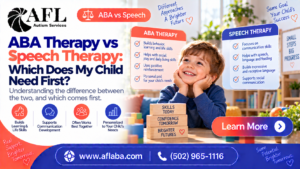

A Question Framed the Wrong Way
Parents often arrive asking which of the two services their child needs, as though choosing one rules out the other. In practice the two disciplines address different problems and frequently belong together.
At Adapt For Life, families often start this conversation while exploring clinic-based ABA therapy and wondering how it fits alongside language support. Understanding what each discipline actually does makes that decision much easier.
The more useful question is what specifically is getting in your child’s way, and which discipline is designed to address that.
What Speech Therapy Addresses
Speech-language pathologists work on the production and structure of language: articulation and speech sound production, oral motor skills, expressive vocabulary and grammar, receptive understanding, and in some cases feeding and swallowing.
If your child’s difficulty is being understood, forming sounds, or constructing sentences, this is the relevant discipline.
What ABA Addresses
Behaviour analysts work on why and when behaviour occurs. In communication terms that means the motivation to communicate, the frequency of spontaneous initiation, the replacement of challenging behaviour with communicative alternatives, and generalisation across people and settings.
If your child can produce words but rarely uses them spontaneously, or communicates through behaviour rather than language, this is the relevant discipline.
How the Two Disciplines Overlap
The line between the two is not always sharp. A child learning to request a snack is building language, which a speech-language pathologist cares about, and also building motivation and independence, which a behaviour analyst cares about. Neither discipline owns communication outright. They look at it from different angles.
Speech therapy asks whether the child has the tools to form and understand language. ABA asks whether the child uses those tools in real moments, with real people. Seeing both angles gives a fuller picture than either one alone.
Signs to Look For
Your child may benefit from speech therapy if other people struggle to understand their speech, if they drop or swap sounds well past the age you would expect, if their vocabulary is small for their age, or if they find it hard to follow spoken instructions. Feeding difficulties, such as trouble chewing or swallowing certain textures, can also be a reason to involve a speech-language pathologist.
ABA may be the better fit if your child has words but rarely uses them, if frustration leads to crying, hitting or running away, if routines are hard to change, or if skills learned in one place do not show up at home or school. These patterns point to behaviour and motivation rather than the mechanics of speech.
Choosing When Resources Are Limited
Where only one service is realistic, the deciding factor is usually the presence of behaviour that is limiting safety or learning. Significant challenging behaviour generally needs behavioural intervention first, because it blocks progress in every other domain.
Where behaviour is manageable and the barrier is purely the mechanics of speech, speech therapy alone may be the right starting point.
Why Both Together Usually Works Better
Combined delivery avoids the contradictions families encounter with separate providers: one team encouraging a communication device, another discouraging it; one accepting approximations, another not.
Where both services sit in one organisation, goals can be aligned deliberately and each discipline can advise the other on your specific child.
What a Combined Plan Can Look Like
Consider a child who says a handful of words and screams when she wants something. The speech-language pathologist might target the sounds and words she can already almost say. The behaviour analyst might teach her to ask for what she wants using those words, and reward each attempt so that asking becomes easier than screaming.
Each team reports back to the other, so the words practised in the speech room are the same ones used in daily routines. Progress in one setting supports progress in the other.
What to Ask a Provider Offering Both
How do the two teams communicate about my child? Are goals shared between plans? Will I get one coordinated review or two separate ones?
Specific answers indicate genuine integration. Vague ones indicate two services in the same building.
Taking the Next Step
You do not need to have the answer before you reach out. A proper assessment looks at your child’s speech, behaviour, play and daily routines, then recommends where to begin. Bring any notes from teachers or doctors, and write down the moments that worry you most, since specific examples help the team more than general concerns.
If you are ready to compare options, you can view all AFL clinic locations and find the one closest to your family. Starting with questions is perfectly fine.
Frequently Asked Questions
Can my child receive ABA and speech therapy at the same time?
Yes, and many children do. The services address different aspects of communication.
Does ABA include speech work?
ABA addresses communication behaviour but does not replace the specialist expertise of a speech-language pathologist in speech production and language structure.
Will insurance cover both?
Many plans cover both, usually authorised separately. Verification is completed during intake.
Where is speech therapy available?
Speech therapy is offered at Adapt For Life locations across Indiana, Kentucky, North Carolina and Illinois.
About the Provider
Adapt For Life AFL Autism Services
Adapt For Life provides applied behavior analysis therapy, autism diagnostic services and speech therapy for children and families across Indiana, Kentucky, North Carolina and Illinois. Programmes are designed and supervised by Board Certified Behavior Analysts and built around each child’s individual assessment.
Address: Clinic locations across Indiana, Kentucky, North Carolina and Illinois
Phone: (317) 383-0188
Email: aflinfo@adaptforlifeaba.com
Hours: Monday Friday, 8:00 AM 5:00 PM
Services: Clinic-Based ABA Therapy, Autism Diagnostic Services, Speech Therapy
Website: https://aflaba.com/locations/
To book an assessment, call (317) 383-0188, email aflinfo@adaptforlifeaba.com or visit Adapt For Life Autism Services.