
As natural language processing (NLP) models become more capable, simply identifying whether a piece of text is positive, negative, or neutral is no longer enough. Modern AI systems increasingly need to understand the subtle emotional signals behind human communication—such as gratitude, frustration, embarrassment, relief, admiration, disappointment, or anticipation.
This is where fine-grained emotion annotation becomes critical. Instead of assigning a broad sentiment label, fine-grained annotation captures specific emotions, their intensity, contextual meaning, and sometimes multiple emotions expressed within the same piece of content. Large-scale resources such as Google’s GoEmotions demonstrate the value of this approach by using 27 emotion categories plus neutral to represent nuanced emotional expression.
For organizations developing next-generation NLP and generative AI systems, high-quality emotion-labeled datasets can provide the foundation for models that understand language more naturally and respond more appropriately.
What Is Fine-Grained Emotion Annotation?
Fine-grained emotion annotation is the process of labeling text according to specific emotional states rather than relying only on broad sentiment categories.
For example, consider the statement:
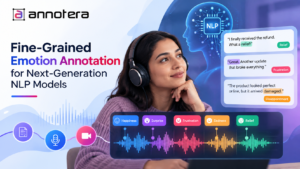
“I finally received the refund. What a relief!”
A conventional sentiment model might classify this as positive. A fine-grained annotation approach could identify relief as the dominant emotion, while recognizing that the statement also reflects a positive outcome.
Similarly:
“The product looked perfect online, but it arrived damaged.”
This could contain disappointment, frustration, and dissatisfaction rather than simply being classified as negative.
Fine-grained datasets may use categorical emotions, multilabel annotations, emotion intensity scores, or combinations of these approaches. The choice depends on the intended NLP application.
Why Next-Generation NLP Models Need Emotional Context
Large language models and other advanced NLP systems are expected to understand increasingly complex human communication. Emotional context can influence how an utterance should be interpreted and how an AI system should respond.
Consider a customer saying:
“Great. Another update that broke everything.”
A keyword-based system might interpret “Great” as positive. A context-aware model should recognize the sarcasm and infer frustration.
Fine-grained annotation helps models learn these distinctions by exposing them to examples where emotional meaning depends on context, linguistic cues, conversational history, and intent.
Research has also shown that fine-grained emotion datasets can support applications ranging from conversational AI and customer support to harmful-content detection and empathetic interaction.
Key Dimensions of Fine-Grained Emotion Annotation
Effective emotion annotation can capture several dimensions simultaneously.
1. Specific Emotion Categories
Instead of broad polarity labels, datasets can distinguish emotions such as:
-
Joy
-
Anger
-
Fear
-
Sadness
-
Gratitude
-
Disappointment
-
Embarrassment
-
Admiration
-
Relief
-
Excitement
-
Confusion
-
Remorse
A broader taxonomy gives models more information for learning subtle emotional differences.
2. Multiple Emotions
Human communication rarely follows a single-emotion pattern. A person can feel excited and nervous, grateful and relieved, or disappointed and angry at the same time.
Therefore, multilabel annotation can be more representative than forcing every sentence into one category.
3. Emotion Intensity
The difference between mild irritation and intense anger can be important in real-world applications. Annotation frameworks can therefore incorporate intensity levels or continuous scores for emotional strength.
4. Contextual Meaning
Emotion is often dependent on surrounding context. Annotators may need to examine preceding sentences, conversation turns, punctuation, emojis, or domain-specific terminology before assigning a label.
Challenges in Creating Fine-Grained Emotion Datasets
Emotion annotation is inherently more complicated than straightforward entity or keyword labeling because emotional interpretation can be subjective.
Subjectivity and Annotator Disagreement
Two qualified annotators may interpret the same statement differently. This is particularly common with subtle emotions, sarcasm, rhetorical questions, and ambiguous language.
Recent research continues to highlight the difficulty of achieving consistent fine-grained emotion annotations, especially for less obvious emotional categories.
Rather than treating disagreement as an automatic failure, annotation programs can analyze disagreement patterns to identify ambiguous categories and improve labeling guidelines.
Cultural and Linguistic Differences
Emotion does not always translate directly across languages or cultures. Expressions, idioms, humor, politeness conventions, and emotional intensity can vary considerably.
Multilingual resources such as XED demonstrate the importance of developing emotion datasets across languages rather than relying exclusively on English-language data.
For global AI applications, native-language expertise can therefore be valuable when creating high-quality emotion datasets.
Sarcasm, Irony, and Indirect Emotion
People frequently communicate emotions indirectly.
For example:
“Fantastic customer service—I’ve been waiting for three hours.”
The literal wording appears positive, but the intended emotion is frustration or dissatisfaction.
Annotators need clear instructions for identifying the intended emotional meaning rather than simply matching positive or negative words.
Best Practices for High-Quality Emotion Annotation
Building a reliable dataset requires a structured annotation methodology.
Define a clear emotion taxonomy:
Labels should be distinct enough to be useful while avoiding unnecessary overlap between similar emotional categories.
Create detailed annotation guidelines:
Examples, edge cases, decision rules, and explanations should clarify how annotators should distinguish closely related emotions.
Use multiple annotators:
Independent annotations can reveal ambiguity and provide a stronger basis for quality control.
Measure agreement:
Inter-annotator agreement, confusion patterns, and label distributions can help identify problematic categories.
Preserve contextual information:
Whenever possible, annotation interfaces should provide sufficient conversational or textual context.
Include diverse data:
Datasets should represent different domains, demographics, languages, writing styles, and communication environments.
Implement continuous quality assurance:
Regular audits, expert reviews, adjudication, and feedback loops can improve consistency as projects scale.
The Role of Audio and Multimodal Emotion Data
Emotion is not limited to written language. In conversational AI, speech carries additional information through tone, pitch, pauses, speaking rate, and vocal intensity.
This makes emotion annotation particularly valuable for speech AI, virtual assistants, contact-center analytics, and voice-based customer experience platforms.
Organizations developing such systems may combine textual emotion labels with acoustic and conversational annotations. Working with experienced audio annotation outsourcing services can help AI teams scale these specialized datasets while maintaining consistent annotation protocols.
An experienced audio annotation company can support workflows involving speech segmentation, emotion classification, speaker-related metadata, transcription, sentiment labeling, and other speech-data requirements.
Multimodal systems can further combine text, audio, and visual signals to build a richer representation of human emotion. However, multimodal annotation also introduces challenges involving synchronization, temporal alignment, and dataset diversity.
How Fine-Grained Annotation Supports Advanced AI Applications
High-quality emotion datasets can support several emerging applications:
-
Emotion-aware conversational AI
-
Customer experience analytics
-
Mental-health support technologies
-
Social media monitoring
-
Content moderation
-
Voice assistants
-
Personalized recommendation systems
-
Empathetic chatbots
-
Human-AI interaction
-
LLM evaluation and instruction tuning
For large language models, emotion annotation can also contribute to training and evaluation frameworks designed to measure whether AI systems appropriately recognize and respond to affective cues.
The objective is not simply to make AI “emotional.” It is to make AI systems better at interpreting the human context surrounding language.
Building Better Emotion Datasets with Annotera
The future of NLP depends increasingly on datasets that capture the complexity of real-world communication. Fine-grained emotion annotation provides an important layer of this data foundation by moving beyond simple sentiment polarity toward richer representations of human affect.
At Annotera, we help organizations develop structured, high-quality datasets for NLP, generative AI, speech AI, and other machine learning applications. Our annotation workflows can be tailored to specific taxonomies, languages, domains, and quality requirements.
Whether you need text emotion annotation, sentiment labeling, conversational datasets, or speech-focused annotation, a carefully designed human-in-the-loop process can help transform unstructured communication into training-ready AI data.
Ready to build more context-aware NLP models? Partner with Annotera to create high-quality emotion and sentiment datasets designed around your AI objectives.