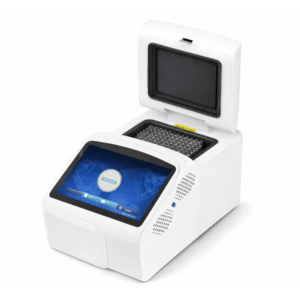

Every PCR protocol has a number that matters more than almost any other single variable: the annealing temperature. Get it right, and your primers bind with precision, your target amplifies cleanly, and your gel shows a single band where you expected one. Get it slightly wrong and non-specific bands multiply, your yield drops, and the diagnostic or research conclusion you were trying to draw becomes harder to trust. The inconvenient truth about annealing temperature is that you cannot reliably calculate the correct value from first principles. You have to test it empirically. A gradient thermal cycler is the instrument that turns that empirical testing from a multi-day iterative process into a single experiment.
This guide covers what a gradient thermal cycler actually does, the PCR applications where it provides the most value, the key specifications to evaluate, and how to decide whether it is the right instrument for your specific laboratory.
What A Gradient Thermal Cycler Does Differently
A standard thermal cycler heats every well on its sample block to the same temperature at each step of the PCR cycle. This is appropriate for running validated protocols where the annealing temperature has already been established. A gradient thermal cycler adds one critical capability: it can apply a deliberate temperature gradient across the block during the annealing step, so that different columns of wells simultaneously experience different temperatures within a defined range.
The user sets a low temperature and a high temperature for the gradient, and the cycler calculates and maintains precise temperatures for each column across the block. In a standard 96-well format, this typically produces 12 distinct annealing temperatures tested simultaneously in a single run. One reaction, one set of reagents, one template preparation, 12 different annealing conditions tested in parallel. When you analyze the gel result from this run, you identify which column or columns produced the cleanest, most specific amplification at the highest yield, and that temperature becomes your validated annealing condition.
According to Thermo Fisher Scientific’s technical documentation on PCR optimization, the annealing temperature is the most critical variable in PCR design. Bio-Rad’s gradient PCR documentation confirms that gradient thermal cyclers allow simultaneous screening of a temperature range, dramatically accelerating the protocol development phase by collapsing what might take multiple days of separate experiments into a single day’s work.
The Annealing Temperature Problem
Theoretical melting temperature (Tm) calculations provide a starting point for annealing temperature selection, but the actual optimal temperature differs from the calculated Tm for reasons that cannot be predicted without empirical testing: buffer composition, polymerase characteristics, the specific sequence context around the primer binding sites, template complexity, and the presence of secondary structure in the template all influence what the optimal annealing temperature actually is.
Too low, and primers bind to off-target sequences in addition to the intended target, producing additional amplification products that appear as extra bands on the gel. Too high, and primer binding becomes too stringent, reducing amplification efficiency and dropping product yield. The optimal temperature maximizes both specificity and yield simultaneously, and in a given reaction it often falls within a window of two to four degrees. The gradient thermal cycler finds this window in a single run.
Key PCR Applications For Gradient Thermal Cyclers
New assay development: Any time a new primer pair is introduced, gradient optimization should be the first step before the protocol is considered established. Running a gradient experiment with the new primers identifies the optimal annealing temperature empirically before the protocol is used for actual experimental or diagnostic work. This prevents the false positives, low yields, and irreproducible results that come from using a theoretically calculated temperature that is not actually optimal.
Multiplex PCR optimization: When multiple primer pairs run in the same reaction tube, each pair has its own optimal annealing temperature. Finding a single temperature that provides acceptable specificity and yield from all primer pairs simultaneously is challenging by iterative single-temperature testing. A gradient run with all primer pairs present identifies the compromise temperature that works across the multiplex set.
Troubleshooting existing protocols: A protocol that previously worked and has started producing weak amplification, non-specific bands, or inconsistent results may have drifted from its optimal annealing condition due to a new reagent lot, different template preparation, or equipment performance change. A gradient run centered around the current annealing temperature quickly identifies whether the optimal condition has shifted and what the new optimal temperature is.
Genotyping and SNP detection: Allelic discrimination assays require precise temperature control to distinguish between wild-type and mutant sequences. The discrimination efficiency between alleles varies sharply with annealing temperature. Gradient optimization identifies the temperature that maximizes the discrimination ratio, producing reliable allele-calling results.
Key Specifications To Evaluate
Temperature uniformity across the block: The gradient only produces meaningful data if the temperature at each block position is accurately maintained. Look for uniformity specifications within plus or minus 0.2 degrees Celsius across all well positions. Gradient experiments draw conclusions based on differences between columns, and those conclusions are only valid if the differences are thermal rather than the result of block non-uniformity.
Gradient span and column resolution: A useful gradient spans 15 to 20 degrees Celsius. In a 96-well block with 12 columns, a 15-degree span gives you 12 temperatures in 1.36-degree increments. Wider spans cover more optimization range per run. For fine-resolution optimization around a known approximate temperature, a narrower span with smaller column-to-column increments provides better resolution.
Ramp rate: High ramp rates (4 to 5 degrees Celsius per second heating, 3 degrees per second cooling) keep total run time manageable for labs running multiple gradient optimization experiments in a day. Slow ramp rates extend run time significantly for the 25 to 40 cycle programs used in gradient optimization work.
Block format compatibility: Standard 96-well compatibility covers most gradient optimization applications. Some models additionally support 384-well formats for high-throughput optimization screening. Interchangeable block designs that accommodate 0.2 mL tubes, PCR strips, and plates provide operational flexibility across different experimental formats.
Standard Cycler Vs Gradient Cycler: The Decision
If your laboratory runs only fully validated protocols with established annealing temperatures and no new assay development, a standard thermal cycler with excellent block uniformity and ramp rates serves your needs without the additional cost of gradient capability. If your lab develops new assays, introduces new primer pairs, troubleshoots PCR performance problems, or runs multiplex reactions, a gradient thermal cycler is not a luxury. It is the right tool for the workflow, and the time and reagent savings from single-run optimization pay for the capability difference quickly.
A Gradient Cycler That Delivers
The SCILOGEX SCI1000-G Gradient thermal cycler, available through trusted lab suppliers like NE LabSystems, provides high-throughput gradient PCR with excellent temperature uniformity, high-speed ramp rates, and a color LCD touchscreen interface. Compatible with 96 x 0.2 mL PCR tubes and standard 96-well plates, it covers the standard gradient optimization workflow for molecular biology and clinical diagnostic labs. Backed by free extended warranties on U.S. purchases and factory-trained technical support.
Trusted lab suppliers like NE LabSystems carry the SCI1000-G and the full thermal cycler range. The right gradient cycler turns your annealing temperature problem from a multi-day headache into a single morning’s experiment.