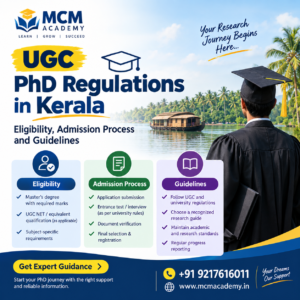

Pursuing a PhD in Kerala is an important academic step for students, researchers and professionals who want to build a career in higher education, research or specialised fields. PhD programmes in Kerala are offered by universities and eligible higher education institutions under the applicable University Grants Commission (UGC) regulations and the individual university’s PhD regulations.
The UGC notified the UGC (Minimum Standards and Procedure for Award of Ph.D. Degree) Regulations, 2022 on 7 November 2022. These regulations apply to universities established under Central, State or other applicable Acts, as well as eligible institutions covered by the UGC framework.
Kerala universities may frame their own regulations and procedures in accordance with the UGC framework. For example, the University of Kerala prepared its Regulations for Award of Ph.D. Degree, 2022 in adherence to the UGC PhD Regulations 2022 and implemented them for candidates seeking registration from the January 2024 session.
What Are the UGC PhD Regulations in Kerala?
There is not a separate UGC regulation exclusively for Kerala. Instead, Kerala universities follow the applicable UGC PhD framework along with their own university ordinances, regulations and admission procedures.
The UGC’s 2022 regulations establish minimum standards and procedures for PhD awards, while individual universities determine operational details such as:
- Admission notifications
- Entrance examinations
- Research areas
- Supervisor allocation
- Coursework
- Registration
- Thesis submission
- Evaluation
- Viva-voce
- University-specific eligibility conditions
Therefore, students should check both the UGC requirements and the current regulations of the Kerala university where they intend to pursue their PhD.
PhD Eligibility in Kerala
The exact eligibility requirements can vary by university and subject. Generally, applicants need a relevant postgraduate qualification and must satisfy the minimum academic requirements prescribed by the applicable regulations.
Students should carefully check:
- Master’s degree requirement
- Minimum percentage or equivalent grade
- Relevant subject requirements
- Entrance examination requirements
- NET/JRF or other national-level qualification, where applicable
- Research proposal requirements
- University-specific conditions
The university’s current PhD admission notification should always be treated as the final source for programme-specific eligibility.
PhD Admission Process in Kerala
Under the UGC PhD Regulations 2022, higher education institutions may admit PhD scholars through recognised national-level fellowship/eligibility examinations and/or an entrance test conducted by the institution, subject to the applicable rules.
A typical admission process may involve:
1. Check Eligibility
Confirm that your postgraduate qualification and academic marks satisfy the university’s requirements.
2. Find a Suitable Research Area
Select a research topic or broad research area related to your academic background.
3. Apply for Entrance Examination
Where an entrance examination is required, candidates must apply according to the university’s notification.
4. Entrance Test
Under the UGC framework, an institutional entrance test can include 50% research methodology and 50% subject-specific content. Candidates who secure the required marks may be called for an interview.
5. Interview
The university may assess the candidate’s research interests, subject knowledge, research proposal and suitability for the available research area.
6. Supervisor Allocation
Registration is subject to the availability of eligible research supervisors and seats.
For example, the University of Kerala states that qualifying in its PhD entrance examination alone does not automatically make a candidate eligible for PhD registration; registration is subject to the applicable regulations and availability of seats with supervising teachers.
Admission Through NET, JRF and Other National-Level Tests
The UGC framework allows higher education institutions to admit candidates who qualify for fellowship or eligibility through examinations such as UGC-NET, UGC-CSIR-NET, GATE, CEED and similar national-level examinations, subject to the applicable institutional rules and interview process.
Students should check the current university admission notification to determine:
- Which national-level qualifications are accepted
- Whether an entrance examination is required
- Whether an interview is required
- How candidates are shortlisted
- Whether fellowship status affects admission
PhD Entrance Examination in Kerala
Kerala universities may conduct their own PhD entrance examinations.
The structure and eligibility can differ between universities and academic disciplines.
For example, the University of Kerala’s PhD admission documentation states that registration depends on the applicable university regulations, UGC norms and the availability of seats with supervising teachers.
Students should therefore avoid relying on an old entrance notification and should check the latest admission announcement from their chosen university.
PhD Coursework
Coursework is an important component of the PhD process.
Under the UGC PhD Regulations 2022, a PhD scholar must obtain at least 55% marks or an equivalent grade in coursework to continue in the programme and submit the thesis.
Coursework may include areas such as:
- Research methodology
- Research ethics
- Subject-specific advanced study
- Academic writing
- Research tools and techniques
- Literature review
The exact coursework structure is determined by the university and research discipline.
Research Supervisor
A PhD scholar must work under an eligible research supervisor according to the university’s regulations.
The UGC framework sets requirements relating to eligible supervisors and research facilities. Universities then implement these requirements through their own regulations.
The University of Kerala’s 2022 regulations, for example, specify eligibility conditions for recognised research supervisors based on academic position, PhD qualification and research publications.
Students should therefore verify whether a prospective supervisor is officially recognised by the university before making an admission decision.
Part-Time PhD in Kerala
The UGC PhD Regulations 2022 permit part-time PhD programmes, provided the prescribed conditions are fulfilled.
For employed candidates, the university may require a No Objection Certificate (NOC) from the employer confirming that the candidate is permitted to pursue the programme and can devote sufficient time to research.
However, students should distinguish a legitimate university-approved part-time PhD from an online or distance PhD.
The UGC 2022 regulations specifically state that higher education institutions covered by the regulation cannot conduct PhD programmes through distance and/or online mode.
Can You Do an Online PhD in Kerala?
Students should be very careful with advertisements offering a “100% online PhD” or “distance PhD” in Kerala.
The UGC PhD Regulations 2022 state that PhD programmes cannot be conducted through distance and/or online mode by the institutions covered by the regulations.
A part-time PhD is different from an online PhD. A part-time programme still has to satisfy the applicable UGC and university requirements.
PhD Thesis and Evaluation
The doctoral thesis must satisfy the university’s research and academic standards.
Under the UGC framework, the thesis is evaluated by the research supervisor and external examiners who are experts in the relevant field and are not employed by the concerned higher education institution.
The evaluation process is followed by a viva-voce according to the university’s applicable regulations.
The UGC framework also requires mechanisms to detect plagiarism and emphasises research integrity.
PhD Viva-Voce
The viva-voce gives the researcher an opportunity to defend the research work and respond to questions about the thesis.
The UGC regulations provide for a viva-voce board involving the research supervisor and external examiner(s), with provisions allowing online conduct where permitted by the applicable rules.
The exact procedure can differ according to the university’s PhD regulations.
PhD Duration in Kerala
The duration of a PhD depends on the university, discipline and individual research progress.
Students should check the current PhD regulations of the university for:
- Minimum registration period
- Maximum registration period
- Coursework period
- Progress review
- Thesis submission requirements
- Extension provisions
It is important not to assume that every PhD programme in Kerala has the same duration.
Major PhD Subjects in Kerala
Kerala universities offer doctoral research opportunities across many disciplines, depending on the institution and available supervisors.
Possible areas include:
- Commerce
- Management
- Economics
- Computer Science
- Engineering
- Physics
- Chemistry
- Mathematics
- Biotechnology
- Education
- English
- Malayalam
- Social Sciences
- Psychology
- Law
- Political Science
- History
- Life Sciences
The availability of a specific PhD subject depends on the university and its recognised research departments.
PhD After M.Com in Kerala
M.Com graduates may consider PhD programmes in areas such as:
- Commerce
- Accounting
- Finance
- Management
- Economics
- Banking
- Business studies
However, eligibility depends on the specific university and research area.
Applicants should check whether their M.Com specialisation matches the proposed PhD discipline and whether they satisfy the university’s minimum academic requirements.
Important Documents for PhD Admission
Depending on the university, applicants may need:
- Degree certificates
- Postgraduate mark sheets
- Bachelor’s degree certificates
- Academic transcripts
- Entrance examination score/details
- NET/JRF certificate, where applicable
- Research proposal
- Passport-size photographs
- Identity proof
- Category certificate, where applicable
- Experience certificate, where applicable
- NOC for eligible employed candidates, where required
The exact list should be checked in the latest university admission notification.
How to Choose a PhD University in Kerala
Before applying, students should verify:
- Whether the university is authorised to award PhD degrees.
- Whether the desired subject is available.
- Whether suitable research supervisors are available.
- The university’s current PhD regulations.
- Admission and entrance requirements.
- Coursework requirements.
- Research facilities and library resources.
- Thesis and examination procedures.
- Fees and other charges.
- Minimum and maximum registration period.
Important Warning About PhD Advertisements
Students should be cautious about advertisements promising:
- “PhD in one year”
- “Guaranteed PhD”
- “No research required”
- “No thesis required”
- “100% online UGC PhD”
- “Direct PhD without eligibility”
- “Guaranteed PhD certificate”
A legitimate PhD involves research, supervision, academic evaluation and a thesis or equivalent doctoral research requirements under the applicable regulations.
Students should verify the programme directly with the university before making any payment.
UGC PhD Regulations 2022: Key Points
| Area | General UGC Requirement |
|---|---|
| Main regulation | UGC PhD Regulations 2022 |
| Entrance route | National-level qualifications and/or university entrance test, subject to rules |
| Entrance test | 50% research methodology and 50% subject-specific content where institutional entrance is used |
| Entrance qualification | 50% marks in entrance test for eligibility to be called for interview, subject to applicable provisions |
| Coursework | Minimum 55% required to continue and submit thesis |
| Part-time PhD | Permitted subject to conditions |
| Distance/online PhD | Not permitted under the 2022 regulation for covered HEIs |
| Thesis evaluation | Supervisor + at least two external examiners |
| Research integrity | Plagiarism detection and research-integrity requirements |
| University rules | Individual universities may prescribe additional procedures consistent with the framework |
The above points are based on the UGC PhD Regulations 2022 and should be read together with the current regulations and admission notification of the university concerned.
Conclusion
The UGC PhD Regulations in Kerala are based on the UGC’s national PhD framework, particularly the UGC (Minimum Standards and Procedure for Award of Ph.D. Degree) Regulations, 2022. Kerala universities implement these standards through their own PhD regulations, admission notifications and academic procedures.
Students planning to pursue a PhD in Kerala should carefully verify eligibility, entrance requirements, research supervisor availability, coursework, study mode, university recognition, thesis requirements and current admission rules before applying.
Most importantly, students should rely on the official website and latest PhD notification of the university rather than advertisements from third-party agencies or consultants.