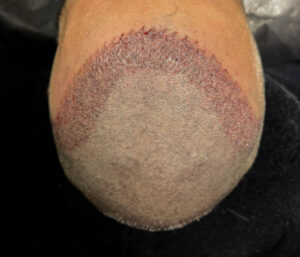

The donor scar after FUT Hair Transplant in Dubai heals progressively rather than becoming fully mature immediately after surgery. The skin closes during the early healing phase, while the scar gradually becomes flatter, softer, and less noticeable over the following months.
The final appearance depends on the surgical closure, scalp characteristics, healing response, hair coverage, and how carefully the donor area is managed during recovery.
How Does the Donor Area Heal After FUT Hair Transplant in Dubai?
FUT involves removing a strip of donor scalp from the selected donor region. The edges of the remaining scalp are then brought together and closed.
This creates a linear incision that needs time to heal.
The healing process generally involves several stages:
- Initial wound closure
- Early scar formation
- Reduction in redness and sensitivity
- Scar remodeling
- Long-term maturation
The visible appearance can continue changing long after the incision has closed.
What Does the Donor Scar Look Like During the First Week?
During the earliest stage, the donor area may appear more noticeable because the incision is fresh.
Patients may experience:
- Mild swelling
- Redness
- Tenderness
- Tightness
- Temporary sensitivity
The area should be handled according to the surgeon’s instructions.
Avoid scratching, unnecessary stretching, or applying unapproved products to the incision.
When Does the Incision Begin to Close?
Skin begins repairing itself immediately after surgery.
However, a closed incision does not mean the scar is fully healed.
The deeper tissues continue strengthening and remodeling after the surface has closed.
This distinction is important because patients sometimes assume that a scar is finished once the wound no longer looks open.
How Does the Scar Change During the Following Weeks?
As the healing process continues, the incision generally becomes less inflamed.
The scar may still appear pink or slightly raised in some patients.
Hair surrounding the incision can also begin to make the area less noticeable as it grows.
Individual healing varies considerably.
How Long Does FUT Scar Maturation Take?
Scar maturation is a longer process than initial wound closure.
Over time, a scar may become:
- Flatter
- Softer
- Less pigmented
- Less noticeable
- Better blended with surrounding tissue
The exact timeline varies between patients.
Some scars mature relatively quickly, while others continue changing for many months.
What Determines How Noticeable the Scar Becomes?
Several factors influence the final appearance.
Surgical Closure
The way the donor incision is closed can affect tension and scar formation.
Scalp Characteristics
Individual skin and scalp properties influence healing.
Scar Biology
Some people naturally develop more visible scars than others.
Wound Care
Following postoperative instructions can help support appropriate healing.
Tension on the Incision
Excessive tension during early recovery may affect comfort and scar development.
Does Hair Grow Around the Scar?
Yes.
The hair surrounding the donor incision continues to provide coverage.
As the surrounding hair grows, it can help conceal the linear scar.
This is one reason hairstyle length can influence how visible the donor area appears.
Can the Scar Become Less Visible Over Time?
Often, yes.
Scar tissue commonly changes as it matures.
A scar that appears relatively noticeable during the early healing period may become much less conspicuous later.
However, no surgical scar can be guaranteed to disappear completely.
Can Hair Length Affect Scar Visibility?
Yes.
Longer surrounding hair generally provides more coverage.
Very short hairstyles may expose more of the donor region, depending on scar width, hair density, and individual healing.
This is an important consideration for patients who regularly wear short hairstyles.
What Should You Avoid During Scar Healing?
Follow your surgeon’s instructions regarding:
- Heavy physical activity
- Excessive stretching
- Scratching
- Picking
- Unapproved scar treatments
- Direct sun exposure
- Hair products applied to the healing incision
Do not apply scar treatments without first confirming that the incision is ready for them.
When Should a Scar Be Reviewed by the Clinic?
Follow-up appointments allow the surgical team to evaluate healing.
Contact your clinic if the donor area develops unexpected changes such as worsening pain, increasing redness, significant swelling, discharge, or other symptoms that concern you.
The treating team can determine whether the appearance is part of normal healing.
Does the Scar Affect the Final Hair Transplant Result?
The donor scar is only one component of the overall result.
A successful restoration also depends on:
- Graft quality
- Recipient-site design
- Hairline planning
- Graft survival
- Hair growth
- Long-term native hair stability
The donor area should therefore be considered as part of the complete treatment plan.
Final Thoughts
The donor scar after FUT Hair Transplant in Dubai usually changes substantially as healing progresses. The incision may look more noticeable early on, while scar tissue gradually matures and surrounding hair provides additional camouflage.
For personalized donor-area assessment and recovery guidance, explore FUT Hair Transplant in Dubai at Tajmeels Clinic.