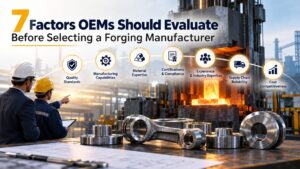

For OEMs, choosing a forging manufacturer is not simply about finding a supplier that can produce a metal component at the right price. Forged components often become part of critical equipment, machinery, and industrial systems where quality, consistency, and reliability directly influence overall performance.
A supplier may offer competitive pricing, but that alone does not guarantee consistent quality, reliable delivery, or the technical capability required for demanding applications.
Before selecting a forging manufacturer, OEM procurement and engineering teams should evaluate several factors beyond the initial quotation.
Here are seven important criteria to consider.
1. Manufacturing Capability and Product Range
The first question should be simple: Can the manufacturer actually produce what you need?
Forging requirements can vary significantly depending on component size, geometry, material, weight, production volume, and application. A capable manufacturer should have suitable equipment, forging processes, heat-treatment capabilities, machining options, and inspection systems.
OEMs should evaluate:
- Maximum component dimensions and weight
- Open-die, closed-die, or ring-rolling capabilities
- Material grades supported
- Heat-treatment capabilities
- Machining and finishing options
- Ability to manufacture complex or customized components
- Production capacity for both prototypes and larger volumes
A broad manufacturing capability can also reduce the need to work with multiple suppliers for different component categories.
2. Quality Management and Certifications
Quality should be evaluated as a system, not simply by inspecting the finished product.
A reliable forging manufacturer should have documented quality-management processes covering raw material inspection, forging, heat treatment, machining, testing, final inspection, and documentation.
Depending on the industry, OEMs may also require specific certifications or approvals.
For example, CHW Forge lists certifications and approvals including ISO 9001, ISO 14001, ISO 45001, EN 9100, API 6A, PED, AD 2000-Merkblatt WO, and ISO 27001 on its official website.
When evaluating suppliers, OEMs should verify whether the manufacturer’s certifications are:
- Relevant to the required application
- Current and valid
- Issued by recognized certification bodies
- Supported by appropriate manufacturing and inspection processes
Certifications do not replace supplier evaluation, but they can provide an important indication of process discipline and compliance.
3. Material Expertise
The performance of a forged component depends heavily on selecting and processing the right material.
Different industries may require carbon steel, alloy steel, stainless steel, duplex stainless steel, aluminium alloys, titanium, or other specialized materials.
OEMs should therefore evaluate whether the manufacturer has experience with the specific materials required for their applications.
Important questions include:
- Does the manufacturer source certified raw materials?
- Is material traceability maintained?
- Can the supplier meet specified chemical and mechanical properties?
- Are heat-treatment procedures controlled and documented?
- Can the manufacturer support material testing and certification requirements?
Material expertise becomes particularly important for components operating under high loads, pressure, temperature, corrosion, or demanding environmental conditions.
4. Testing, Inspection and Traceability
A forged component can look perfect externally while still requiring detailed testing to verify its internal and mechanical characteristics.
That is why inspection and testing capabilities should be part of the supplier-selection process.
Depending on the component and application, OEMs may require:
- Dimensional inspection
- Chemical analysis
- Mechanical testing
- Ultrasonic testing
- Magnetic particle testing
- Hardness testing
- Microstructure examination
- Heat-treatment records
- Material certificates
- Third-party inspection
Traceability is equally important. The manufacturer should be able to connect the finished component with its raw material, manufacturing stages, testing records, and inspection documentation.
For industries such as aerospace, oil & gas, power generation, and nuclear, this level of documentation can become an important part of supplier qualification.
CHW Forge states that it maintains end-to-end product traceability and process-driven operations as part of its manufacturing approach.
5. Engineering and Customization Capability
Not every OEM requirement can be fulfilled using an off-the-shelf component.
Many industrial applications involve customized dimensions, material specifications, tolerances, heat-treatment requirements, or forging designs.
A strong forging partner should therefore be able to work with engineering teams rather than simply manufacture against a purchase order.
Look for capabilities such as:
- Design and process engineering
- Forging process development
- Technical drawing interpretation
- Customized manufacturing
- Engineering consultation
- Prototype and development support
- Process optimization
This collaboration can help identify manufacturing challenges early and potentially reduce rework, material waste, and production delays.
CHW Forge describes its approach as beginning with understanding customer requirements, followed by design and planning before implementation.
6. Production Capacity and Delivery Reliability
A manufacturer may produce excellent components but still create problems if it cannot meet required delivery schedules.
For OEMs, supply reliability is particularly important because a delayed forged component can affect machining schedules, assembly lines, equipment commissioning, and customer deliveries.
Before finalizing a supplier, evaluate:
- Monthly production capacity
- Typical lead times
- Raw material availability
- Production planning systems
- Inventory management
- Ability to handle urgent requirements
- Track record of on-time delivery
- Logistics and export capabilities
The goal should not be simply to find a manufacturer that can produce the component. It should be to find a partner capable of producing it consistently and delivering it when required.
7. Industry Experience and Long-Term Reliability
Finally, consider whether the forging manufacturer understands your industry.
A supplier serving aerospace applications may operate under very different requirements from one supplying construction equipment or general engineering components.
Industry experience can influence the manufacturer’s understanding of:
- Application-specific standards
- Customer specifications
- Testing requirements
- Documentation
- Regulatory expectations
- Component performance requirements
- Supplier qualification procedures
For example, states that it serves sectors including aerospace, oil & gas, power generation, heavy industrial equipment, mining, construction, infrastructure, and engineering applications.
Its product capabilities also include forged blocks, shafts, rings, gear blanks, flanges, hubs, hollow forgings, and other industrial components.
This type of cross-industry experience can be valuable for OEMs looking for a long-term manufacturing relationship rather than a one-time supplier.
A Practical OEM Supplier-Selection Checklist
Before approving a forging manufacturer, procurement and engineering teams can ask:
- Does the supplier have the required manufacturing capacity?
- Can it manufacture the required material and component size?
- Are relevant certifications available?
- Is raw material and production traceability maintained?
- What testing and inspection capabilities are available?
- Can the supplier support customized engineering requirements?
- Does it have a proven delivery and production system?
- Does it understand the standards and requirements of your industry?
Answering these questions can help OEMs move beyond price-based supplier selection.
Final Thoughts
Selecting a forging manufacturer is ultimately a decision about manufacturing reliability, quality, engineering capability, and supply-chain confidence.
Price will always matter, but choosing a supplier solely on quotation value can overlook factors that become much more expensive later—such as inconsistent quality, production delays, rework, rejected components, or supply interruptions.
For OEMs sourcing critical forged components, the right approach is to evaluate the complete manufacturing ecosystem: capability, quality, materials, testing, engineering, delivery, and industry experience.
A forging manufacturer that performs well across these areas can become more than a component supplier—it can become a dependable part of the OEM’s long-term supply chain.