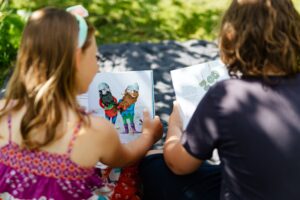

In a world where children’s literature often emphasizes action, adventure, and defeating the enemy, one author has taken a different path. Melissa Lovelace has crafted a story that challenges young readers to reconsider what true bravery looks like. Her book, Tom Boppa and the Dragon, published in February 2025, presents a refreshing take on courage—one rooted not in conquest, but in understanding.
The story follows young Tom Boppa and his faithful sheep, Ernestine, as they confront a fearsome dragon threatening their peaceful kingdom of Esse-by-the-Sea. But instead of slaying the beast, Tom discovers that the dragon is not what he appears to be. The book’s central message resonates deeply: “Bravery isn’t just about fighting monsters but about understanding them”.
The Inspiration Behind Tom Boppa
Understanding why Melissa Lovelace wrote this book requires looking at the themes that drive the narrative. The kingdom of Esse-by-the-Sea operates on a simple but profound principle: “Think as the other would think”. This philosophy of perspective-taking is woven throughout the story’s fabric.
The author draws a stark contrast between Esse-by-the-Sea and another kingdom where people “fight over who is right”. In that other land, conflict leads to drought, disappearance of animals, and ultimately forces the last dragon to flee. When the dragon arrives in Esse-by-the-Sea, it brings fear and destruction—not because it is inherently evil, but because it is hungry, heartbroken, and alone.
Melissa Lovelace seems to be making a deliberate point: fear and conflict often stem from misunderstanding, not malice. By creating a scenario where a child protagonist must look beyond appearances, she offers young readers a framework for navigating a complex world.
The Empathy Lesson at the Heart of the Story
Empathy is not a simple concept to teach children. It requires moving beyond sympathy—feeling sorry for someone—to genuinely understanding another’s perspective. Tom Boppa models this for young readers in a way that is both accessible and emotionally resonant.
When Tom steps forward to confront the dragon, he does not carry a sword or shield. He is “armed with nothing but determination and the companionship of his sheep, Ernestine”. This detail is significant. The author strips away traditional weapons of power and replaces them with tools of connection. Tom’s journey is not about defeating an enemy; it is about uncovering “truths far deeper than he imagined”.
The dragon, it turns out, has a story. Like the people of Esse-by-the-Sea, it has experienced loss and hardship. The dragon crossed the sea not to conquer, but because its own land had become uninhabitable. When Tom chooses to understand rather than attack, he unlocks a path to peace that violence never could have achieved.
Why This Matters for Young Readers
Children’s books have long served as vehicles for teaching values. But the most effective lessons are those that feel like discoveries rather than lectures. Tom Boppa and the Dragon achieves this by embedding its message within an engaging narrative.
The book belongs to the Juvenile Fiction category, specifically the “Animals – Dragons, Unicorns & Mythical” subcategory. This positioning is telling. Dragons have traditionally represented the ultimate monster—a creature to be feared and destroyed. By subverting this expectation, Melissa Lovelace invites young readers to question their own assumptions about who the “monsters” in their lives might be.
Empathy, as the book demonstrates, is not weakness. It takes courage to set aside fear and approach another being with curiosity rather than hostility. Tom Boppa shows children that the bravest people are not those who fight hardest, but those who listen most deeply.
A Timeless Message for a Complex World
In an era where division and conflict dominate headlines, stories like Tom Boppa and the Dragon offer a counter-narrative. They remind us that understanding is not capitulation—it is a strength. They teach that every adversary has a story, and that recognizing that story is the first step toward resolution.
Melissa Lovelace has created more than a children’s book. She has crafted a gentle introduction to a radical idea: that empathy is not just a virtue, but a form of bravery. For young readers navigating an increasingly complicated world, this lesson could not be more timely or more necessary.