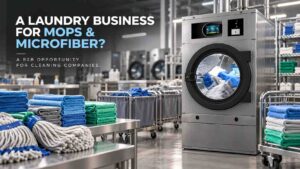

Most people think of laundry as clothes, bedsheets, or towels. But cleaning contractors and facility-management companies also handle a steady stream of reusable textiles such as mop heads, microfiber cloths, wiping towels, and similar cleaning materials.
That creates an interesting business question: could you build a B2B laundry business around processing these textiles for companies that use them every day? With the right customer base, workflow, and commercial laundry equipment, this could become a specialized service model rather than a traditional walk-in laundry.
Why Could Cleaning Companies Become Recurring B2B Laundry Customers?
Cleaning companies repeatedly use reusable textiles as part of their daily operations. Depending on the size of the contractor and the sites it serves, this may include mop heads, microfiber cloths, cleaning towels, and other washable materials.
That makes the business model different from a regular retail laundry.
A typical retail laundry handles:
Many Individual Customers → Smaller Separate Orders → Variable Demand
A specialized B2B processing unit could instead operate around:
Fewer Business Clients → Recurring Textile Volume → Scheduled Collection → Central Processing → Scheduled Return
Potential customers may include:
- Facility-management companies
- Commercial cleaning contractors
- Office housekeeping providers
- Building-maintenance companies
- Cleaning service agencies
- Institutional housekeeping operations
The important point is not the number of individual mop heads or cloths. The opportunity comes from recurring processing volume.
A contractor that serves multiple buildings may need reusable cleaning textiles processed regularly. If several such businesses operate in the same city or industrial area, an entrepreneur could investigate whether there is enough demand to support a dedicated laundry processing service.
The better way to think about the opportunity is:
Recurring Textile Usage → Regular Washing Requirement → Outsourcing Need → B2B Laundry Service
Before investing, however, actual local demand should be verified rather than assumed.
What Types of Cleaning Textiles Could a Commercial Laundry Process?
A specialized operation may handle several types of reusable cleaning textiles, depending on customer requirements and the suitability of the materials.
These could include:
- Microfiber cloths
- Flat mop pads
- Mop heads
- Cleaning towels
- Reusable wiping cloths
- Other washable housekeeping textiles
However, not every item should automatically be placed into the same load.
Different textiles may contain different types of soil, residues, colours, or care requirements. Some items may have been used in general housekeeping, while others may have been exposed to oils, chemicals, food-related dirt, or other contaminants.
A better professional workflow starts with sorting.
Receive → Identify Client → Sort by Textile Type → Check Soil Level → Review Care Requirements → Select Process → Wash → Dry Where Suitable → Inspect → Pack
Microfiber also requires careful process selection. Washing temperature, chemistry, drying conditions, and handling should follow the textile supplier’s care recommendations and the requirements of the specific application.
This makes one principle especially important:
Textile Type + Soil Type + Care Requirement = Processing Decision
A professional laundry service for facility management companies should therefore be built around proper classification, not just high machine capacity.
What Commercial Laundry Equipment Would This Business Need?
The right commercial laundry equipment depends on the expected volume, textile categories, working hours, and turnaround requirements.
A typical setup may involve:
- Commercial washer extractor
- Suitable commercial tumble dryer
- Sorting tables
- Laundry trolleys or containers
- Weighing arrangement
- Storage racks
- Packing area
- Suitable chemical dosing arrangement where required
- Water, drainage, and electrical infrastructure
The machine should be selected only after understanding the business demand.
A useful planning sequence is:
Number of Clients → Average Textile Volume → Daily KG → Load Categories → Loads per Day → Operating Hours → Equipment Capacity
For example:
Expected Daily Laundry KG = Active B2B Clients × Average Daily KG per Client
Then:
Required Loads per Day = Expected Daily KG ÷ Practical Average Load
These calculations help estimate how much processing capacity may be required.
But rated KG capacity alone is not enough when choosing a commercial washing machine or industrial washing machine.
You should also consider:
- Practical load size
- Textile mix
- Extraction performance
- Utility requirements
- Machine controls
- Available working hours
- Peak-day volume
- Service and maintenance support
A commercial tumble dryer may also be required if the business needs controlled drying capacity, but not every textile should automatically be dried using the same program. The correct process depends on the material and care instructions.
The goal should be to build a balanced commercial laundry business setup, not simply buy the biggest machine available.
How Would a Mop and Microfiber Laundry Service Operate?
The success of this business model would depend heavily on workflow and logistics.
Unlike a walk-in laundry, a B2B operation could be designed around scheduled pickup and delivery routes.
A typical process may look like:
Scheduled Collection → Client Identification → Receiving → Sorting → Weighing → Washing → Drying Where Suitable → Inspection → Packing → Dispatch
Each incoming batch should be clearly identified so different clients’ textiles do not become mixed.
A simple tracking structure could include:
Client Name → Batch ID → Textile Category → Quantity or Weight → Process → Completion → Dispatch
Collection frequency could vary by client.
Some companies may need service several times a week, while others may require scheduled weekly processing. The correct frequency should be based on actual operational requirements.
This model can also reduce dependence on a premium retail location.
A processing-focused business may benefit more from a site with:
- Adequate floor space
- Suitable water supply
- Proper drainage
- Electrical capacity
- Equipment access
- Storage space
- Vehicle access for pickup and delivery
- Efficient dirty-to-clean workflow
This can make the business structurally different from a traditional neighbourhood laundry.
How Do You Validate Demand Before Buying Laundry Equipment for Business?
This is the most important step.
Do not purchase laundry equipment for business simply because the idea sounds promising.
Start by identifying potential customers in your target area.
Research cleaning companies, facility-management contractors, housekeeping service providers, and building-maintenance firms.
Then ask practical questions:
- What reusable cleaning textiles do you use?
- How much do you process in a week?
- Do you wash them internally or outsource them?
- How often do you need clean stock returned?
- Do different textile types need separate handling?
- What turnaround time do you expect?
- Would scheduled pickup and delivery be useful?
Once you have real answers, estimate likely processing volume.
The investment path should be:
Potential Clients → Confirmed Interest → Expected Weekly Volume → Daily Processing Requirement → Equipment Selection
This prevents one of the biggest startup mistakes: buying capacity first and searching for customers later.
The stronger approach is:
Find recurring textile volume first. Buy the equipment around that demand second.
If the initial market is strong, the business may later explore other compatible B2B textile-processing categories, provided the correct segregation and processing requirements are maintained.
How Orgaearth Can Help You Build a B2B Laundry Setup
Orgaearth can help entrepreneurs evaluate commercial laundry machines in India based on the actual processing requirements of the proposed business.
Planning can begin with:
Expected Daily KG + Textile Mix + Practical Loads + Operating Hours + Available Space + Utilities + Required Workflow
Depending on the application, the setup may include suitable washer extractors, tumble dryers, chemical dosing solutions, and supporting professional laundry equipment.
The objective is not simply to purchase machines. It is to create a processing setup where washing, drying, handling, and logistics work together around real customer demand.
Frequently Asked Questions
What commercial laundry equipment is needed for a B2B laundry business?
The setup may include a commercial washer extractor, drying equipment, sorting tables, trolleys, storage, weighing systems, packing space, and suitable utility infrastructure. The exact requirement depends on expected volume and textile type.
Can I start a laundry service for cleaning companies?
Potentially, yes. First validate whether cleaning contractors in your area generate enough reusable textile volume and whether they are interested in outsourcing the processing.
Can a commercial washing machine process mops and microfiber cloths?
Suitable items may be processed in commercial equipment, but textile construction, soil type, chemical exposure, and care instructions should be checked before selecting a wash process.
How do I choose a commercial washer extractor for this business?
Estimate expected daily KG, practical load size, load categories, working hours, and peak demand. Then compare machine specifications, utilities, extraction performance, and service support.
Do I need a commercial tumble dryer for a mop and microfiber laundry service?
That depends on the textile type, customer requirement, drying method, and care instructions. A commercial dryer can provide controlled drying capacity where suitable.
Can a B2B laundry operate without a retail shop?
Yes. A processing-focused operation can potentially serve business clients through scheduled collection and delivery without depending on walk-in retail customers.
Conclusion
A specialized B2B laundry business for cleaning companies could be built around something many people overlook: recurring volumes of reusable mops, microfiber cloths, and housekeeping textiles.
The opportunity should be approached in the right order:
Find B2B Clients → Measure Textile Volume → Understand Processing Requirements → Estimate Daily Loads → Plan Workflow → Select Commercial Laundry Equipment
The strongest business is not the one with the biggest machines. It is the one where equipment capacity is matched to real, repeatable customer demand.
Contact Us:
Orgaearth Laundry Solutions
Plot no. 774, Udyog Vihar, Phase 5, Gurugram, Haryana, India-122016
Email: marketing@orgaearth.com
Contact No.- +91 7042912777