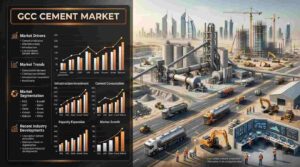

IMARC Group, a leading global market research and management consulting firm, has published its latest market intelligence report on the GCC Cement Market. The GCC cement market size reached 98.9 Million Tons in 2025 and is projected to reach 148.3 Million Tons by 2034, exhibiting a CAGR of 4.47 percent during 2026-2034. Growth is being driven by robust economic growth, increasing urbanization, governmental investments in mega-projects, sustainable construction practices, rising population, and a growing focus on affordable housing solutions across the region.
Cement remains the essential building block of the GCC’s ambitious economic diversification agenda, underpinning residential, commercial, and infrastructure construction across Saudi Arabia, the UAE, Qatar, Oman, Kuwait, and Bahrain. Saudi Arabia commands the largest share of regional cement consumption, driven by its Vision 2030 initiative and giga-projects such as NEOM and the Red Sea Project, while Saudi cement sales reached approximately 14.87 million tonnes in the fourth quarter of 2024 alone on the back of strong domestic demand. Portland cement remains the most widely used type given its versatility and relatively lower carbon footprint, while residential construction continues to account for the largest end-use share as governments roll out affordable housing schemes. At the same time, AI-powered project scheduling, resource allocation, and predictive site monitoring are increasingly being deployed across the region’s construction sector, backed by Saudi Arabia’s multi-billion-dollar AI initiative and the UAE’s AI Strategy 2031. Combined with sustained infrastructure mega-project investment and rising sustainability requirements, these forces are reshaping the competitive landscape and setting the stage for durable, long term growth across the GCC.
GCC Cement Market at a Glance
- Market Size (2025): 98.9 Million Tons
- Market Forecast (2034): 148.3 Million Tons
- Growth Rate (2026-2034): CAGR of 4.47 percent
- Base Year: 2025, Historical Period: 2020-2025, Forecast Period: 2026-2034
- Leading Type Segment: Portland, supported by its versatility, strength, and relatively lower carbon footprint compared to other cement types
- Leading Country: Saudi Arabia, driven by Vision 2030 diversification goals and large-scale giga-project construction
How AI is Reshaping the Future of the GCC Cement Market
- AI-Powered Project Scheduling and Resource Optimization: Advanced AI algorithms are optimizing project scheduling and resource allocation across GCC construction projects, reducing delays by up to 25 percent and expediting approval processes by nearly 30 percent, directly improving cement demand planning and supply chain efficiency.
- National AI Strategies Driving Construction Digitalization: Saudi Arabia’s multi-billion-dollar AI initiative and the UAE’s AI Strategy 2031 are driving heavy investment in digital infrastructure and smart city projects, accelerating AI adoption across the construction and cement value chain region-wide.
- AI-Powered Drones and Autonomous Site Monitoring: Leading construction firms across the GCC are deploying AI-powered drones, autonomous machinery, and real-time site monitoring systems to boost precision, address labor shortages, and improve safety by predicting potential hazards on large-scale cement-intensive infrastructure projects.
Grab a sample PDF of this report: https://www.imarcgroup.com/gcc-cement-market/requestsample
GCC Cement Market Trends and Drivers
Demand across the GCC cement market is being underpinned by robust economic growth and rapid urbanization. Economic prosperity driven by oil exports, trade diversification, and foreign investments has led to a surge in construction activities, with rising urban populations necessitating residential complexes, commercial buildings, and public infrastructure such as schools, hospitals, and transportation networks.
The market’s structural differentiator is the scale of governmental investment in mega-projects. Governments across the GCC are executing large-scale developments such as stadiums, airports, and industrial complexes as part of broader economic diversification efforts, with Saudi Arabia’s Vision 2030 giga-projects, including NEOM and the Red Sea Project, requiring vast quantities of cement to materialize the Kingdom’s ambitious development plans.
A third driver is the region’s rising population combined with a growing tourism and hospitality sector, further fueling the need for additional construction activity. Advancements in technology and sustainable practices are simultaneously encouraging manufacturers to innovate and produce eco-friendly cement solutions, aligning with the region’s environmental goals and green building standards.
Government Schemes and Regulatory Initiatives Driving Demand
- Public Investment Fund-Backed Development in Makkah: Government and Public Investment Fund-backed development projects in the Makkah region are expected to drive rising cement demand, with major producers such as Arabian Cement Company forecasting increased output to meet growing regional construction needs.
- Liquid Fuel Displacement and Grid Connection Programs: Saudi cement producers are progressing on projects to connect production facilities to the Saudi Electricity Company grid under the Kingdom’s liquid fuel displacement programme, supporting the sector’s shift toward more sustainable and cost-efficient energy sources.
- UAE and Regional Affordable Housing Schemes: GCC governments continue to implement various housing schemes and incentives to meet growing population needs, with a strong focus on affordable housing solutions and real estate development driving sustained residential cement demand across the region.
- Interest Rate and Real Estate Policy Support: A regional interest rate cut led to a revival of real estate project activity across the GCC, with government and PIF-backed development projects reinforcing positive momentum for cement demand as financing conditions improve for both public and private construction ventures.
GCC Cement Market Industry Segmentation
The report has segmented the market into the following categories:
Breakup By Type:
- Blended
- Portland
- Others
Portland represents the largest segment given the increasing trend toward sustainable and green building practices, its relatively lower carbon footprint compared to other cement types, and its widespread adoption across high-rise buildings, roads, and bridges.
Breakup By End Use:
- Residential
- Commercial
- Infrastructure
The residential sector accounts for the largest market share, driven by rapid population growth, urbanization, and government focus on providing affordable housing solutions, while infrastructure remains a key growth segment given the scale of ongoing mega-project investment.
Breakup By Country:
- Saudi Arabia
- UAE
- Qatar
- Oman
- Kuwait
- Bahrain
Saudi Arabia accounts for the largest market share, given its Vision 2030-driven infrastructure investment and rapidly growing urban population, while the UAE, Qatar, and other GCC nations continue to expand cement demand through their own economic diversification and mega-project pipelines.
Competitive Landscape
The GCC cement market is highly fragmented, featuring intense competition among major regional and international cement manufacturers. Key players include:
- Al Safwa Cement Company
- Cemex UAE (CEMEX S.A.B. de C.V.)
- Emirates Steel Arkan
- Gulf Cement Company
- Kuwait Cement Company (K.S.C.)
- Lafarge Emirates Cement Company LLC (Holcim Group)
- Najran Cement Company
- Oman Cement Company (S.A.O.G)
- Qatar National Cement Company
- Saudi Cement Company
- Yanbu Cement Company
Large multinational cement companies and prominent regional players dominate the market by leveraging extensive production capacities and well-established brand presence, while competitive forces continue to push manufacturers toward research and development of innovative, sustainable cement solutions that meet the region’s growing environmental and green building requirements.
Market Concentration Analysis
- Saudi Arabia accounts for an estimated 45 to 50 percent of total GCC cement consumption, driven by its large population, massive infrastructure projects, and high domestic demand relative to other regional markets.
- The market remains highly fragmented at the manufacturer level, with numerous regional and international cement producers competing across the six GCC countries rather than a small number of dominant players controlling the bulk of supply.
- Consolidation activity, including capital restructuring such as City Cement’s stake acquisition in Umm Al Qura Cement, reflects gradual market tightening as producers seek scale advantages amid ongoing oversupply pressures in parts of the region.
What Does The Full Report Cover?
- Historical, current, and forecast market size for the GCC cement market from 2020 to 2034
- Market breakup by type, end use, and country
- Country-level analysis covering Saudi Arabia, the UAE, Qatar, Oman, Kuwait, and Bahrain
- Key growth drivers, restraints, and opportunities shaping the market
- Porter’s Five Forces analysis and value chain assessment
- Competitive landscape, market structure, and player positioning
- Detailed profiles of major regional and international cement companies
Recent News and Developments in the GCC Cement Market
- December 2024: DAW Construction and QGPC unveiled polymer resin concrete technology aimed at supporting sustainable infrastructure development across the region, reflecting growing industry focus on eco-friendly construction materials.
- January 2025: Saudi Arabia’s City Cement Company announced a capital hike to acquire a stake in Umm Al Qura Cement, with post-transaction shareholders set to own approximately 30.4 percent of Umm Al Qura Cement’s capital.
- April 2025: Arabian Cement Company reported in its 2024 annual report that it was increasing production capacity at its fifth production line, with completion targeted by the fourth quarter of 2025, while forecasting rising 2025 cement demand driven by government and PIF-backed development projects in the Makkah region.
- November 2025: Industry coverage highlighted the deepening relationship between AI and energy across Gulf industries, with major regional energy players emphasizing AI’s role in driving generational opportunity across construction and adjacent heavy industries.
- July 2026: Industry analysis presented at the Cemtech MEA conference in Riyadh confirmed that infrastructure mega-projects continue to drive cement demand growth across Saudi Arabia, the UAE, Bahrain, Kuwait, Oman, and Qatar.
Note: If you require specific details, data, or insights that are not currently included in the scope of this report, we are happy to accommodate your request. As part of our customization service, we will gather and provide the additional information you need, tailored to your specific requirements. Please let us know your exact needs, and we will ensure the report is updated accordingly to meet your expectations.
Key Questions This Report Answers
- How big is the GCC cement market and what is its growth outlook through 2034?
- What are the key growth drivers, restraints, and opportunities in the GCC cement market?
- Which type and end-use segments hold the largest share of the market?
- Which country leads the GCC cement market, and why?
- How are government schemes and mega-project pipelines shaping regional demand?
- Who are the key players in the GCC cement market, and how is the competitive landscape evolving?
- What role is AI playing in the future of GCC cement production and construction operations?
About Us
IMARC Group is a global management consulting firm that helps the world’s most ambitious changemakers to create a lasting impact. The company provides a comprehensive suite of market entry and expansion services. IMARC offerings include thorough market assessment, feasibility studies, company incorporation assistance, factory setup support, regulatory approvals and licensing navigation, branding, marketing and sales strategies, competitive landscape and benchmarking analyses, pricing and cost research, and procurement research.
Media and Sales Contact
IMARC Group
Email: sales@imarcgroup.com
United States: +1-201-971-6302
India: +91-120-433-0800
United Kingdom: +44-753-714-6104