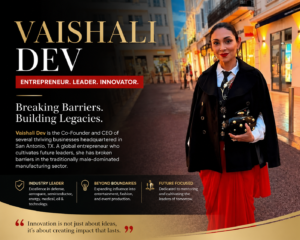

People ask me this a lot — what it’s actually like being a female entrepreneur in the USA, especially in an industry that definitely wasn’t holding a seat open for me. And every single time, I catch myself about to give the polished, stage-ready version of the answer. The honest one is messier. It’s also, I think, a lot more useful to anyone actually walking this road themselves right now.
Starting Somewhere I Wasn’t Really Expected To Be
When I first stepped into manufacturing, I noticed something almost right away — I was usually the only woman in the room. Sometimes the only woman in the entire building. Defense, aerospace, semiconductors, energy, medical technology, oil — these industries were built on decades of tradition, and that tradition never really left much room for someone who looked like me anywhere near the decision-making table.
I still remember specific meetings where I could feel people quietly deciding whether to take me seriously before I’d even said a word. Nobody ever said it out loud, obviously. It showed up in smaller ways — a slight pause before someone addressed me, or a question that somehow ended up aimed at the man sitting next to me instead. I could have let that shrink me down. I didn’t. I decided pretty early that I’d let the actual work speak louder than whatever assumption was sitting in the room. Precision, reliability, results — this industry respects those things no matter who’s the one delivering them.
Building Something From Nothing, Basically
Founding and growing Microteq Engineering Inc. was never some clean, straight climb upward — nothing like that ever is, if I’m being honest. There were real nights of doubt, where I genuinely wondered if I’d taken on more than I could actually carry, especially in fields as unforgiving as aerospace and defense. One missed spec. One broken deadline. That’s really all it takes for years of trust to fall apart in a single phone call.
But I’ve always believed the hardest industries are exactly the ones worth mastering. Every contract we landed in semiconductors, energy, medical, and technology felt like a quiet little statement, honestly — that leadership and capability were never actually about gender to begin with. Over time, that quiet statement turned into an actual track record. And that track record slowly became a reputation I still don’t take for granted, not even a little.
The Weight That Comes With Being “The First”
Something people don’t talk about enough is the pressure that comes with being one of the first women leading at this level in manufacturing. It’s not just about running the business well, though obviously that matters too. It’s knowing that how you show up quietly shapes whether the next woman gets taken seriously a little faster than you did.
That responsibility genuinely reshaped how I lead. Early on, I made a promise to myself — if I ever got the chance to build something that was actually mine, I wasn’t going to just chase my own success. I’d spend just as much energy creating room for other people to rise too. That’s probably why mentoring emerging leaders has become such a central part of who I am now, not just as a founder, but honestly as a person. I know exactly what it feels like to look up the ladder and not see anyone who looks like you standing there. I didn’t want the next wave of women coming into this industry to feel that same isolation I did back then.
Refusing to Live in Just One Lane
Somewhere along the way, I made a decision that genuinely surprised a lot of people around me — I didn’t stop at manufacturing. I expanded into entertainment, fashion, and event production, industries that, on paper, share almost nothing with precision engineering.
That expansion was never really about proving anything to anyone else. It was more about being honest with how my own mind actually works. I’ve never been someone who could stay boxed into one lane, one identity, one narrow idea of what a manufacturing executive is supposed to look like. To me, creativity and precision were never really opposites anyway — they’re just two different sides of the same drive to build something that actually matters.
What This Whole Journey Has Actually Taught Me
If there’s one thing I’d want other women building their own path in the U.S. to take away from my story, it’s this — you don’t have to sit around waiting for an industry to make space for you. Sometimes you just have to walk in, put in the work, and make that space yourself, even when it’s genuinely uncomfortable, even when you’re the only one who looks like you in the room.
My journey as a female entrepreneur is honestly far from finished. Every new venture, every young leader I get to mentor, every small, quiet shift in this industry because a woman proved she belonged there — that’s the real measure of success for me. Not just what I’ve managed to build for myself, but what becomes possible for the women coming up right behind me.
That’s the story so far, anyway. And I’m nowhere close to done writing it.