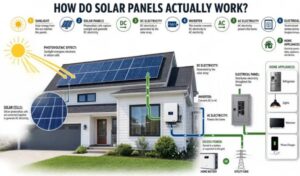

The sun is bright, the panels are producing, and then the neighborhood loses power. Inside the house, the lights go dark anyway.
For many Houston homeowners, that moment feels impossible. If solar panels are generating electricity, why can the home not use it? The grid outage solar question has a surprisingly simple answer: most residential systems are designed to shut down when the utility grid fails.
A standard solar system outage is not usually caused by damaged panels. It is a safety response. Without the right battery, inverter, and isolation equipment, the system cannot safely separate the home from utility lines and continue operating independently.
Key Takeaways
- Standard grid-tied solar usually shuts down during an outage.
- Anti-islanding protection helps keep utility workers safe.
- Batteries and compatible equipment can keep selected circuits operating.
- Solar recharging during an outage depends on system design and conditions.
What Happens During a Solar System Outage?
When utility power disappears, a grid-connected inverter detects the loss of voltage and frequency from the grid. It then stops sending solar electricity into the home and utility lines.
This automatic shutdown prevents the solar array from energizing wires that utility crews may believe are inactive. The panels may still be exposed to sunlight and capable of producing direct-current electricity, but the standard inverter will not convert and deliver that power while the grid remains unavailable.
That is why rooftop panels alone do not guarantee blackout protection. Homeowners comparing solar solutions Houston providers should confirm whether a proposal includes outage operation or only bill-reduction features.
The potential length of an outage makes that distinction even more important. Federal Energy Regulatory Commission data show that the average U.S. electricity customer experienced 611.3 minutes of interrupted service in 2024, compared with 342 minutes in 2023 and 335.5 minutes in 2022. That equals approximately 10.2 total hours of interrupted service during 2024. The increase reinforces why homeowners should identify essential loads and plan enough backup capacity for disruptions that may last longer than expected.
Why Do Grid Outage Solar Systems Shut Down Automatically?
The main reason is anti-islanding protection.
An electrical “island” is a section of the power system that continues operating after it has disconnected from the utility grid. A home can operate safely as an island only when approved equipment isolates it from utility lines and controls local voltage, frequency, production, storage, and household demand.
Without that controlled separation, solar electricity could flow beyond the property and create a hazard. Standard grid-tied systems therefore shut down instead of attempting to power the home independently.
The shutdown is intentional, immediate, and different from a panel failure.
The Solar Outage Sequence Every Homeowner Should Know
A blackout-ready system moves through several distinct states.
1. The Grid Signal Disappears
The inverter and control equipment detect that utility voltage or frequency is no longer within acceptable operating conditions.
2. The Home Disconnects From the Utility
Approved transfer or isolation equipment separates protected household circuits from the external grid. This prevents electricity from feeding back into utility lines.
3. The Battery Takes Control
If the home has compatible storage, the battery and inverter create a stable local electrical supply. Protected circuits can continue operating without waiting for the utility grid to return.
4. Solar Production Is Redirected
When sunlight is available and the system supports outage operation, solar energy can serve household loads and recharge the battery. Production may be reduced when demand is low and the battery is full.
5. The System Reconnects Safely
After utility service returns and remains stable, the system synchronizes with the grid and resumes normal operation.
This sequence depends on proper energy storage integration. A battery added without compatible controls, switching equipment, and commissioning may not provide the outage behavior a homeowner expects.
“The time to repair the roof is when the sun is shining.” — John F. Kennedy
The same principle applies to solar backup. System settings, protected circuits, and household instructions should be checked before storm clouds arrive.
How Do Different Solar Systems Behave During a Blackout?
|
System Configuration |
What Happens When the Grid Fails |
Can Solar Serve the Home? |
Main Limitation |
|
Grid-tied solar only |
Inverter shuts down |
Usually no |
No safe islanding capability |
|
Solar with compatible battery |
System isolates and supports protected loads |
Yes, when properly configured |
Capacity and output remain limited |
|
Battery without solar |
Stored energy supplies protected circuits |
Yes, from the battery only |
No solar recharging during the outage |
|
Off-grid solar system |
Continues operating independently |
Yes |
Requires larger storage and careful energy management |
The key difference is not whether panels exist. It is whether the equipment can establish a safe, controlled power system after the utility connection disappears.
What Does the Battery Actually Do?
The battery does more than store electricity. In many outage-capable systems, it helps establish the electrical conditions that allow the inverter and solar array to continue operating independently.
Storage also balances production and demand. Solar output rises and falls with sunlight, while household electricity use changes whenever appliances start or stop. The battery absorbs surplus production and releases energy when solar output is insufficient.
Good energy storage integration coordinates four elements:
- The battery’s usable capacity
- The inverter’s continuous and surge output
- The solar array’s available production
- The demand from protected circuits
A larger battery may extend backup time, but it does not remove inverter limits or guarantee that every circuit can operate together.
Can Solar Panels Recharge the Battery During an Outage?
They can when the system is designed for it.
During daylight, solar production may power active loads first and send remaining electricity into storage. If household demand exceeds solar production, the battery supplies the difference. At night, the home depends mainly on stored energy.
Cloud cover, panel condition, shading, battery state, and active loads all affect recovery. After a hurricane, debris or damaged electrical equipment may also prevent normal production.
Homeowners considering solar solutions Houston installations should ask a direct question: “Will the panels recharge the battery while the grid is down?” The answer should include the equipment required, operating limits, and expected system behavior.
Outage Myths That Create Dangerous Assumptions
Do this: Confirm whether the system has approved islanding and transfer equipment.
Do not: Assume rooftop panels automatically power the home during a blackout.
Do this: Learn which circuits are protected.
Do not: Assume every outlet and appliance receives backup electricity.
Do this: Review battery reserve settings before severe weather.
Do not: leave the battery nearly empty because it was used for daily savings.
Do this: Monitor solar production, battery charge, and household demand.
Do not: treat sunny weather as unlimited electricity.
Do this: Contact qualified support when the system reports a fault.
Do not: open electrical equipment or attempt unsafe wiring changes during an outage.
The Midday Outage That Tests a Houston Solar System
Consider a Houston household that loses utility power shortly after noon because storm debris has damaged nearby distribution equipment.
The home has solar panels, a battery, isolation equipment, and a protected-load panel. Utility power disappears, but the backed-up circuits remain available after a brief transition. Refrigeration, networking equipment, medical devices, selected lights, and a few outlets continue operating.
Solar production supplies the active loads and sends excess energy into the battery. When cloud cover reduces output, the battery fills the gap. Heavy circuits outside the protected panel remain off, so the system does not waste stored energy trying to operate the entire house as usual.
Later, the battery reaches a high state of charge. The system reduces solar production because there is nowhere else for the excess electricity to go. After sunset, stored energy carries the protected circuits.
When the grid returns, the equipment verifies that utility service is stable before reconnecting. The household does not need to move extension cords or manually switch between energy sources. That is the practical value of properly planned energy storage integration.
Conclusion: Making Solar Work After the Grid Goes Dark
A standard solar system outage can surprise homeowners because sunlight does not override electrical safety requirements. Without approved backup equipment, grid-connected solar usually shuts down to prevent dangerous backfeeding.
A properly designed grid outage solar setup can isolate the home, activate battery power, support selected circuits, accept daytime solar production, and reconnect safely when utility service returns. Houston homeowners seeking clear outage expectations and customized solar-plus-storage planning can work with GPT Energy Inc to build a system around their property, priorities, and resilience goals.
Frequently Asked Questions
1. Why do solar panels shut down during a grid outage?
Standard grid-tied systems stop operating to prevent electricity from feeding into utility lines while crews are making repairs.
2. What makes a good solar outage backup system?
A good system combines compatible storage, inverter controls, isolation equipment, protected circuits, monitoring, and realistic load planning.
3. Can solar panels recharge a home battery during a blackout?
Yes, when the system supports island operation and sufficient sunlight is available after household loads are served.
4. How can homeowners prepare their solar system for an outage?
They should check reserve settings, monitoring access, protected circuits, equipment alerts, and household operating instructions before severe weather.
5. When should a professional inspect the backup system?
Professional support is appropriate after equipment faults, major storms, electrical work, roof damage, or unexplained changes in system performance.