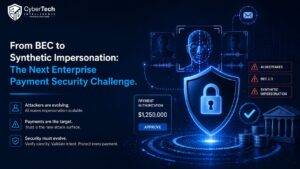

Enterprise payment fraud has traditionally relied on a simple weakness: trust.
An employee receives an urgent message that appears to come from an executive. A supplier requests a change to banking details. A finance team is asked to accelerate an important payment. When the communication appears legitimate and the request fits an established business relationship, normal processes can become easier to bypass.
Business email compromise (BEC) has industrialized this form of deception. Artificial intelligence is now making it considerably harder to recognize.
Generative AI allows attackers to reproduce writing styles, create convincing identities, clone voices, generate realistic video, and personalize fraudulent communications using information gathered from public and compromised sources. Instead of merely taking over an email account, an adversary can attempt to recreate the person the victim expects to see or hear.
That changes the enterprise payment security problem.
Organizations can no longer assume that a familiar voice, a convincing video call, a recognizable writing style, or an apparently legitimate message provides sufficient proof of identity. Payment authorization increasingly requires organizations to independently verify the transaction, identity, context, and approval path, regardless of the communication that initiated the request.
The next phase of BEC defense is therefore not simply better email filtering. It is rebuilding trust across the entire payment authorization process.
Why Traditional BEC Controls Are Being Challenged
Conventional BEC attacks commonly rely on account compromise, domain impersonation, fraudulent invoices, executive impersonation, or manipulation of existing email conversations.
Organizations have responded with email security, employee awareness training, multi-factor authentication, transaction limits, and approval workflows.
These controls remain important.
The problem is that generative AI improves the attacker’s ability to manipulate the human layer surrounding those controls.
An attacker researching an organization can potentially use publicly available information to understand:
- Executive roles
- Reporting relationships
- Suppliers and business partners
- Corporate terminology
- Upcoming events or transactions
- Employee communication styles
- Organizational changes
AI can then help turn those fragments into highly contextual social engineering.
A fraudulent request no longer needs to read like an obvious phishing message. It can reference a legitimate project, mimic an executive’s tone, appear during a plausible business situation, and create exactly the urgency required to influence an employee’s decision.
Synthetic Impersonation Changes What Identity Means
The central challenge is that many signals people instinctively use to establish trust are becoming reproducible.
Voice Is No Longer Strong Proof of Identity
A phone call from a familiar executive once provided additional confidence when an unusual payment request needed confirmation.
Voice cloning weakens that assumption.
If an attacker can convincingly imitate a known person’s speech, calling the number supplied within the suspicious communication may provide little additional assurance.
Organizations need verification processes that do not depend entirely on the channel being used to make the request.
Video Does Not Automatically Establish Authenticity
Video communication has traditionally felt more trustworthy than text because participants can see the person requesting an action.
Deepfake technologies challenge that perception.
The practical lesson for enterprises is not that every video call should be considered fraudulent. It is that appearance alone should not authorize high-risk financial actions.
Sensitive transactions need controls that remain effective even when visual and audio signals can be manipulated.
Writing Style Is Becoming Easier to Replicate
Many employees identify suspicious messages because they “do not sound like” the supposed sender.
Generative AI reduces the usefulness of that signal.
With enough legitimate material, AI can produce communications that approximate vocabulary, tone, sentence structure, and business terminology associated with a particular person or organization.
Grammar quality and writing style therefore cannot function as primary fraud controls.
The Core Principles of Modern Payment Security
Defending against synthetic impersonation requires enterprises to shift from recognizing fake communications toward independently validating sensitive actions.
Separate Payment Verification From the Request
High-risk payment requests should be confirmed through an independently established channel.
If a message requests new banking details, employees should verify the change using contact information already stored in trusted enterprise systems rather than phone numbers or links supplied in the request itself.
This creates an important separation between the person asking for the transaction and the mechanism used to prove the request is legitimate.
Strengthen Controls Around Payment Changes
Changes to established payment information deserve particular scrutiny.
Organizations should consider stronger verification for events such as:
- New supplier bank accounts
- Changes to existing payment details
- Unusually large transfers
- First-time recipients
- Unexpected international payments
- Requests that bypass normal approval timelines
The objective is not to introduce friction into every transaction. It is to increase assurance when contextual risk changes.
Require Independent Authorization
AI impersonation becomes more powerful when one compromised employee can authorize a sensitive action.
High-value or unusual transactions should require appropriately separated approvals.
Dual authorization, role separation, transaction thresholds, and independent confirmation can prevent a convincing impersonation from becoming a completed fraudulent payment.
Use Behavioral Context Alongside Identity
A valid identity does not necessarily mean an activity is trustworthy.
Organizations should evaluate contextual signals surrounding payment activity, including unusual timing, changes in transaction behavior, unexpected recipients, device characteristics, geographic anomalies, and deviations from normal approval patterns.
Combining identity and transaction context provides stronger protection than relying on authentication alone.
BEC 2.0 Is Also an Identity Security Problem
Modern BEC increasingly overlaps with enterprise identity security.
Attackers may compromise an actual account before introducing synthetic impersonation into the attack. A legitimate mailbox gives them access to internal conversations, relationships, invoices, signatures, and business context that can make later deception far more convincing.
Organizations therefore need to secure the identities surrounding financial workflows.
That includes:
- Strong authentication
- Privileged access management
- Identity threat detection
- Session monitoring
- Rapid account containment
- Least-privilege access
- Protection for finance and executive accounts
The strongest payment authorization process can still face significant pressure if attackers have persistent access to trusted identities and communications.
Industry Spotlight: Business Services
Business services organizations often manage payment relationships across clients, consultants, suppliers, contractors, and external partners.
These distributed relationships create opportunities for impersonation because finance teams may regularly receive legitimate requests involving invoices, account details, contracts, and payment changes.
AI-generated communications can make fraudulent requests appear consistent with existing business conversations.
Business services organizations can reduce this exposure by establishing independent verification for payment-detail changes, separating financial approval responsibilities, strengthening protection around executive and finance identities, and training employees to recognize that professional-looking communications are no longer evidence of authenticity.
Industry Spotlight: Logistics & Supply Chain
Logistics and supply chain operations depend on large networks of suppliers, carriers, distributors, service providers, and procurement teams.
Payment information can change as vendors, routes, contracts, and business relationships evolve. Attackers can exploit this complexity by impersonating suppliers or manipulating communications around legitimate transactions.
A convincing request to update banking information may appear operationally routine.
For logistics organizations, strong payment security requires trusted supplier records, independent verification of account changes, transaction monitoring, and clear escalation procedures for unusual requests.
The goal is to ensure that supply chain complexity does not become a shortcut around financial controls.
Why Employee Awareness Alone Cannot Solve the Problem
Employee training remains essential, but organizations should be careful about making people the final fraud detection system.
AI-generated deception will continue becoming more convincing.
Even well-trained employees can make mistakes when a request appears authentic, arrives during a busy period, references legitimate information, and creates credible urgency.
Security architecture should assume that some deceptive communications will reach employees.
The stronger question is:
What prevents a convincing fake from becoming an authorized payment?
The answer should come from layered controls rather than individual intuition.
Building a Synthetic-Impersonation-Resistant Payment Process
Organizations should review payment authorization from the attacker’s perspective.
A practical strategy should prioritize:
- Mapping high-risk financial workflows
- Identifying employees capable of initiating and approving payments
- Strengthening security around finance and executive identities
- Requiring independent verification for payment-detail changes
- Establishing transaction thresholds for additional approval
- Separating initiation and authorization responsibilities
- Monitoring abnormal payment behavior
- Creating clear procedures for urgent executive requests
- Testing deepfake and BEC scenarios through security exercises
- Establishing rapid processes for stopping or recalling suspicious transactions
Cybersecurity, finance, procurement, risk, and executive leadership should participate in this process.
Synthetic impersonation sits between cybersecurity and financial controls, which means neither function can manage the risk effectively in isolation.
The Future of Enterprise Payment Security
Generative AI will continue reducing the cost of sophisticated impersonation.
Attackers will be able to combine information from compromised accounts, public sources, social networks, voice samples, organizational websites, and previous communications to construct increasingly credible scenarios.
Defensive capabilities will evolve as well.
Enterprise payment security will increasingly incorporate:
- Continuous identity risk assessment
- Behavioral transaction analytics
- Deepfake detection
- Communication authenticity signals
- Risk-adaptive approval workflows
- Automated anomaly detection
- Stronger machine-verifiable authorization
Yet technology alone will not solve the problem.
Enterprises need payment processes designed around the assumption that human-facing signals can be fabricated.
Final Thoughts
Business email compromise taught enterprises that an email address could not always be trusted.
Synthetic impersonation is forcing organizations to confront a more difficult reality: a familiar face, recognizable voice, convincing writing style, and apparently legitimate identity may no longer provide enough evidence either.
That does not mean digital business must operate without trust.
It means trust must become harder to fake.
Modern payment security should independently validate sensitive requests, strengthen identity protection, evaluate transaction context, and require additional assurance when financial risk increases.
The organizations best prepared for BEC 2.0 will not be those expecting employees to identify every deepfake. They will be the ones that design payment workflows capable of remaining secure even when the impersonation looks real.