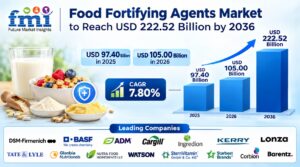

The global food fortifying agents market is expanding rapidly, transitioning from an elective product differentiation strategy into a public health and preventive wellness foundation, according to latest insights by Future Market Insights. Driven by government-mandated staple food fortification programs (targeting iron, folic acid, vitamin A, and vitamin D in flour, cooking oil, rice, and milk), expanding voluntary industry reformulations, and consumer demand for targeted functional wellness, nutrient-enrichment solutions are scaling across global food processing operations.
The global market, valued at USD 97.40 billion in 2025, is projected to reach USD 105.00 billion in 2026. Advancing at a Compound Annual Growth Rate (CAGR) of 7.80% over the ten-year forecast period, total market valuation is anticipated to achieve USD 222.52 billion by 2036, delivering an absolute incremental opportunity of USD 117.52 billion.
Request a Sample Report: https://www.futuremarketinsights.com/reports/sample/rep-gb-25875
Market Performance Overview (2026–2036)
To map out the leading nutrient types, target health benefit applications, core delivery sectors, and regional growth vectors guiding this USD 117.52 billion market expansion, key segment allocations highlight where global commercial demand is concentrated:
- Vitamins Type Segment (31.7% share): Commands the nutrient type category in 2026, driven by the global standardization of vitamins A, D, C, and B-complex (especially folic acid and B12) in mandatory national food security and voluntary functional food programs.
- Minerals, Amino Acids, & Fatty Acids (68.3% combined share): Represent high-volume secondary nutrient pillars, targeting electrolyte balance, protein density, and cardiovascular/cognitive support (e.g., calcium, zinc, iron, and omega-3 DHA/EPA).
- Bone Health Benefit Segment (26.5% share): Leads health outcome demand in 2026, driven by calcium and vitamin D fortification in dairy, plant-based milk alternatives, and fortified breakfast cereals to mitigate osteoporosis in aging populations.
- Dietary Supplements Application Segment (37.9% share): Represents the largest single commercial demand pool, utilizing fortifying agents across gummies, effervescent tablets, powders, and specialized capsules.
- Dairy, Cereals, & Grains Sectors: Form the primary staple food fortification cluster, supported by legal mandates in the United States, United Kingdom, and India requiring micronutrient restoration in flours and dairy liquids.
- China & India Regional Leadership: Lead national expansion rates at 50% CAGR and 9.80% CAGR respectively through 2036, driven by national malnutrition reduction initiatives, expanding middle-class wellness spending, and rapid formalization of packaged food production.
Technical Drivers and Formulation Shifts
The commercial scaling and diversification of food fortifying agents across food manufacturing are propelled by three primary industry catalysts:
Mandatory Government Public Health Programs
National governments and international bodies (WHO, Food Fortification Initiative) mandate the addition of essential micronutrients to staple foods to combat widespread hidden hunger. Mandatory fortification of wheat flour with folic acid/iron, edible oils with vitamins A and D, and salt with iodine creates an inelastic, high-volume baseline demand for certified fortifying premixes.
Microencapsulation and Sensory Stability Technologies
A historical hurdle in food fortification has been organoleptic degradation—such as metallic off-tastes from iron, color oxidation from vitamin C, or rancidity from omega-3 fatty acids. Advances in lipid microencapsulation, spray-chilling, and cyclodextrin complexation protect sensitive micronutrients from thermal degradation during processing while preventing flavor and color alterations in finished food matrices.
Clean-Label and Bioavailable Sourcing
Consumers increasingly scrutinize product declarations for natural, bio-available sources of vitamins and minerals. Formulators are adopting fermentation-derived vitamins, plant-extracted minerals, and chelated trace elements (such as zinc and iron bisglycinates) to support “whole-food” and clean-label packaging claims without causing gastrointestinal irritation.
Industrial Constraints & Formulation Challenges
Food processors, vitamin premix blenders, and procurement managers navigate specific operational hurdles:
- Regulatory Dossier Harmonization Across Borders: Inconsistent micronutrient maximum allowable limits (MAL) and varying daily value (DV) standards between regulatory jurisdictions (US FDA, EFSA, FSSAI, China SAMR) force multinational CPG brands to maintain region-specific SKU formulations.
- Thermal and Processing Degradation Losses: High-temperature processing (extrusion, baking, UHT pasteurization) degrades heat-sensitive vitamins (e.g., vitamin C, thiamine, vitamin A), requiring formulators to engineer precise overages to ensure labeled potency throughout product shelf life.
Regional Growth Profile
Regional demand reflects intensive public health modernization and packaged food growth in Asia alongside mature preventive wellness consumption in Western markets:
- China (10.50% CAGR): The global growth frontrunner, driven by state-backed nutrition improvement programs, expanding domestic dairy processing, and high consumer willingness to pay for functional, clean-label fortified foods.
- India (9.80% CAGR): Spurring rapid volume expansion through government-enforced fortification of edible oils, milk, and rice kernels (+F logo compliance) alongside rising middle-class demand for fortified packaged staples.
- Germany (9.00% CAGR) & France (8.20% CAGR): Lead European demand, supported by an aging demographic seeking bone and joint health nutrition, strict EFSA-compliant clean-label formulations, and the expansion of fortified plant-based dairy substitutes.
- United Kingdom (7.40% CAGR): Driven by mandatory grain fortification policies, retailer private-label functional foods, and active lifestyle wellness supplementation.
- United States (6.60% CAGR): Represents a mature, high-value demand center focused on clean-label gummy supplements, functional beverages, and personalized micronutrient premixes.
- Brazil (5.90% CAGR): Expanding through regional public health staple enrichment and modernizing cereal processing infrastructure.
Competitive Landscape
The global food fortifying agents landscape is highly concentrated among multinational nutrition conglomerates, specialized vitamin/mineral premixers, and industrial biotechnology developers.
Key market participants profiled in the report include DSM-Firmenich, BASF SE, Archer Daniels Midland Company (ADM), Cargill, Incorporated, Ingredion Incorporated, Kerry Group, Lonza Group, Tate & Lyle PLC, Glanbia Nutritionals, Nutra Food Ingredients LLC, Watson Inc., SternVitamin GmbH & Co. KG, Starbest Brands, Corbion, and Barentz. Leading suppliers compete by providing customized all-in-one nutrient premixes, advanced microencapsulation technologies, and global regulatory affairs support to de-risk multi-jurisdiction product launches.
Exclusive Discounts on Full Report: https://www.futuremarketinsights.com/reports/food-fortifying-agents-market
Frequently Asked Questions
What is the projected valuation of the global food fortifying agents market by 2036?
The global food fortifying agents market is projected to reach USD 222.52 billion by 2036, expanding from an estimated baseline valuation of USD 105.00 billion in 2026 at a CAGR of 7.80%.
Why does the Vitamins segment lead with a 31.7% share?
Vitamins dominate the type category in 2026 because vitamins A, D, C, and B-complex are universally incorporated across mandatory staple food enrichment laws (flour, oil, milk) and high-growth voluntary dietary supplements.
What health benefit category holds the largest share of the market?
Bone health leads with a 26.5% market share in 2026, driven by global demand for calcium, vitamin D, and magnesium fortification across dairy products, plant milks, and nutritional supplements aimed at preventing osteoporosis.
FMI Custom Research: Strategic Intelligence for Confident Decision-Making
In today’s rapidly evolving business environment, leadership teams need clear, actionable intelligence tailored to their strategic objectives. FMI’s Custom Research solutions are designed around specific business questions, enabling executives to evaluate growth opportunities, validate investments, assess competitive dynamics, and reduce uncertainty before making critical decisions.
Key Executive Benefits
- Decision-Ready Insights: Research tailored to your specific business challenges, growth plans, and investment priorities.
- Reduced Strategic Risk: Validate market opportunities, customer demand, and competitive positioning before committing resources.
- Market Entry Confidence: Assess opportunity size, regulatory barriers, channel dynamics, and competitive landscapes with precision.
- Competitive Advantage: Gain proprietary intelligence unavailable through syndicated reports or internal datasets.
- Faster Growth Decisions: Accelerate expansion, product development, portfolio optimization, and investment planning.
- Primary Market Validation: Access real-world customer, buyer, and stakeholder insights that support high-confidence decision-making.
Business Impact
FMI helps organizations transform market complexity into strategic clarity, enabling leadership teams to identify growth opportunities faster, optimize resource allocation, strengthen competitive positioning, and make high-stakes business decisions with confidence.
To explore how FMI Custom Research can support your strategic priorities, connect with our team at – sales@futuremarketinsights.com
About Future Market Insights (FMI)
Future Market Insights (FMI) delivers actionable, decision-focused market intelligence that goes beyond traditional research reports. The company provides:
- In-depth pricing and cost benchmarking analysis
- Demand forecasting based on real industry inputs
- Procurement and buyer behavior insights
- Supply chain and trade flow intelligence
- Technology and application trend analysis across industries
FMI follows a robust bottom-up research methodology, combining insights from industry experts, procurement leaders, manufacturers, and technical professionals to ensure accurate and practical market intelligence.