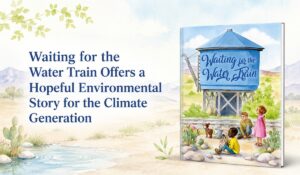

New Picture Book Gives Children an Honest but Hopeful Introduction to Water Scarcity
As conversations about climate change, drought, and water shortages become increasingly common, families and educators are searching for age-appropriate ways to help children understand these complex issues without creating unnecessary fear. Waiting for the Water Train, written by Virginia De Francisco and illustrated by Svitlana Holovchenko, answers that need with a hopeful picture book that combines environmental education, community resilience, and practical conservation lessons.
Inspired by life in a desert community where weekly water deliveries became a necessity after local groundwater supplies failed, the story follows young Emma as she learns that water is far more precious than she once believed.
Although Emma’s experience is rooted in a historical setting, the issues explored throughout the book remain remarkably relevant today.
Communities around the world continue to face water shortages caused by drought, growing populations, aging infrastructure, and groundwater depletion. In many regions, underground aquifers are being used faster than nature can replenish them. Climate conditions are placing additional pressure on already limited freshwater resources, while some households still rely upon trucked or transported water for everyday living.
For today’s children, these realities often appear in classroom discussions, news reports, and community conversations. Yet the topic can feel overwhelming when presented without hope.
Waiting for the Water Train takes a different approach.
Rather than denying the seriousness of water scarcity, the story presents its challenges honestly while emphasizing that cooperation, preparation, and thoughtful choices can make a meaningful difference.
Emma first experiences the consequences of taking water for granted when her community’s well begins pumping mud instead of fresh water. Families suddenly find themselves waiting anxiously for the weekly water train that has become the town’s only dependable source of clean water.
The story acknowledges uncertainty without becoming frightening.
Neighbors support one another. Families share limited supplies responsibly. A neighboring community helps deliver emergency relief through the arriving train. Children witness adults making calm, practical decisions instead of responding with panic.
Most importantly, Emma herself changes.
She recognizes the impact of her earlier habits and develops a lasting appreciation for every drop of water. Her personal transformation demonstrates that education can inspire meaningful action, giving young readers confidence that their own daily choices matter.
The book encourages children to become active participants in conservation rather than passive observers of environmental problems.
Readers are invited to think about where their household water comes from, why groundwater deserves protection, and how simple habits—such as turning off faucets, using only what is needed, and avoiding unnecessary waste—can benefit entire communities.
These lessons align naturally with many school sustainability initiatives, including water conservation campaigns, Earth Day activities, environmental science instruction, service-learning projects, and classroom discussions about responsible citizenship.
The story also broadens children’s understanding of environmental responsibility by showing that water supports entire ecosystems. Families depend upon clean water for health and sanitation. Pets require daily care. Wildlife survives through healthy habitats. Plants and gardens need careful stewardship. Every living thing shares the same limited natural resources.
Svitlana Holovchenko’s richly detailed watercolor illustrations reinforce these themes by filling every page with desert wildlife, flowering cacti, expansive landscapes, and moments of quiet community resilience. Readers are encouraged to slow down, observe carefully, and appreciate both the beauty and fragility of desert life.
Because the story combines literacy, science, geography, environmental stewardship, and social-emotional learning, Waiting for the Water Train offers exceptional flexibility across educational settings.
Schools can incorporate the book into conservation units and climate education lessons. Libraries may feature it during Earth Day programming, family literacy events, or summer reading initiatives. Environmental organizations and nonprofit groups can use the story to introduce younger audiences to water stewardship through an encouraging and accessible narrative.
Parents will also appreciate that the book offers opportunities for meaningful conversations about environmental responsibility without leaving children feeling discouraged or powerless.
Instead, readers finish the story understanding that every thoughtful action contributes to healthier communities and a stronger future.
In a time when environmental topics often seem overwhelming, Waiting for the Water Train reminds children that hope grows through education, cooperation, compassion, and responsible choices.
Review copies, classroom resources, author interviews, environmental event participation, Earth Day programming, educational partnerships, library appearances, conservation campaign collaborations, and media interviews are now available. Waiting for the Water Train is available through major booksellers and retailers wherever children’s books are sold.
Contact:
Amazon: Waiting for the Water Train
Author: Virginia De Francisco
https://www.facebook.com/profile.php?id=61591557835010#