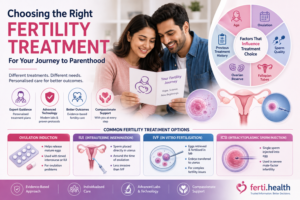

Choosing the right fertility treatment can feel overwhelming, particularly when couples encounter terms such as IVF, IUI, ICSI and ovulation induction for the first time.
The important point is that there is no single fertility treatment suitable for everyone.
Treatment is generally selected according to the cause of infertility, age, ovarian reserve, sperm parameters, medical history and previous treatment outcomes.
Ferti.health provides educational guides covering several fertility treatment options, including IVF, IUI and ovulation induction, with explanations of who may benefit from each approach.
What Is Fertility Treatment?
The term fertility treatment covers a broad range of medical approaches designed to improve the likelihood of pregnancy.
Some treatments are relatively simple, while others involve advanced assisted reproductive technology.
Common options include:
- Ovulation induction
- Timed intercourse
- IUI
- IVF
- ICSI
- Embryo transfer
- Fertility preservation
The appropriate option depends on the underlying fertility concern.
Ovulation Induction
Ovulation induction may be considered when irregular or absent ovulation is contributing to infertility.
Medications such as letrozole or clomiphene may be used under medical supervision to encourage ovulation.
Ferti.health explains that ovulation induction aims to produce a small number of mature eggs and may be combined with timed intercourse or IUI.
This approach differs from IVF stimulation, where the objective is usually to develop multiple follicles for egg retrieval.
What Is IUI?
Intrauterine insemination, or IUI, is another type of fertility treatment.
During IUI, prepared sperm is placed directly inside the uterus around the time of ovulation.
IUI may be considered in situations such as:
- Mild male-factor infertility
- Unexplained infertility
- Ovulation problems
- Use of donor sperm
- Certain cervical-factor concerns
The treatment is less invasive than IVF but is not appropriate for every patient.
What Is IVF?
In-vitro fertilisation is an advanced form of fertility treatment in which eggs are retrieved from the ovaries and fertilised with sperm in a laboratory.
After fertilisation and embryo development, an embryo may be transferred into the uterus.
IVF may be considered when:
- Fallopian tubes are blocked
- Male-factor infertility is significant
- Other fertility treatments have failed
- Certain age-related fertility factors exist
- Some cases of endometriosis are present
- Specific reproductive circumstances require assisted reproduction
IVF vs IUI
|
Factor |
IUI |
IVF |
|
Fertilisation |
Inside body |
Laboratory |
|
Egg retrieval |
No |
Yes |
|
Embryo creation |
No |
Yes |
|
Invasiveness |
Lower |
Higher |
|
Typical complexity |
Lower |
Higher |
|
Laboratory involvement |
Limited |
Extensive |
The decision should be based on medical suitability rather than simply choosing the treatment with the highest perceived success.
How Is the Right Fertility Treatment Selected?
Doctors generally consider several factors before recommending treatment.
These include:
Age: Age can influence treatment urgency and expected outcomes.
Ovulation: Irregular ovulation may make ovulation induction appropriate.
Sperm parameters: Semen analysis helps identify male-factor infertility.
Fallopian tubes: Tubal blockage can significantly affect the suitability of timed intercourse or IUI.
Ovarian reserve: Tests such as AMH and antral follicle count can contribute to treatment planning.
Previous treatment: The outcome of previous fertility treatment can influence the next step.
Why Diagnosis Matters
Different fertility conditions require different approaches.
For example, Ferti.health notes that blocked fallopian tubes can prevent sperm and egg from meeting naturally, while PCOS can interfere with regular ovulation.
This illustrates why fertility treatment should not be selected based solely on general internet advice.
When Should Couples Seek Fertility Advice?
People should consider speaking with a fertility specialist when conception is taking longer than expected or when there is a known fertility concern.
Earlier evaluation may be particularly important when there are:
- Irregular periods
- Known PCOS
- Endometriosis
- Previous pelvic surgery
- Suspected tubal problems
- Abnormal semen analysis
- Reduced ovarian reserve
- Increasing reproductive age
Frequently Asked Questions
Is IVF the first fertility treatment?
Not always. Depending on the diagnosis, doctors may initially recommend ovulation induction, timed intercourse or IUI.
Is IUI better than IVF?
Neither is universally better. They are different treatments designed for different circumstances.
Can fertility treatment guarantee pregnancy?
No fertility treatment can guarantee pregnancy. Outcomes depend on individual medical and reproductive factors.
Final Thoughts
The right fertility treatment depends on why pregnancy has not occurred and the individual’s overall reproductive profile.
Understanding the differences between ovulation induction, IUI and IVF can help couples have more productive discussions with their fertility specialists.
Evidence-based resources such as Ferti.health can also help patients understand treatment terminology, expected processes, potential costs and questions to ask before beginning treatment.
Quick Answer: Fertility treatment includes several approaches ranging from ovulation induction and IUI to IVF and ICSI. The most appropriate treatment depends on factors such as age, ovulation, sperm quality, fallopian tube health and previous treatment history.