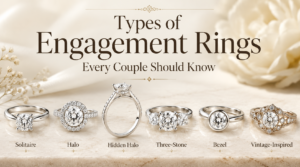

Shopping for an engagement ring becomes much easier once you know what the different styles actually mean. Some rings keep all the attention on one beautiful center stone, while others add halos, side stones, or detailed bands for extra sparkle. Understanding the most popular Types of Engagement Rings can help you find a design that fits your style, daily routine, budget, and future wedding band.
What Are the Main Types of Engagement Rings?
Engagement rings can look very different even when they use the same center stone. The setting, number of stones, band design, and small decorative details all influence the final appearance.
A solitaire feels simple and timeless. A halo creates more sparkle around the center. A three-stone ring gives you a wider look across the finger, while vintage and nature-inspired rings focus more on decorative details.
There is no single style that works for everyone. The best choice is usually the one that feels comfortable to wear and still looks like you years from now.
1. Solitaire Engagement Rings
A solitaire is probably the first design many people picture when they think of an engagement ring. It features one main stone and keeps the rest of the design relatively simple.
Because there are fewer distractions around the center, the shape and sparkle of the main stone become the focus. Round, oval, pear, cushion, emerald, radiant, and marquise stones can all look beautiful in solitaire settings.
Best for:
Couples who like clean, classic, and versatile jewelry.
Solitaire rings are also easy to personalize. You can choose a plain band for a minimal look or add subtle details such as a hidden halo or small pavé stones without changing the overall simplicity.
2. Halo Engagement Rings
A halo setting places a border of smaller stones around the main center stone. Those smaller stones add extra brilliance and can make the center appear more prominent on the finger.
Halos work especially well when you want a ring with plenty of sparkle from the top view. They can surround round, oval, pear, cushion, emerald, and many other center shapes.
A traditional halo is easy to notice, so it usually has a more glamorous appearance than a simple solitaire.
Best for:
Someone who wants noticeable sparkle and a center stone that has more visual presence.
3. Hidden Halo Engagement Rings
Love the clean look of a solitaire but still want an extra detail? A hidden halo may give you both.
Instead of surrounding the center stone from the top, a hidden halo places small accent stones underneath it. From above, the ring can still appear simple. Turn it to the side and you see an extra line of sparkle below the center stone.
This is one of the Types of Engagement Rings that works especially well for someone who likes subtle details rather than an obvious halo.
Best for:
Modern styles with a little surprise sparkle from the side.
4. Pavé Engagement Rings
With a pavé ring, small stones are set closely along the band to create a continuous sparkling effect.
The center stone is still the main attraction, but the pavé band gives the entire ring more brilliance. This can make even a simple center setting look more detailed and luxurious.
You may see pavé combined with solitaire, halo, hidden halo, and other styles, so it is less about the number of center stones and more about how the band is decorated.
If you are comparing different women’s engagement rings, think about whether you prefer sparkle across the entire design or want the center stone to receive most of the attention.
5. Three-Stone Engagement Rings
A three-stone engagement ring places one main stone in the center with a smaller stone on each side.
The extra stones provide more coverage across the finger and create a balanced appearance without completely surrounding the center like a halo.
Many couples also like the romantic meaning associated with the design. The three stones are commonly used to represent a couple’s past, present, and future together.
The side stones do not always need to match the center. An oval center can be paired with pear-shaped sides, while an emerald-cut center can look elegant with tapered stones beside it.
Best for:
Couples who want symbolism, extra sparkle, and a fuller look.
6. Bezel Engagement Rings
A bezel setting uses a thin rim of metal around all or part of the center stone instead of relying only on visible prongs.
The result is smooth, clean, and modern. Because more of the stone’s outer edge is surrounded by metal, a bezel can also provide additional protection during everyday wear.
This design is worth considering if you work with your hands frequently or simply prefer a ring with fewer raised details.
Bezel settings look especially attractive with round, oval, emerald, and other clean stone shapes.
Best for:
Active lifestyles and people who prefer a modern, streamlined design.
7. Side-Stone Engagement Rings
Side-stone rings add smaller gems around the center stone, usually along the shoulders of the band.
Unlike a three-stone ring, which normally has two clearly defined side stones, this style may include several smaller stones leading away from the center.
The additional stones can add brightness while helping the center stone blend naturally into the band.
Side-stone settings are a good middle ground if a solitaire feels too simple but a full halo feels more detailed than you want.
8. Vintage-Inspired Engagement Rings
Vintage-inspired rings are all about small details. They may include milgrain edges, engraved patterns, decorative halos, filigree, floral elements, or unusual stone arrangements.
Some designs take inspiration from Victorian, Edwardian, Art Deco, and other historic jewelry periods without actually being antique rings.
Because the details are more noticeable, vintage-inspired rings can feel more individual than a simple modern setting.
Best for:
Someone who loves romantic details, old-world character, and jewelry that feels different from standard modern designs.
9. Cathedral Engagement Rings
Look at a cathedral ring from the side and you will notice metal arches rising from the band toward the center stone.
These arches help support the center setting and create a more dramatic profile. The name comes from their resemblance to architectural cathedral arches.
A cathedral setting can be simple or highly detailed. Some designs use a plain polished band, while others add pavé stones or a hidden halo.
Among the different Types of Engagement Rings, cathedral settings are a good choice when you want the center stone to sit more prominently above the band.
10. Split-Shank Engagement Rings
A split-shank ring begins with a regular band and divides into two sections as it approaches the center stone.
The open space makes the top of the ring look wider and adds visual interest without necessarily adding more stones.
Some split-shank rings feature plain metal, while others cover both sections with pavé accents for a more sparkling finish.
The style can work particularly well with larger or elongated center stones because the wider top provides visual balance.
Best for:
A statement look that still feels elegant rather than overly decorative.
11. Nature-Inspired Engagement Rings
Nature-inspired rings move away from perfectly straight lines and traditional band designs.
Instead, you may see details shaped like leaves, vines, petals, branches, or flowers. Small stones can also be placed in patterns that resemble natural elements.
Some nature-inspired settings are delicate and subtle, while others use detailed botanical patterns throughout the entire band.
These rings are a beautiful option for someone who wants the engagement ring to feel more artistic and personal.
12. Cluster Engagement Rings
Instead of using one large center stone, a cluster engagement ring groups several smaller stones together to create a larger focal point.
Clusters can be symmetrical, floral, geometric, or completely unique depending on the design.
Because the stones work together visually, the ring can have impressive coverage without relying entirely on one large gemstone.
Best for:
Someone who likes unconventional designs and wants something noticeably different from a traditional solitaire.
13. Toi et Moi Engagement Rings
Toi et Moi rings use two main stones placed together instead of one.
The French name translates to “you and me,” which gives the two-stone design a romantic meaning.
One of the most interesting parts of this style is the ability to combine different shapes. You might pair an emerald cut with a pear shape, an oval with a round stone, or use two complementary gemstones.
It is one of the more distinctive Types of Engagement Rings for couples who want to move beyond the traditional single-center-stone design.
Which Engagement Ring Style Gives the Most Sparkle?
If sparkle is your main priority, halo and pavé settings are good places to start because they include multiple smaller stones around the center or band.
Three-stone and side-stone designs can also create plenty of brilliance while offering a different overall shape.
A solitaire has fewer accent stones, but that does not mean it cannot sparkle beautifully. A well-cut center stone can still become the main visual focus of the entire ring.
Instead of simply choosing the ring with the most stones, think about where you want the sparkle to appear.
Which Engagement Ring Is Best for Everyday Wear?
Your daily routine matters more than many people realize.
If you regularly work with your hands, exercise frequently, wear gloves, or have an active lifestyle, you may prefer a lower-profile setting or a bezel design.
If your lifestyle allows for a more elevated ring, cathedral, halo, and traditional prong settings give you additional style options.
Also consider how easily the ring can be cleaned and whether small stones or raised details fit comfortably into your routine.
A beautiful ring should not become something you are afraid to wear.
Think About Your Wedding Band Before Choosing
Your engagement ring and wedding band will eventually be worn together, so it helps to think about the final combination from the beginning.
Some engagement ring settings leave enough space underneath the center stone for a straight wedding band to sit closely beside them. Lower or more detailed settings may leave a small gap and work better with a curved or contoured band.
Before deciding on your final setting, see how it may pair with different luxury wedding bands. A little planning now can make your future ring stack feel much more balanced.
How to Choose Between the Different Types of Engagement Rings
Instead of trying to find the style everyone else is buying, start with a few simple questions.
-
Do you prefer minimal or detailed jewelry?
-
How much sparkle do you want?
-
Do you use your hands heavily during the day?
-
Do you want a straight wedding band to sit beside the ring?
-
Which center stone shape do you love most?
-
Do you prefer classic, vintage, romantic, or modern designs?
Your answers can quickly narrow down the Types of Engagement Rings that make sense for you.
Someone who values simplicity may naturally move toward a solitaire. Someone who loves sparkle may prefer pavé or halo details. A person with an active lifestyle may appreciate a bezel, while someone looking for something artistic might choose a nature-inspired or vintage design.
Final Thoughts
There are many Types of Engagement Rings, but you do not need to love every style to find the right one. Start with the overall look you want, then think about comfort, stone security, sparkle, your lifestyle, and how the ring will pair with a future wedding band.
At Venust Diamonds, an engagement ring should feel personal rather than simply fashionable. Whether you prefer a classic solitaire, a sparkling hidden halo, a meaningful three-stone design, or something completely unconventional, the best choice is the ring that continues to feel like your style every time you wear it.