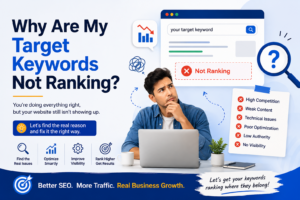

Why Are My Target Keywords Not Ranking?
You’ve chosen the right keywords. You’ve created dedicated pages. You’ve added keywords to your titles, headings, and content. Yet, when you search Google, your website is nowhere near the first page.
Sound familiar?
This is one of the most common frustrations businesses face with SEO. The problem is that adding a keyword to a page doesn’t automatically make it rank. Google looks at many signals before deciding which pages deserve visibility.
If your target keywords are not ranking, there could be several reasons behind it. Let’s look at the most common ones and what you can actually do about them.
1. You’re Targeting Keywords That Are Too Competitive
One of the first things to check is keyword difficulty.
If you’re a relatively new business or your website doesn’t have much authority yet, targeting highly competitive keywords can make ranking extremely difficult.
For example, a new website targeting a broad keyword such as “digital marketing” is competing against established agencies, publishers, and high-authority websites.
Instead, you could start with more specific, location-based, or intent-focused keywords.
For a Chennai business, targeting terms related to your actual services and audience can be a much more practical starting point.
The goal isn’t simply to target keywords with high search volume. You need to target keywords where your business has a realistic opportunity to compete.
2. Your Content Doesn’t Match Search Intent
This is a big one.
Google doesn’t rank a page simply because it contains the target keyword. It wants to show users content that actually answers what they are looking for.
Think about what someone means when they search for a keyword.
Are they:
-
Looking for information?
-
Comparing different services?
-
Looking for a company?
-
Ready to make a purchase?
-
Searching for a local business?
For example, someone searching “how SEO works” probably wants an educational guide.
Someone searching “SEO Agency in Chennai” is likely looking for an agency that can provide SEO services.
If your page doesn’t satisfy that intent, ranking becomes much harder.
Before creating content, search your target keyword on Google and look at the type of pages currently ranking. This gives you a useful idea of what Google considers relevant for that search.
3. Your Content Is Too Generic
Another common problem is creating content that sounds good but doesn’t provide anything particularly useful.
Imagine searching for:
“How can SEO increase leads?”
If every article gives the same basic advice—use keywords, create content, build backlinks, improve your website—it doesn’t give the reader much reason to stay.
Your content needs to bring something useful to the table.
That could include:
-
Real examples
-
Practical steps
-
Common mistakes
-
Industry-specific advice
-
Clear explanations
-
FAQs
-
Original insights
-
Solutions to actual customer problems
Think beyond “What keyword should I use?”
Instead, ask:
“What does my potential customer actually need to know?”
That shift can make your content much stronger.
4. Your Website Has Technical SEO Problems
Sometimes the content is perfectly good, but Google is struggling to crawl, understand, or index the page.
Technical issues can include:
-
Pages accidentally blocked from search engines
-
Incorrect canonical tags
-
Poor internal linking
-
Slow page performance
-
Mobile usability problems
-
Broken links
-
Duplicate content
-
Incorrect redirects
-
Indexing issues
If your target page isn’t properly indexed, it obviously won’t rank.
This is why SEO isn’t only about writing blogs and adding keywords. Your website’s technical foundation matters too.
Regularly checking Google Search Console can help identify indexing and performance issues that may otherwise go unnoticed.
5. You’re Not Building Enough Topical Authority
One page rarely establishes your website as an expert on an entire subject.
Suppose you want to rank for a major service keyword. Creating one service page and expecting it to rank immediately may not be enough.
You can strengthen the topic by creating supporting content around related questions and subtopics.
For example, if your main service is digital marketing, supporting content could cover topics such as:
-
How digital marketing generates leads
-
SEO vs paid advertising
-
Common digital marketing mistakes
-
How long SEO takes
-
How to measure digital marketing ROI
-
Local SEO strategies for businesses
These pages can be internally linked to your main service page.
Over time, this creates a stronger content structure and helps search engines understand the topics your website covers.
6. Your Internal Linking Is Weak
Internal links are often overlooked.
When you publish a new blog, don’t leave it sitting alone on your website.
Link it to relevant service pages, category pages, and other useful articles. Likewise, link from older authoritative pages to newer important content when relevant.
This helps users discover more information and gives search engines additional context about the relationship between your pages.
A well-planned internal linking structure can also help distribute authority throughout your website.
7. Your Website Doesn’t Have Enough Authority Yet
SEO takes time.
If your website is relatively new, it may take longer to compete against websites that have been publishing useful content and earning backlinks for years.
This doesn’t mean you need thousands of backlinks overnight.
Instead, focus on earning relevant and trustworthy links naturally through useful content, industry relationships, business listings, digital PR, partnerships, and other legitimate strategies.
Quality and relevance matter far more than simply collecting a large number of links.
8. You’re Expecting Results Too Quickly
This is probably the hardest part of SEO for business owners.
You publish a page today and check Google tomorrow.
Then again next week.
And you start wondering, “Why isn’t it ranking?”
SEO usually requires consistent effort. Google needs time to crawl, understand, evaluate, and compare your content with competing pages.
Ranking changes can also happen gradually.
That’s why SEO should be treated as a long-term marketing investment rather than a quick campaign.
9. Your Competitors Are Simply Doing More
Sometimes your page isn’t necessarily bad.
Your competitors may just be doing a better job.
They might have:
-
More comprehensive content
-
Stronger backlinks
-
Better internal linking
-
Greater topical authority
-
Better user experience
-
More established websites
-
Stronger local signals
Instead of asking, “Why isn’t Google ranking me?”
Ask:
“What are the top-ranking pages doing that my page isn’t?”
That competitive analysis can reveal opportunities you may have missed.
What Should You Do If Your Keywords Aren’t Ranking?
Don’t immediately rewrite your entire website.
Start with a proper SEO audit.
Check:
-
Is the page indexed?
-
Does the content match search intent?
-
Is the keyword realistically competitive?
-
Is the content genuinely useful?
-
Does the page have relevant internal links?
-
Are there technical SEO issues?
-
Does your website have enough topical authority?
-
Are competitors providing something better?
-
Are you tracking impressions and clicks, not just rankings?
At SME Digital, we believe SEO should be connected to actual business goals—not just keyword positions.
The purpose of Digital Marketing Services in Chennai should be more than getting your website to appear for a few keywords. Your SEO strategy should help attract the right audience, generate qualified traffic, build trust, and ultimately support business growth.
If you’re struggling to improve visibility, working with an experienced SEO Agency in Chennai can help identify what is holding your website back and build a strategy around your business goals.
Final Thoughts
Not ranking for your target keywords doesn’t always mean your SEO is failing.
It could mean the keyword is too competitive. Your content may not match search intent. Your website might have technical problems. Or you may simply need more time and authority.
The important thing is to find the actual reason instead of randomly adding keywords or publishing more content.
SEO works best when every part of your strategy—from technical SEO and content to internal linking and authority building—works together.
So, if your target keywords aren’t ranking, don’t panic.
Find the gap. Fix the problem. Improve the page. Measure the results.
That’s how sustainable SEO growth is built.