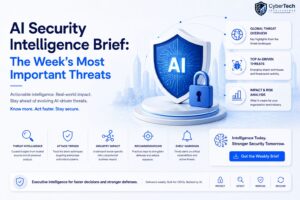

Artificial intelligence is rapidly becoming part of enterprise technology stacks, security operations, software development, customer services, and business decision-making. While AI creates significant opportunities, its rapid adoption is also introducing new cybersecurity risks.
The AI Security Intelligence Brief provides a focused view of the most important AI security threats, vulnerabilities, attack techniques, and emerging risks that organizations should monitor.
AI Attack Surfaces Are Expanding
AI systems are no longer isolated experiments. Organizations are integrating large language models (LLMs), AI assistants, machine learning platforms, autonomous agents, and third-party AI services into business workflows.
This creates new attack surfaces involving models, prompts, APIs, identities, data, plugins, integrations, and infrastructure.
Security teams must therefore consider not only whether an AI model is secure, but also how the surrounding ecosystem can be exploited.
Prompt Injection Remains a Key Concern
Prompt injection continues to represent an important AI security challenge. Attackers can craft malicious instructions designed to manipulate an AI system into ignoring intended controls or performing unintended actions.
The risk becomes greater when AI systems have access to enterprise data or external tools.
An AI agent with permission to retrieve documents, interact with applications, or execute workflows could potentially turn a successful prompt manipulation into a broader security incident.
Organizations should treat AI instructions and external content as potentially untrusted inputs.
AI-Powered Social Engineering Is Increasingly Sophisticated
Generative AI can make phishing and social engineering campaigns more convincing.
Attackers can generate highly personalized messages, create realistic business communications, and adapt content to specific targets. This can make traditional indicators of phishing more difficult for employees to recognize.
Security awareness programs therefore need to evolve alongside AI-enabled attack techniques.
Organizations should combine employee education with strong authentication, email security, identity protection, and behavioral monitoring.
AI Systems Can Create New Data Security Risks
AI applications frequently require access to corporate information to provide useful responses. This introduces questions about what data an AI system can access, where that information is processed, and who can retrieve it.
Potential risks include:
- Sensitive data exposure
- Excessive AI application permissions
- Unauthorized data retrieval
- Insecure third-party AI integrations
- Poorly governed enterprise AI tools
- Accidental disclosure through prompts
Organizations should establish clear policies for what information employees and AI applications are permitted to access.
AI Agents Introduce Additional Security Challenges
The evolution from conversational AI to autonomous AI agents is creating another important security consideration.
AI agents may be capable of taking actions rather than simply generating responses. Depending on their design, they may interact with databases, applications, APIs, or business workflows.
This increases the importance of:
- Least-privilege permissions
- Strong authentication
- Tool access controls
- Action logging
- Human approval for high-risk actions
- Continuous monitoring
An AI agent should have only the access required for its specific function.
The Importance of AI Security Monitoring
AI security cannot depend entirely on predeployment testing. Models, applications, integrations, permissions, and threats can change over time.
Security teams should continuously monitor AI environments for unusual behavior, unexpected data access, unauthorized integrations, and changes in permissions.
AI security should also be incorporated into existing security operations rather than treated as a completely separate discipline.
What Security Leaders Should Watch
Organizations should closely monitor several areas of AI security:
Model Security: Vulnerabilities and weaknesses affecting AI models and applications.
Identity: Accounts, credentials, and permissions associated with AI systems.
Data: Sensitive information accessed, processed, or generated by AI applications.
Integrations: APIs, plugins, tools, and external services connected to AI systems.
Agents: Autonomous systems capable of taking actions on behalf of users.
Threat Activity: Emerging attack techniques targeting AI-enabled environments.
Building a Stronger AI Security Strategy
Organizations can reduce AI-related risks by establishing governance before expanding AI adoption.
Security leaders should:
- Maintain an inventory of approved AI applications.
- Define acceptable AI data usage policies.
- Apply least privilege to AI services and agents.
- Monitor AI-related identities and integrations.
- Test applications for prompt injection and other AI-specific threats.
- Protect sensitive information from unauthorized AI access.
- Establish incident response procedures for AI-related security events.
- Continuously reassess AI risks as technologies evolve.
Conclusion
AI security is becoming a core enterprise cybersecurity priority as organizations rapidly integrate AI into business operations.
The most important risks are not limited to vulnerabilities within AI models themselves. Attackers can target identities, data, integrations, prompts, APIs, and autonomous agents surrounding those models.
A strong AI Security Intelligence program helps organizations stay ahead of these evolving risks by continuously tracking emerging threats, understanding new attack techniques, and translating developments into actionable security priorities.
For security leaders, the objective is clear: adopt AI responsibly while ensuring that increased automation does not create unmanaged pathways into critical business systems and data.
About Cyber Tech Intelligence
Cyber Tech Intelligence is a leading cybersecurity intelligence platform dedicated to delivering research-driven insights, threat intelligence, and strategic analysis across the evolving cybersecurity landscape. We help enterprises, CISOs, technology leaders, and cybersecurity vendors navigate emerging threats, security technologies, and business risks with confidence. Our expertise spans AI Security, Threat Intelligence, Cloud Security, Identity Security, Zero Trust, SIEM, XDR, DevSecOps, Application Security, and Enterprise Cyber Resilience. Through independent research, executive engagement, and market intelligence, we provide actionable insights that support informed decision-making and stronger security outcomes.
At Cyber Tech Intelligence, we believe effective cybersecurity strategies are built on trusted intelligence, transparency, and strategic relevance. Our services include cybersecurity research reports, threat trend analysis, executive briefings, vendor intelligence, CISO engagement programs, webinars, and advisory services designed to help organizations stay resilient in a rapidly changing threat environment. Whether you are looking for strategic cybersecurity insights, partnership opportunities, or expert guidance, our team is ready to help. Contact Us to connect with our cybersecurity experts and learn how we can support your organization’s security goals.