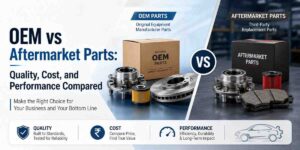

When businesses need components for their products, machinery, vehicles, appliances, or equipment, one important decision is whether to use OEM parts or aftermarket parts. The choice can influence product quality, compatibility, performance, maintenance, and overall cost.
For manufacturers and brands, this decision becomes even more important when sourcing components at scale. OEM manufacturing allows businesses to develop components according to specific product requirements, design standards, material specifications, and performance expectations.
But how do OEM and aftermarket parts differ? And which option makes more sense for your business?
Let’s compare OEM vs aftermarket parts based on quality, cost, performance, customization, compatibility, and long-term value.
What Are OEM Parts?
OEM stands for Original Equipment Manufacturer. OEM parts are components manufactured according to the specifications and requirements of the original product manufacturer.
An OEM manufacturer may produce a component for another brand based on its drawings, specifications, material requirements, dimensions, performance standards, and quality expectations.
For example, a kitchen appliance brand may partner with an OEM manufacturer to produce stainless steel bowls, jars, blades, housings, or other components specifically designed for its products.
The key advantage of OEM manufacturing is that the component is developed with the final product and its requirements in mind.
What Are Aftermarket Parts?
Aftermarket parts are replacement or alternative components manufactured by companies other than the original equipment manufacturer or its designated manufacturing partner.
These parts are generally designed to fit an existing product or system and may be available from multiple suppliers.
Aftermarket manufacturers may focus on offering competitive pricing, wider availability, or alternative designs. However, specifications, materials, manufacturing processes, and quality levels can differ from one supplier to another.
This means businesses need to evaluate aftermarket parts carefully, particularly when consistency and product performance are important.
OEM vs Aftermarket Parts: Key Differences
The biggest differences between OEM and aftermarket parts usually relate to quality control, compatibility, customization, cost, and performance.
1. Quality and Manufacturing Standards
Quality is one of the most important considerations when sourcing components.
OEM parts are generally manufactured according to defined specifications provided by the original product manufacturer. This can include material grade, dimensions, tolerances, surface finish, strength, durability, and testing requirements.
With aftermarket components, quality can vary depending on the manufacturer and product category. Some aftermarket suppliers may offer high-quality components, while others may prioritize lower production costs.
For businesses purchasing components in large quantities, having clearly defined manufacturing and inspection standards can help maintain consistent product quality.
2. Compatibility and Fit
OEM components are developed to meet the requirements of a particular product or application. This can provide a higher level of confidence regarding fit and compatibility.
Aftermarket parts may be designed to work with multiple products or models. While this can offer flexibility, differences in dimensions, tolerances, materials, or design can sometimes affect compatibility.
For products where precision is important, businesses should carefully evaluate component specifications before choosing an aftermarket alternative.
3. Cost Comparison
One of the major reasons businesses consider aftermarket components is their potentially lower upfront cost.
Aftermarket manufacturers may produce standardized components at competitive prices, making them attractive for replacement applications or cost-sensitive projects.
OEM manufacturing, however, can provide value beyond the initial purchase price. Components can be developed according to the specific requirements of the product, potentially reducing issues related to poor fit, inconsistent quality, rework, or premature replacement.
Therefore, businesses should consider total cost of ownership rather than comparing purchase prices alone.
4. Performance and Reliability
Performance depends heavily on how well a component matches the requirements of the final product.
OEM components are manufactured around defined product specifications. When the right material, dimensions, tolerances, and manufacturing processes are followed, the component can deliver consistent performance within the intended application.
Aftermarket components can also perform well, but performance may differ between suppliers and product variants.
For applications where reliability and repeatable performance are essential, businesses should evaluate supplier capabilities, testing procedures, certifications, and quality systems before selecting components.
5. Customization
Customization is another major difference between OEM manufacturing and aftermarket sourcing.
OEM manufacturing allows brands to specify requirements such as:
- Material grade
- Component dimensions
- Surface finish
- Product design
- Weight and thickness
- Functional requirements
- Packaging requirements
- Production quantities
- Quality standards
This is particularly useful for businesses developing their own products or modifying existing product designs.
Aftermarket parts are generally manufactured for broader applications, so customization options may be more limited.
6. Supply Consistency
For businesses manufacturing products at scale, consistent supply is essential.
An OEM manufacturing partner can work with a brand to establish production specifications and quality requirements. Once these are finalized, the manufacturer can follow established processes for repeat production.
This helps businesses maintain consistency across multiple production batches.
With aftermarket sourcing, businesses may need to compare multiple suppliers or product variations to maintain the required quality and availability.
OEM vs Aftermarket: Which Is More Cost-Effective?
The answer depends on the application.
If a business needs a readily available replacement component for an existing product, an aftermarket part may be a practical option, particularly when price and availability are the primary concerns.
However, businesses developing products for long-term commercial use may benefit from OEM manufacturing. While the initial development and manufacturing process can involve higher investment, customized components can provide better control over quality, specifications, compatibility, and production consistency.
The right decision should therefore consider:
Initial cost + quality + performance + maintenance + replacement frequency + production requirements.
When Should Businesses Choose OEM Manufacturing?
OEM manufacturing can be particularly suitable when businesses require:
- Custom-designed components
- Consistent product quality
- Specific material requirements
- High-volume production
- Reliable component compatibility
- Repeatable manufacturing standards
- Product-specific dimensions and tolerances
- Long-term manufacturing partnerships
- Quality and compliance documentation
For brands that want greater control over their product components, working with an experienced OEM manufacturer can provide advantages throughout the product development and manufacturing process.
How Jindal Lifestyle Supports OEM Manufacturing
Jindal Lifestyle provides custom OEM manufacturing solutions for businesses looking for reliable, high-quality components and products.
With experience in stainless steel manufacturing and product development, Jindal Lifestyle works with businesses to develop solutions according to their specific requirements. The focus can extend from material selection and product design to manufacturing, finishing, quality control, and delivery.
This approach is particularly relevant for businesses that require customized stainless steel products or components for applications across areas such as home appliances, kitchen products, mobility solutions, and other consumer and industrial applications.
Instead of choosing a generic component based only on price, businesses can work with an OEM partner to develop products around their exact requirements.
OEM vs Aftermarket Parts: Making the Right Choice
There is no single solution that works for every business.
Aftermarket parts can be suitable when businesses need affordable, readily available replacement components. However, for brands that require customized components, consistent quality, precise specifications, and long-term production support, OEM manufacturing can offer greater control.
The right choice depends on the importance of quality, compatibility, performance, customization, production volume, and long-term cost.
For businesses looking beyond short-term pricing and focusing on reliable product manufacturing, partnering with an experienced OEM manufacturer can be a strategic advantage.
Conclusion
The difference between OEM and aftermarket parts goes beyond price. OEM manufacturing focuses on producing components according to defined product requirements, while aftermarket parts generally provide alternative solutions for existing products.
When evaluating the two options, businesses should consider quality, compatibility, customization, performance, supply consistency, and total cost—not just the initial purchase price.