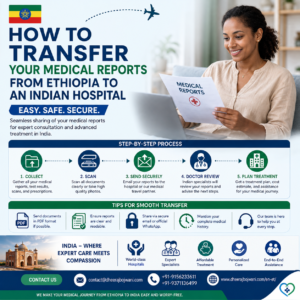

For many patients in Ethiopia, the decision to travel to India for medical treatment begins with one important question:
“How do I send my medical reports to an Indian doctor?”
Whether you need heart surgery, cancer treatment, orthopedic care, organ transplantation, or another specialized procedure, your medical records are the starting point of your treatment journey. They help doctors understand your condition before you travel, allowing them to recommend the right specialist, estimate treatment costs, and prepare a personalized care plan.
Fortunately, sharing your reports with an Indian hospital is much easier than many people expect. With the right documents and a little preparation, your case can often be reviewed within a few days, helping you move forward with confidence.
This guide explains everything Ethiopian patients need to know.
Why Should You Send Your Medical Reports Before Travelling?
Travelling internationally for treatment is a major decision. Before confirming whether you need to come to India, doctors first need to understand your medical history.
Your reports allow specialists to:
- Confirm your diagnosis
- Review previous treatments
- Decide whether additional tests are required
- Recommend the most appropriate specialist
- Estimate treatment costs
- Plan your hospital admission in advance
When your records are reviewed before your arrival, many unnecessary delays can be avoided, and your treatment can often begin much sooner after you reach India.
Also Read: Transfer Medical Reports from Ethiopia to India
Which Medical Reports Should You Send?
The exact documents depend on your health condition, but most Indian hospitals will request the following:
|
Document |
Why It Is Important |
|
Doctor’s referral or consultation notes |
Explains your medical condition |
|
Hospital discharge summaries |
Provides treatment history |
|
Recent blood investigations |
Shows your current health status |
|
MRI, CT Scan, PET Scan or X-ray reports |
Helps doctors evaluate the condition |
|
Original scan images (CD, DVD or digital files) |
Enables detailed assessment |
|
Biopsy or pathology reports |
Essential for cancer diagnosis |
|
Current prescription list |
Helps doctors understand ongoing treatment |
|
Previous surgery reports |
Important for planning future procedures |
|
Passport copy |
Required for registration and medical travel documentation |
The more complete your records are, the easier it is for specialists to provide an accurate medical opinion.
The Best Ways to Send Medical Reports to India
Most leading hospitals in India accept digital medical records, making the process quick and convenient.
Email remains the most commonly used method.
Scan your reports clearly and save them as PDF files before sending them. Avoid taking unclear mobile photos, as poor-quality images can make it difficult for doctors to review your case.
- Google Drive or Other Cloud Storage
MRI scans, CT scans, and other imaging files are often too large to send by email.
Uploading them to Google Drive or another secure cloud platform allows you to share the original files without reducing their quality.
Simply send the download link along with your medical reports.
Many international patient coordinators also accept reports through WhatsApp for an initial review or quick communication.
However, detailed medical evaluation is usually completed after receiving the full reports through email or secure file-sharing services.
- Hospital Patient Portals
Some Indian hospitals provide dedicated online portals for international patients.
These portals allow you to upload reports securely while keeping all your medical information organized in one place.
Organize Your Reports Before Sending
Doctors often receive hundreds of medical files every week. A well-organized set of reports helps them understand your condition much faster.
Arrange your documents in chronological order, beginning with the most recent reports.
A simple structure could be:
- Latest consultation notes
- Blood test reports
- MRI, CT scan or X-ray reports
- Scan images
- Previous surgery records
- Current medication list
It is also helpful to give each file a clear name, such as:
- MRI_Spine_March2026.pdf
- BloodTests_June2026.pdf
- DischargeSummary.pdf
Small details like these can make the review process much smoother.
Should Your Reports Be Translated?
Most hospitals in Ethiopia provide medical reports in English.
However, if any documents are written in Amharic or another local language, it is advisable to have them translated into English before sending them.
This helps Indian specialists understand your medical history accurately and avoids unnecessary delays.
How Long Does It Take to Receive a Medical Opinion?
Once the hospital receives all the required documents, many specialists are able to provide an initial opinion within 24 to 72 hours, although complex cases may take a little longer.
After reviewing your reports, the medical team may recommend:
- The most suitable treatment option
- Additional investigations if required
- An online consultation with the specialist
- An estimated treatment cost
- Expected hospital stay
- Approximate recovery period
Receiving this information before travelling allows you to plan your journey with greater clarity.
Common Mistakes That Delay Medical Reviews
One of the biggest reasons for delayed medical opinions is incomplete documentation.
Before sending your reports, check that you have avoided these common mistakes:
- Sending blurred photographs instead of scanned copies
- Forgetting to include scan images
- Missing biopsy or pathology reports
- Sending outdated blood investigations
- Leaving out your doctor’s diagnosis
- Uploading files without proper names
- Sending reports across multiple emails without explanation
Taking a few extra minutes to organize everything properly can save several days during the review process.
What Happens After Your Reports Are Reviewed?
Once the specialist has completed the review, you will generally receive:
- A preliminary medical opinion
- Recommended treatment plan
- Estimated treatment cost
- Expected duration of hospital stay
- Guidance on medical visa documentation
- Advice on when to travel
- Information about follow-up care after treatment
This allows you and your family to make informed decisions before leaving Ethiopia.
How a Medical Travel Advisor Can Help
Preparing for treatment in another country involves much more than sending medical reports. Coordinating appointments, communicating with hospitals, arranging travel, and understanding treatment options can quickly become overwhelming.
An experienced medical travel advisor acts as a single point of contact throughout the process.
Support typically includes:
- Reviewing your medical documents before submission
- Connecting you with the appropriate specialist
- Arranging online consultations
- Obtaining treatment estimates
- Assisting with medical visa documentation
- Scheduling hospital appointments before arrival
- Helping with airport transfers, accommodation, language assistance, and other travel arrangements
Having professional guidance allows you to focus on what matters most—your health and recovery.
Final Thoughts
Sending your medical reports to an Indian hospital is the first step toward receiving the right treatment. Clear, complete, and well-organized records help specialists understand your condition, recommend the best treatment plan, and guide you before you travel. For patients from Ethiopia, sharing your reports in advance can save time, reduce uncertainty, and make your medical journey to India smoother and better planned.
Useful Official Reference Links
- Ministry of Health & Family Welfare (India): https://www.mohfw.gov.in/
- National Health Authority (India): https://nha.gov.in/
- National Medical Commission: https://www.nmc.org.in/
- Indian Council of Medical Research: https://www.icmr.gov.in/
Dr. Dheeraj Bojwani
Medical Travel Advisor for International Patients Seeking Treatment in India
📍 New Delhi, India
🩺 25+ Years of Experience
🌍 Assisted 5,000+ International Patients
🌐 Website: https://www.dheerajbojwani.com/en-et/
📧 Email: contact@dheerajbojwani.com
📞 Phone: +91 9156233611
📞 Alternate Phone: +91 9371136499
Disclaimer
This article is intended for educational and informational purposes only and should not be considered medical, legal, or visa advice. Medical recommendations, treatment plans, and procedures may vary from one patient to another based on individual health conditions and circumstances. Readers are strongly advised to consult qualified healthcare professionals before making any medical-related decisions.
Learn More: Indian Hospital Consultation for Ethiopian Patients