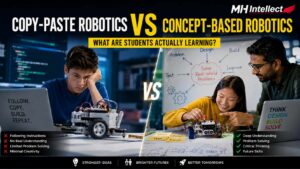

Two classrooms can use the same robot kit and achieve completely different learning outcomes. In one classroom, students follow instructions, copy a programme, press start, and watch the robot complete its task. In another, students investigate sensors, modify code, test designs, identify failures, and explain why their robot behaves the way it does. This is the fundamental difference between Copy-paste robotics and deeper, concept-driven learning.
What Is Copy-Paste Robotics?
Copy-paste robotics is an instruction-based approach where students reproduce a predefined robot. They may follow an assembly guide, position motors and sensors exactly as instructed, copy block-based or text-based code, and run the finished programme.
Guided activities can be useful when beginners are learning unfamiliar components. The problem arises when copying becomes the entire learning process. A student may successfully build a functioning robot but still be unable to explain why it turns, how its sensor works, or which part of the programme controls its behaviour.
Why Concept-Based Robotics Creates Deeper Learning
Concept-based robotics shifts attention from completing instructions to understanding systems. Students explore how sensors collect information, how algorithms make decisions, how motors create movement, and how engineering design influences performance.
Instead of receiving a finished solution, students might be challenged to programme a robot to detect an obstacle and choose a safe route. They must test sensor positions, adjust conditions, modify code, observe results, and improve their solution.
Failure therefore becomes useful evidence rather than something to avoid. Students learn to observe a problem, suggest a cause, change one variable, test again, and evaluate whether the modification worked.
What Students Actually Learn Through Robotics
Effective Robotics education develops much more than the ability to assemble a machine. Students can learn sequencing, loops, conditions, variables, algorithms, sensor logic, debugging, engineering design, computational thinking, teamwork, and technical communication.
For example, a line-following activity can either give students completed code or require them to analyse sensor readings and determine when the robot should turn. Both approaches may produce a working robot, but only the second requires students to understand how information becomes a programmed action.
Schools can also explore Robots in Education to understand how structured robotics activities can contribute to wider student learning outcomes.
Educational Robots Are Tools, Not the Curriculum
Purchasing advanced Educational robots does not automatically create meaningful STEM learning. The educational value comes from how teachers structure challenges, the questions students must answer, and whether learners have opportunities to make independent decisions.
Strong robotics lessons gradually move from guided construction toward independent design. Students should eventually be able to change code, reposition sensors, redesign mechanisms, troubleshoot unexpected behaviour, and explain the reasoning behind their decisions.
What Schools Should Look for in Robotics Programmes
When evaluating Robotics for schools, school leaders should look beyond impressive demonstrations. Ask whether students modify programmes themselves, solve unfamiliar challenges, participate in debugging, explain component choices, test alternative designs, and present what they learned.
A completed robot proves that the system works. It does not automatically prove that the student understands it. The strongest evidence of learning is whether students can transfer a concept from one robotics challenge to another.
How MH Intellect Supports Concept-Based Robotics Learning
MH Intellect supports schools in creating robotics learning experiences centred on understanding, experimentation, and practical problem-solving. The goal is to move students beyond simply assembling predefined models toward exploring coding logic, sensors, engineering principles, debugging, design thinking, and real-world applications.
Through structured robotics and STEM learning, students can develop the confidence to ask not only “Did my robot work?” but also “Why did it work, and how can I make it better?”
Ready to Build Meaningful Robotics Learning in Your School?
Robotics becomes truly valuable when students understand the technology behind the finished project. Schools need programmes that encourage learners to investigate, design, test, fail intelligently, improve, and communicate their reasoning—not simply reproduce instructions.
Ready to move beyond copy-paste robotics? Book a consultation with MH Intellect to explore concept-based robotics programmes that help students develop practical coding, engineering, computational thinking, problem-solving, and future-ready STEM skills.