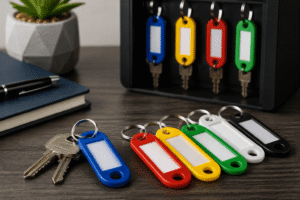

If you’ve ever dug through a drawer full of unlabeled keys, trying to figure out which one opens the supply closet and which one starts the delivery van, you already understand the problem custom numbering key tags were built to solve. It’s a small piece of hardware, but it can be the difference between a smooth-running facility and a daily scavenger hunt.
This guide walks through what custom numbering key tags actually are, why they matter more than most people assume, the different types available, and how to set up a system that actually works long-term not just for the first month after you buy them.
What Are Custom Numbering Key Tags?
Custom numbering key tags are small labels or fobs attached to keys, each stamped or printed with a unique number (and sometimes additional text like a department name, unit number, or barcode). Instead of relying on memory or handwritten sticky notes, every key gets a permanent, legible identifier that corresponds to an entry in a master log or digital system.
They’re common in:
- Property management and apartment complexes
- Hotels and hospitality
- Auto dealerships and vehicle fleets
- Schools and universities
- Hospitals and healthcare facilities
- Warehouses and industrial sites
- Government buildings and law enforcement
The core idea is simple: a number replaces a description. Instead of writing “key to the side door near the loading dock,” you write “Key #047” — and that number never changes, never gets abbreviated differently by two people, and never gets lost in translation.
Why Key Management Actually Matters
It’s easy to underestimate how much confusion unlabeled or inconsistently labeled keys create until you’re the one locked out of a unit at 9 PM with three unmarked keys in your hand.
A few real consequences of poor key management:
Security risk. If keys aren’t tracked, you have no reliable way of knowing who has access to what. A lost or stolen key becomes a much bigger problem when nobody can say which lock it opens.
Wasted time. Maintenance staff, property managers, and front desk employees lose real hours every week just identifying and re-identifying keys that should have been obvious at a glance.
Liability exposure. In healthcare, education, and multi-tenant housing, poor access control can turn into a legal and safety issue, not just an inconvenience.
Turnover chaos. When an employee who “just knew” the key system leaves, everyone else is stuck reverse-engineering their informal system.
Custom numbering key tags fix this by making the identification system independent of any one person’s memory.
Types of Custom Numbering Key Tags
Not all key tags are built the same way, and the right choice depends on your environment.
1. Plastic Numbered Tags
Lightweight, inexpensive, and available in a wide range of colors. Good for color-coding by department or building. Numbers are usually engraved or printed, so they resist fading better than handwritten labels.
2. Metal Stamped Tags
Durable and often used in industrial or high-security settings. The numbers are physically stamped into the metal, so they can’t be scratched off or altered easily. These hold up well outdoors or in rough handling environments.
3. Aluminum Tags with Sequential Numbering
Common in hotels and property management. Lightweight but sturdy, and typically sold in pre-numbered sets, which saves time when setting up a system from scratch for the first time.
4. Barcoded or QR-Coded Tags
These pair a visible number with a scannable code, allowing the tag to link directly into a digital tracking system. Useful for larger operations that need real-time check-in/check-out records.
5. Color-Coded Numbered Tags
Combine a number with a color category for example, red for maintenance keys, blue for tenant units, yellow for common areas. This adds a second layer of quick visual sorting on top of the number itself.
6. Cabinet and Panel Tags
Used specifically for wall-mounted key cabinets, where each hook is numbered and each key tag matches. This creates a simple visual system: if a hook is empty, you instantly know which key is out and, when paired with a log, who has it.
How to Set Up a Custom Numbering System That Works
Buying the tags is the easy part. The system around them is what actually determines whether key management improves or just moves the mess somewhere else.
Step 1: Decide on a Numbering Logic
Don’t just number keys 1, 2, 3 in random order. Build logic into the sequence. For example:
- 100–199 for Building A units
- 200–299 for Building B units
- 300–399 for maintenance and utility keys
- 900+ for master keys
This way, someone can glance at a number and immediately have a rough sense of what it belongs to, even before checking the log.
Step 2: Create a Master Key Log
This can be a spreadsheet, a dedicated key management app, or a physical logbook but it needs to exist and be kept current. At minimum, track:
- Key number
- What it opens
- Who currently has it (if checked out)
- Date issued and date returned
- Number of duplicates in circulation
Step 3: Choose Durable, Legible Tags
Pick tags that will still be readable in a year. Engraved or stamped numbers outlast printed or handwritten ones, especially in environments with a lot of handling, moisture, or temperature swings.
Step 4: Use a Physical Key Cabinet or Rack
Numbered hooks that match numbered tags create a self-checking system. If key isn’t hanging on hook , someone knows to check the log rather than assuming it was simply misplaced.
Step 5: Restrict Duplication
Every duplicate key should get its own number, not a copy of the original number. If key #12 is duplicated, the copy might be labeled #12A or added as a separate entry in the log tracking that a second copy exists. Untracked duplicates are one of the most common ways key systems break down.
Step 6: Train Everyone Who Touches the System
A great numbering system fails if only one person understands it. Make sure anyone checking keys in or out front desk staff, maintenance teams, security knows how to read tags and update the log.
Step 7: Audit Periodically
Set a recurring schedule (monthly or quarterly, depending on volume) to physically confirm that every key in the log is accounted for. This catches problems lost keys, unreturned duplicates, mislabeled tags before they become security incidents.
Common Mistakes to Avoid
- Reusing numbers after a key is retired. This creates confusion in historical records and can cause security gaps if an old log entry is mistaken for a new key.
- Skipping the log and relying on tags alone. The tag identifies the key; the log is what makes that identification useful.
- Using tags that fade or wear out quickly. Cheap printed labels often become unreadable within months in high-use environments.
- Not color-coding when you have overlapping numbering ranges across locations. Two “Key #14″s in different buildings without a distinguishing color or prefix is a recipe for mix-ups.
- Failing to update the log in real time. A log that’s a week behind is functionally the same as no log at all.
FAQ
Q: What are custom numbering key tags?
Small tags attached to keys, each marked with a unique number that’s cross-referenced in a master log so a number identifies the key instead of a written description.
Q: Are custom numbering key tags worth it for a small business?
Yes. Even a handful of shared keys benefits once more than one person handles access it removes guesswork during shift changes and staff turnover.
Q: Can I order key tags in a specific numbering sequence?
Yes. Most suppliers offer custom sequential numbering, so you can start at any number or follow a logic that matches your buildings or departments.
Q: What’s the most durable material for key tags?
Stamped metal lasts longest in heavy-use or outdoor settings. Engraved plastic or aluminum works well for lighter indoor use.
Q: How do custom numbering key tags improve security?
If lost, a numbered tag reveals nothing on its own the number is meaningless without the log. A written label, by contrast, can point a stranger straight to what it opens.
Conclusion
Custom numbering key tags aren’t just a labeling convenience, they’re a foundational part of a real key management system. The tag itself is simple, but paired with a logical numbering structure, a maintained log, and consistent staff training, it turns a chaotic drawer of keys into something you can actually trust and audit.
Whether you’re managing a ten-unit apartment building or a sprawling industrial site, the principle stays the same: every key should tell you exactly what it is at a glance, and exactly who’s responsible for it at any given moment. That’s what a good numbering system delivers less time hunting, fewer security gaps, and a lot less guesswork.