
A brand owner asked me this a few months ago. She’d just gotten quotes back for both packaging types, and the price gap caught her off guard. Was the upgrade actually worth it, or was she just paying extra for something that looked nicer in a sample photo? Fair question. And honestly, the answer depends heavily on the product and the customer buying it not the most satisfying answer, but the true one.
Both formats do the same core job: get a product from a warehouse to a customer in one piece. Beyond that, though, they’re pretty different animals.
What Each One Actually Is
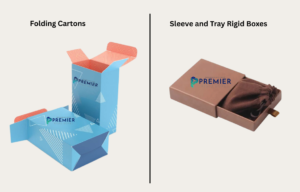
Folding cartons are what most people picture when they hear box. Thin paperboard, printed flat, folded and glued into shape. They’re light, cheap to produce at volume, and they ship flat before assembly which saves a lot on storage and freight.
Sleeve boxes work differently. A rigid tray, made from thick, dense board, holds the product directly. An outer sleeve slides over it, usually carrying the branding and printed details. Since rigid board doesn’t fold like thinner stock, the tray typically ships pre-assembled rather than flat.
Cost Is the First Real Difference and a Big One
There’s no dressing this up. Sleeve and tray rigid boxes cost noticeably more per unit, sometimes two to three times as much depending on size and finish. Some of that comes down to materials rigid board just costs more than folding carton stock. Some of it’s the extra manual assembly, plus the fact that rigid boxes can’t ship flat, which drives up freight costs too.
For high-volume, lower-margin products, that price gap can make sleeve boxes a non-starter. It’s tough to justify tripling your packaging spend on something that sells for a few dollars.
Durability Isn’t Even Close
This one’s not really a contest. Folding cartons flex under pressure. That’s fine for plenty of products, but a real liability for anything fragile glass, electronics, delicate cosmetics. All of it holds up better inside a rigid tray that doesn’t give the way thin folded board does.
Shipping damage numbers usually back this up. Products in sleeve and tray packaging tend to arrive in better shape than the same items shipped in comparable folding cartons, especially when the box gets tossed around rather than handled the whole way gently through.
The Unboxing Experience Isn’t Really Comparable
Folding cartons open with a flap, a tuck, maybe a magnetic closure if you spring for the nicer version. Functional, but it doesn’t create much of a moment. Sleeve and tray boxes do mostly because of that sliding motion, and the way the product gets revealed all at once instead of gradually.
For brands where the purchase carries some emotional weight tech, beauty, cannabis, higher-end food the reveal moment can shape how customers feel about the purchase, sometimes more than the branding on the box itself.
Branding Flexibility Actually Favors Sleeve and Tray
This one surprises people. Because the sleeve is separate from the tray, brands can swap in seasonal designs, run limited editions, or create regional variants just by reprinting the sleeve, leaving the tray untouched. Folding cartons don’t give you that option the whole carton usually needs a full redesign and reprint for any refresh.
Over time, for brands doing frequent limited drops or seasonal packaging, that flexibility can help offset the higher upfront cost. Reprinting a sleeve again and again is usually cheaper than redesigning and reprinting an entire carton each time.
Where Folding Cartons Still Win
It’s not all in favor of rigid boxes. Folding cartons ship flat, which matters a lot for storage and freight, especially at scale. They’re also faster to produce, with shorter lead times which count for a lot when packaging needs to turn around quickly.
For products that don’t carry much emotional weight everyday household goods, basic food packaging, bulk retail the extra durability and unboxing experience of a rigid box often isn’t worth the cost. Customers weren’t judging the purchase on packaging quality in the first place.
So Which One Should You Actually Choose?
If the product is fragile, positioned as premium, or sold partly on the strength of the unboxing moment, sleeve and tray boxes are usually worth the extra spend. The durability alone can pay for itself in fewer damaged shipments and returns, and the perceived value bump tends to support a higher price point anyway.
If the product is lower-cost, high-volume, or doesn’t lean on packaging to drive the sale, folding cartons remain the more practical pick. No reason to pay a premium for a reveal moment nobody’s paying attention to.
Some brands split the difference folding cartons for everyday products, Custom sleeve and tray boxes reserved for gift sets, limited editions, or flagship items. That way they control costs on volume goods while still delivering a premium feel where it actually matters.
The Bottom Line
There’s no universal right answer here, and any packaging supplier who tells you one format is objectively better probably hasn’t asked enough about your product and your customer. Sleeve and tray boxes win on durability, brand perception, and design flexibility. Folding cartons win on cost, speed, and storage efficiency. The right call comes down to what your product actually is, what it costs, and how much the sale depends on how it feels to open.