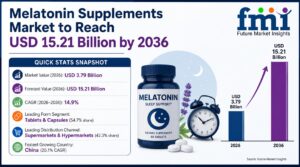

The global melatonin supplements market is experiencing rapid expansion, according to latest insights by Future Market Insights. Driven by a global sleep health crisis linked to screen exposure, workplace stress, and urban lifestyle disruptions, consumers are increasingly seeking non-pharmaceutical, non-habit-forming sleep support. The global industry, valued at USD 3.30 billion in 2025, is projected to reach USD 3.79 billion in 2026. Advancing at a fast Compound Annual Growth Rate (CAGR) of 14.90% over the ten-year forecast period, total market valuation is anticipated to hit USD 15.21 billion by 2036, creating an absolute incremental opportunity of USD 11.42 billion.
Request a Sample Report: https://www.futuremarketinsights.com/reports/sample/rep-gb-25681
Market Performance Overview (2026–2036)
To map out the key delivery formats and primary distribution channels guiding this USD 11.42 billion market scale-up, an analysis of leading segment allocations highlights where global demand is concentrated:
- Tablets & Capsules Form (54.7% share): Commands the product form architecture in 2026, serving as the trusted default oral delivery system due to precise dosing, long shelf stability, and low manufacturing costs.
- Insomnia End-Use Indication (48.6% share): Represents the primary end-use driver, fueled by high global rates of chronic sleep-onset difficulties and consumer preference over pharmaceutical sedatives.
- Supermarkets & Hypermarkets Channel (42.3% share): Dominates distribution, reflecting melatonin’s position on mainstream wellness shelves alongside general health supplements rather than being restricted to specialized apothecaries.
Technical Drivers and Delivery System Innovation
The adoption of melatonin supplements across consumer wellness and healthcare channels is propelled by distinct lifestyle and technological catalysts:
Urban Sleep Deprivation and Screen Exposure
Rising screen time, blue-light exposure, and non-traditional working hours have disrupted natural circadian rhythms globally. Consumers are turning to melatonin (N-acetyl-5-methoxytryptamine) as a natural hormone-based solution to regulate sleep-wake cycles without the risk of dependency associated with prescription sedatives.
Advanced Delivery Mechanics for Sleep Maintenance
To address middle-of-the-night awakenings and slow absorption times, supplement formulators are expanding beyond immediate-release tablets. Extended-release, dual-layer, sublingual pellets, liquid drops, and fast-dissolving gummies are rapidly gaining shelf space, delivering higher bioavailability and targeted release kinetics.
Global Travel Recovery and Point-of-Need Channel Expansion
The recovery of international business and leisure travel has reinvigorated jet lag mitigation demand. Brands are actively targeting point-of-need distribution channels, establishing partnerships with airport retailers, hotels, and airlines where travel-focused willingness to pay remains high.
Industrial Infrastructure & Regulatory Hurdles
Supplement manufacturers and global brand houses face complex regulatory and operational constraints:
- Divergent International Regulatory Frameworks: While the United States regulates melatonin freely under DSHEA as a dietary supplement, European Union member states maintain varied frameworks ranging from supplement limits to prescription-only mandates.
- Over-Dosing Scrutiny and Quality Control: Global health authorities are increasing oversight regarding actual active ingredient concentration versus label claims, compelling manufacturers to invest in strict batch testing and Good Manufacturing Practice (GMP) compliance.
Regional Growth Outlook
The geographic analysis reflects rapid market expansion across high-stress urban hubs in Asia alongside steady, high-volume growth in Western markets:
- China (20.10% CAGR): The global growth frontrunner, driven by an acute urban sleep deprivation crisis in tier-1 and tier-2 cities, expanding health food regulatory pathways, and surging online retail consumption.
- India (18.60% CAGR): Spurring rapid development via rising urban stress, expanding wellness awareness, and growing availability across pharmacy chains and digital health platforms.
- Germany (17.10% CAGR): Leading European market growth, supported by strong consumer preference for natural sleep remedies, high-purity formulations, and rigorous pharmacy channel verification.
- France (15.60% CAGR): Driven by an expanding wellness product demographic and growing adoption of non-prescription dietary aids.
- United Kingdom (14.20% CAGR): Supported by strong e-commerce subscription sales, airport travel retail growth, and clean-label supplement preferences.
- United States (12.70% CAGR): Sourcing a large baseline volume footprint, anchored by mature mass-market retail availability, extensive packaging innovations (e.g., gummies), and high consumer self-care adoption.
- Brazil (11.20% CAGR): Showing steady development supported by expanding pharmacy chains and growing consumer interest in preventative healthcare.
Competitive Landscape
The global melatonin supplements landscape is characterized by a balance between established multi-vitamin houses, retail pharmacy brands, and direct-to-consumer specialty labels. Dominant shelf presence, wide distribution networks, and strong brand trust are held by market leaders including Natrol, Nature Made, GNC, CVS Health, Walgreens, Life Extension, Pure Encapsulations, Swanson Health Products, Jarrow Formulas, Puritan’s Pride, and Vitacost.
To capture market share in an evolving regulatory environment, leading manufacturers are prioritizing non-GMO certifications, vegan-friendly gummy lines, and multi-ingredient combination formulas combining melatonin with L-theanine, magnesium, or ashwagandha.
Exclusive Discounts on Full Report: https://www.futuremarketinsights.com/reports/melatonin-supplements-market
Frequently Asked Questions
What is the projected valuation of the global market by 2036?
The global melatonin supplements market is projected to reach USD 15.21 billion by 2036, expanding from an estimated baseline valuation of USD 3.79 billion in 2026 at a CAGR of 14.90%.
Why do Tablets & Capsules lead the Form segment?
Tablets and capsules hold 54.7% of the market share because they provide consistent, cost-effective, and precise dosage delivery with long shelf stability, making them the default recommendation by healthcare practitioners.
What exclusions govern the physical boundaries of this market report?
The scope strictly limits its focus to dietary melatonin supplements, explicitly excluding prescription melatonin receptor agonist drugs (e.g., ramelteon, tasimelteon), veterinary sleep supplements, and unformulated raw bulk API melatonin powder sold B2B.
FMI Custom Research: Strategic Intelligence for Confident Decision-Making
In today’s rapidly evolving business environment, leadership teams need more than market data they need clear, actionable intelligence tailored to their strategic objectives. FMI’s Custom Research solutions are designed around the specific business questions organizations need answered, enabling executives to evaluate growth opportunities, validate investments, assess competitive dynamics.
Key Executive Benefits
- Decision-Ready Insights tailored to business priorities
- Reduced Strategic Risk through validated market intelligence
- Market Entry Confidence with detailed competitive analysis
- Competitive Advantage supported by proprietary research
- Faster Growth Decisions through customized strategic insights
- Primary Market Validation from industry stakeholders
- Global Industry Expertise across diverse sectors
- Proven Track Record with thousands of consulting engagements
Business Impact
FMI helps organizations transform market complexity into strategic clarity, enabling leadership teams to identify growth opportunities faster, optimize resource allocation, strengthen competitive positioning, and make high-stakes business decisions with confidence.
To explore how FMI Custom Research can support your strategic priorities, please connect with our team at – sales@futuremarketinsights.com