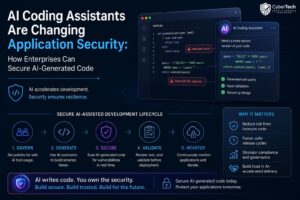

AI coding assistants have rapidly become part of the modern software development lifecycle. Developers are using tools powered by large language models to generate code, write unit tests, explain functions, and automate repetitive programming tasks. These capabilities improve productivity and help development teams deliver applications faster than ever before.
However, AI-generated code also introduces new application security challenges. While AI can produce functional code within seconds, it may also generate insecure logic, outdated libraries, vulnerable API implementations, or code that fails to meet enterprise security standards. If these issues reach production, they can expand an organization’s attack surface and increase cyber risk.
In 2026, enterprises are recognizing that securing AI-generated code requires more than trusting the output of an AI assistant. It requires strong governance, secure development practices, and continuous security testing.
Why AI-Generated Code Introduces New Risks
AI coding assistants learn from vast collections of publicly available code and documentation. Although they can accelerate development, they do not always understand an organization’s security policies or compliance requirements.
Common risks include:
- Insecure authentication logic
- Hardcoded credentials
- Vulnerable open source dependencies
- Poor input validation
- Insecure API implementations
- Outdated coding patterns
Without proper review, these issues can become production vulnerabilities.
Secure Development Must Include AI
AI should support developers, not replace secure coding practices.
Organizations should integrate AI coding assistants into an established Secure-by-Design and DevSecOps framework by:
- Defining secure coding standards
- Reviewing AI-generated code before deployment
- Validating third-party dependencies
- Enforcing code quality requirements
- Documenting AI-assisted development activities
Human oversight remains essential for identifying security flaws that AI may overlook.
Continuous Security Testing
Every AI-generated code change should pass through automated security testing before deployment.
Recommended controls include:
- Static Application Security Testing (SAST)
- Dynamic Application Security Testing (DAST)
- Software Composition Analysis (SCA)
- Secrets detection
- Dependency scanning
Automated testing helps identify vulnerabilities early in the development lifecycle.
Governance and Developer Awareness
Organizations should establish clear policies for using AI coding assistants.
Development teams should understand:
- Which AI tools are approved
- What source code can be shared with AI platforms
- How to review AI-generated output
- When manual security reviews are required
Security awareness ensures developers use AI responsibly without exposing sensitive intellectual property.
Conclusion
AI coding assistants are transforming software development by improving productivity and accelerating application delivery. However, faster development should not come at the expense of security. AI-generated code must be treated with the same level of scrutiny as human-written code to prevent vulnerabilities from reaching production.
By combining Secure-by-Design principles, automated security testing, developer oversight, and strong governance, organizations can safely adopt AI coding assistants while maintaining secure application development practices.
As AI continues to reshape software engineering, the organizations that successfully balance innovation with security will be better positioned to build resilient applications, reduce cyber risk, and strengthen customer trust in an increasingly AI-driven development environment.
About Cyber Tech Intelligence
Cyber Tech Intelligence is a leading cybersecurity intelligence platform dedicated to delivering research-driven insights, threat intelligence, and strategic analysis across the evolving cybersecurity landscape. We help enterprises, CISOs, technology leaders, and cybersecurity vendors navigate emerging threats, security technologies, and business risks with confidence. Our expertise spans AI Security, Threat Intelligence, Cloud Security, Identity Security, Zero Trust, SIEM, XDR, DevSecOps, Application Security, and Enterprise Cyber Resilience. Through independent research, executive engagement, and market intelligence, we provide actionable insights that support informed decision-making and stronger security outcomes.
At Cyber Tech Intelligence, we believe effective cybersecurity strategies are built on trusted intelligence, transparency, and strategic relevance. Our services include cybersecurity research reports, threat trend analysis, executive briefings, vendor intelligence, CISO engagement programs, webinars, and advisory services designed to help organizations stay resilient in a rapidly changing threat environment. Whether you are looking for strategic cybersecurity insights, partnership opportunities, or expert guidance, our team is ready to help. Contact Us to connect with our cybersecurity experts and learn how we can support your organization’s security goals.