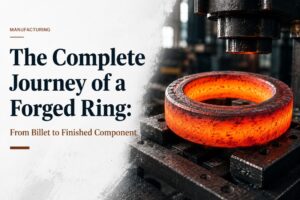

Behind Every High-Performance Machine Is a Precision-Engineered Forged Ring
When we think about heavy machinery, wind turbines, railways, or industrial equipment, our attention often goes to the finished product. Yet, hidden inside these machines are components that quietly ensure strength, stability, and long-term performance. One of the most important among them is the forged ring.
Forged rings are used in industries where failure isn’t an option. Whether supporting rotating equipment in a wind turbine or transmitting power in an industrial gearbox, these components are engineered to perform under extreme loads, high temperatures, and continuous operation.
But what does it take to manufacture a forged ring that can withstand such demanding conditions?
The answer lies in a carefully controlled manufacturing process that transforms a simple metal billet into a high-strength, precision-engineered component. Let’s explore each step of this fascinating journey.
Step 1: Selecting the Right Raw Material
Every exceptional forged ring begins with selecting the right raw material.
Manufacturers choose steel grades based on the component’s intended application, operating environment, and required mechanical properties. Carbon steel, alloy steel, stainless steel, and specialized alloys are among the most commonly used materials.
The quality of the billet determines the foundation of the final product. Choosing the right material ensures the forged ring delivers the required strength, toughness, corrosion resistance, and durability throughout its service life.
Step 2: Preparing the Billet
Once the material is selected, steel bars are cut into billets of precise dimensions.
Accurate billet preparation is essential because it influences how the metal flows during the forging process. Proper sizing minimizes material waste while ensuring consistency throughout production.
Although this step may seem simple, it plays a significant role in achieving dimensional accuracy and manufacturing efficiency.
Step 3: Heating for Forging
The prepared billet is heated in a controlled furnace until it reaches the ideal forging temperature.
Unlike melting, forging heats the metal just enough to make it malleable while preserving its internal structure. Maintaining the correct temperature is critical, as overheating or under heating can affect the quality and mechanical properties of the finished component.
At this stage, the billet is ready for shaping.
Step 4: Ring Rolling and Forging
This is where the transformation truly begins.
The heated billet is pierced to create a central opening before being transferred to a ring rolling mill. Specialized rollers gradually expand the ring while reducing its wall thickness, producing a seamless ring with exceptional structural integrity.
One of the greatest advantages of ring rolling is the improvement of the metal’s grain flow. Instead of cutting across the grain, the forging process aligns it with the shape of the ring, significantly enhancing strength and fatigue resistance.
The result is a component capable of performing reliably in demanding industrial environments for years.
Step 5: Heat Treatment for Enhanced Performance
Forging alone isn’t enough to achieve the desired mechanical properties.
The forged ring undergoes carefully controlled heat treatment processes such as normalizing, quenching, tempering, or annealing, depending on the application.
Heat treatment helps improve hardness, toughness, wear resistance, and overall structural stability while relieving internal stresses developed during forging.
This stage ensures the component is prepared for real-world operating conditions.
Step 6: Precision Machining
Although forging creates a near-net-shape component, precision machining is required to achieve final dimensions and tight tolerances.
Using advanced CNC equipment, manufacturers perform operations including turning, facing, boring, grooving, and drilling.
Machining ensures every forged ring meets exact engineering specifications and integrates seamlessly into larger assemblies.
For industries where precision directly impacts performance, this step is indispensable.
Step 7: Quality Inspection and Testing
Quality isn’t inspected at the end—it is built into every stage of manufacturing.
Before a forged ring is approved for delivery, it undergoes comprehensive inspection and testing. Manufacturers verify dimensions, material properties, hardness, and structural integrity using both visual and non-destructive testing methods.
These inspections help ensure every component meets industry standards and performs reliably under demanding conditions.
Rigorous quality control also reduces the risk of unexpected failures, extending the service life of the final product.
Step 8: Surface Finishing and Delivery
The final stage involves cleaning, protective surface treatment, identification marking, and secure packaging.
Depending on customer requirements, forged rings may receive anti-corrosion coatings or specialized finishes to improve durability during storage and transportation.
Only after passing every inspection is the component prepared for shipment to customers across industries worldwide.
Where Are Forged Rings Used?
Forged rings are found in some of the world’s most demanding industries.
Their ability to withstand heavy loads, repetitive stress, and harsh operating environments makes them indispensable in applications such as:
- Automotive and commercial vehicles
- Wind energy systems
- Oil and gas equipment
- Construction and mining machinery
- Railway infrastructure
- Aerospace engineering
- Industrial gearboxes
- Heavy manufacturing equipment
As industries continue to demand greater efficiency and reliability, the importance of forged rings continues to grow.
Why Forged Rings Continue to Be the Preferred Choice
Modern engineering demands components that are not only strong but also reliable over decades of operation.
Compared to many alternative manufacturing methods, forging offers superior grain flow, higher mechanical strength, excellent fatigue resistance, and improved impact performance. These advantages translate into longer service life, reduced maintenance, and greater operational safety.
For applications where performance and reliability are critical, forged rings remain one of the most trusted engineering solutions available today.
Final Thoughts
The journey of a forged ring is much more than a manufacturing process—it’s a story of precision engineering, material science, and skilled craftsmanship. Every stage, from selecting the billet to the final inspection, contributes to producing a component capable of performing in the world’s toughest environments.
As industries continue to innovate and demand higher levels of performance, forged rings will remain at the heart of modern engineering. Their unmatched combination of strength, durability, and reliability ensures they continue to power the machines and infrastructure that keep our world moving.