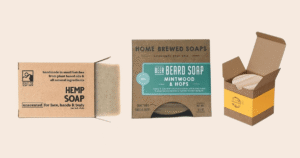

Kraft packaging is the default visual language of natural personal care. Walk into any independent health food store, artisan market, or wellness boutique, and the dominant aesthetic in the soap section is brown kraft board with minimalist typography.
This is not accident, it is the result of a genuine alignment between the values that kraft communicates and the values that customers in this category are buying.
But kraft soap boxes are not a monolithic category. The material, weight, construction style, printing approach, and finishing options vary considerably, and the choices you make within those variables determine whether your boxes look considered and premium or utilitarian and forgettable.
What Kraft Paperboard Actually Is
Kraft is a papermaking process, not a material type per se. In the kraft process, wood chips are cooked in a solution of sodium hydroxide and sodium sulphide which breaks down lignin and leaves strong, long wood fibres intact.
Those long fibres give kraft paper its characteristic toughness and tear resistance.
Unbleached kraft board retains its natural brown colour from the lignin content that remains after pulping. The specific shade, from light tan to deep chocolate, varies by wood source and processing conditions.
For soap boxes, kraft board is typically used in 300 to 450 GSM weights. Below 300 GSM, the board can feel flimsy. Above 450 GSM, the board becomes difficult to score and fold cleanly without specialised equipment.
Structural Options for Kraft Soap Boxes
Tuck-End Box
The most common structure in soap boxes across all material types. The tuck-end kraft box is versatile, economical, and immediately recognisable as artisan packaging. Both reverse and straight tuck configurations are available.
Sleeve-and-Tray
A kraft sleeve over a white or kraft tray combines the natural aesthetic of kraft with a premium structural format.
The tray component can be left as natural kraft or lined in white for enhanced interior presentation, a meaningful distinction for soap brands where the appearance of the bar against the box interior affects purchase perception.
Folding Carton with Window
A die-cut cellophane-covered window in a kraft folding carton allows the soap bar to be partially visible.
This is highly effective for soaps with visual appeal, natural colour from botanical pigments, embedded herbs or flowers, or distinctive swirl patterns from cold-process techniques.
Printing on Kraft: The Rules Are Different
Printing on kraft board requires a different mindset than printing on white board. All printing inks are semi-transparent, which means the brown tone of the board shows through and shifts colour appearance.
A CMYK blue on white board appears as a true blue. The same ink on kraft board appears as a muted, warm-shifted teal with brown undertones.
Two-colour and limited-colour palettes are the most successful design approach on kraft board. Rather than fighting the substrate colour, designs that work with it, using the kraft tone as the third colour in a two-colour print scheme, tend to look intentional and considered.
Black or dark navy plus a single accent colour on kraft is a combination that has worked consistently well across artisan soap categories for years.
Foil Stamping on Kraft
Gold, copper, and silver foil stamping on natural kraft creates perhaps the most visually effective premium combination in artisan soap packaging.
The metallic sheen against the organic texture creates a contrast that reads as simultaneously traditional and sophisticated. Foil can be applied to logos, brand names, and decorative elements.
Sustainability Claims: What Kraft Boxes Do and Do Not Justify
What kraft packaging legitimately supports:
- ‘Made with natural fibre’ or ‘natural paper packaging’, accurate if the board is unbleached kraft
- ‘FSC-certified materials’, only if the board carries actual FSC certification from your supplier
- ‘Plastic-free packaging’, accurate if no lamination or synthetic coating is applied
What kraft packaging does not automatically justify:
- ‘Recyclable’, laminated or coated kraft may not be kerbside recyclable. Uncoated, unlaminated kraft boxes generally are, but confirm with your supplier.
- ‘Compostable’, this requires specific certification. Kraft board without synthetic additives may be compostable in industrial facilities, but home compostability claims require separate certification.
- ‘Sustainable packaging’ as a standalone claim, the FTC Green Guides require that broad environmental claims be qualified and substantiated.
Ordering Kraft Soap Boxes: Practical Specifications
- Board weight: 350 to 400 GSM for standard soap bars. For heavier bars above 5 oz., consider 400 to 450 GSM.
- Printing: Specify ‘printing on natural kraft’ explicitly. If colour accuracy is important, discuss white underbase with your printer before confirming specs.
- Finish: Uncoated or matte aqueous coating for the most authentic natural appearance. Avoid gloss lamination.
- Foil: Specify foil area in square inches and confirm compatibility with your printer’s equipment.
- Sample: Request a physical pre-production sample on the actual board weight you are ordering.