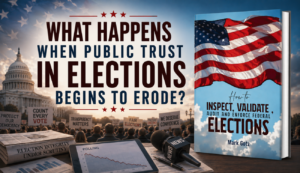

Democracies are built on more than laws and institutions.
They are built on trust.
Trust that systems function fairly.
Trust that procedures are followed consistently.
Trust that the outcome of an election reflects the lawful participation of voters.
When that trust begins to weaken, the effects extend far beyond politics.
In How to Inspect, Validate, Audit, and Enforce Federal Elections, author Mark Gotz examines the growing national conversation surrounding election confidence and asks a difficult but increasingly important question:
What happens when large numbers of citizens no longer feel certain about the systems governing elections?
Rather than approaching the issue through political rhetoric, the book focuses on the underlying structures that shape public confidence. Voter registration maintenance, vote-by-mail procedures, public oversight rights, election audits, and federal compliance requirements are all explored as part of a larger discussion about transparency and accountability.
The tone is measured.
Deliberate.
And rooted in civic concern rather than outrage.
Throughout the book, Gotz suggests that distrust rarely emerges from a single event. More often, it develops gradually when citizens feel disconnected from the processes that determine how elections are administered and verified.
That disconnect, according to the author, creates uncertainty.
And uncertainty has consequences.
The book repeatedly emphasizes that confidence in elections is not maintained through slogans or assurances alone. It is strengthened when procedures are visible, understandable, and open to lawful public review.
This idea becomes one of the central themes of the work.
Transparency, the book argues, is not simply about releasing results after votes are counted. It is about allowing citizens to understand how the process functions from beginning to end.
That includes voter registration systems.
Ballot handling procedures.
Audit mechanisms.
Record preservation requirements.
And citizen oversight rights established under federal law.
Gotz spends considerable time explaining these systems in practical language, making the material accessible to readers without legal or technical backgrounds. The writing avoids unnecessary complexity while still addressing detailed procedural issues that often remain outside public discussion.
As a result, the book feels educational rather than combative.
Its purpose is not merely to raise concerns.
It is to encourage understanding.
That distinction matters.
In recent years, election conversations have frequently become polarized and emotionally charged. But How to Inspect, Validate, Audit, and Enforce Federal Elections approaches the subject from a different angle. Instead of centering exclusively on outcomes, the book focuses on process—how systems operate, where oversight exists, and why public participation matters.
For Gotz, confidence is closely tied to visibility.
People are more likely to trust systems they understand.
The book also explores the psychological dimension of democratic trust. Elections are not only administrative exercises; they are public rituals that reinforce legitimacy within a representative government. When citizens lose faith in the fairness or transparency of those systems, social division often follows.
This broader societal concern gives the work much of its urgency.
The discussion extends beyond technical election procedures and into larger questions about civic stability, institutional credibility, and citizen responsibility. Again and again, the author returns to the idea that democratic systems depend on active participation—not only through voting, but through awareness and oversight.
There is also a noticeable historical perspective throughout the book.
References to constitutional principles, federal election laws, and America’s tradition of self-government frame the discussion within a broader civic context. The message is not that democracy is failing, but that democracy requires continual public engagement in order to function effectively.
That engagement, according to the author, begins with education.
Citizens who understand how election systems work are better equipped to evaluate concerns responsibly, ask informed questions, and participate constructively in public life.
This educational focus gives the book a different tone than many contemporary political works.
It does not attempt to inflame.
It attempts to inform.
At the same time, the book does not avoid difficult realities. It openly acknowledges that distrust surrounding elections has become widespread across the country and that restoring confidence may require greater transparency and stronger public understanding moving forward.
For Gotz, rebuilding trust is not about demanding blind faith in institutions.
It is about creating systems that citizens can observe, evaluate, and understand for themselves.
Ultimately, How to Inspect, Validate, Audit, and Enforce Federal Elections presents election integrity as something larger than politics.
It is framed as a question of civic stability.
Public confidence.
And the long-term health of democratic society.
Whether readers approach the book with concern, curiosity, or skepticism, it offers a detailed exploration of why trust matters—and why maintaining that trust may be one of the defining civic challenges of our time.
For more information about How to Inspect, Validate, Audit, and Enforce Federal Elections or to schedule an interview with Mark Gotz, please contact:
Media Contact:
Author: Mark Gotz
Amazon: How to Inspect, Validate, Audit, and Enforce Federal Elections: An Educational Pamphlet for Citizens
Email: theelectionexpert@gmail.com
About Mark Gotz:
Mark Gotz has spent more than two decades involved in election observation and oversight efforts. His work focuses on election transparency, public accountability, and educating citizens about federal election procedures and civic participation within the democratic process.