
Introduction
Working with metal at extreme temperatures is one of the oldest manufacturing traditions in human history. Today, industrial forging has evolved from small blacksmith shops into massive, highly automated production lines. While technology has drastically increased production speeds, the core elements remain the same: intense heat, heavy pressure, and powerful machinery.
In a modern heavy engineering environment, safety isn’t just a checklist—it is the foundation of the entire operation. Because forging handles metals heated up to several thousand degrees, manufacturing plants enforce rigorous protocols to protect their workforce.
The Realities of the Forging Floor
To understand why safety measures are so strict, it helps to understand the environment. Forging involves massive mechanical hammers, press machines, and automated induction furnaces.
Even during controlled shaping, hot metal naturally sheds surface scale and creates flying sparks. To counteract these hazards, industrial plants rely on five core safety practices.
5 Non-Negotiable Safety Protocols in Modern Forging
1. Advanced Personal Protective Equipment (PPE)
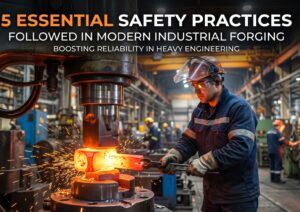
Standard work clothes do not cut it on a forging floor. Every operator and visitor is required to wear specialized gear before stepping near the production line:
- Aluminized /Flame-Resistant Clothing: Reflects radiant heat away from the body.
- High-Impact Safety Glasses & Face Shields: Essential for protecting eyes from stray sparks and airborne oxide scale.
- Heavy-Duty Metatarsal Boots: Steel-toed boots that also offer top-of-foot protection against dropping heavy dies or billets.
2. Pre-Heating the Dies
A common beginner mistake in metalworking is placing a white-hot metal piece onto a freezing cold die. This stark temperature difference causes thermal shock, which can cause the hard steel die to crack or violently shatter under pressure. Modern plants always gradually pre-heat forging dies to ensure structural stability before production begins.
3. Two-Hand Control Systems on Heavy Press Machinery
Modern heavy machinery manufacturing relies heavily on engineering controls to eliminate human error. Most industrial presses utilize “two-hand controls.” This design forces the operator to keep both hands pressing down on separate buttons far away from the machine’s moving parts to cycle the press, ensuring hands can never be trapped in the danger zone.
4. Proper Scale Management
As hot steel is compressed, a flaky crust called “scale” forms on the surface of the metal. If this scale is allowed to build up on the die surface, it ruins the surface finish of the next part and can fly off explosively under the hammer. Forging lines use automated air blasts or specialized scrapers to keep dies completely clear between runs.
5. Comprehensive Automated Ventilation
Heating massive quantities of metal and treating them with industrial lubricants generates fumes and high ambient room temperatures. Large-scale plants employ high-capacity HVAC systems and localized exhaust hoods over furnaces to maintain clean air quality and prevent heat exhaustion.
The Routine Production Pipeline
Ensuring these protocols are met is a continuous process that occurs during every single production shift:
1.Conduct Pre-Operational Inspection:
Operators inspect all hydraulic lines, emergency stop buttons, and guard rails to ensure the machinery is fully functional.
2.Verify Proper Tool and Die Alignment:
Ensure the upper and lower dies are perfectly aligned and securely bolted to avoid uneven shifting under pressure.
3.Monitor Temperature Thresholds:Active Production.
Keep a close watch on both the furnace indicators and die pre-heat temperatures to prevent structural thermal shock.
4.Execute Post-Run Housekeeping:.
Clear out accumulated scale from the machinery beds and log any mechanical wear and tear for the maintenance team.
Conclusion
Modern industrial forging proves that heavy industrial environments can be both incredibly productive and exceptionally safe. By combining robust engineering controls, strict personal protective habits, and routine maintenance, facilities create high-performance parts without compromising the well-being of their teams.
Partnering with an established expert in precision industrial component manufacturing ensures your engineering projects are handled in facilities that prioritize strict international quality and safety benchmarks, resulting in dependable, defect-free components.