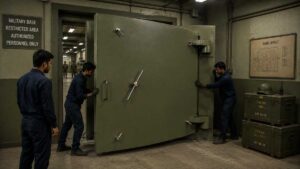

A single unprotected opening can become the weakest point in a defence shelter, refinery control room, or underground utility space during an explosion event. That is why Blast proof door manufacturers in India are now evaluated not only on fabrication cost, but on tested performance, sealing reliability, installation quality, and integration with protective systems. It explains ROI, cost drivers, vendor checks, and practical specifications for Indian projects.
Quick Answer: Blast proof door manufacturers in India are worth the investment when a facility faces explosion, fireball, debris, or CBRN-related pressure risk because the door protects the most vulnerable access opening in the structure. A properly engineered blast door should be selected using calculated overpressure, impulse duration, frame anchoring, and standards such as STANAG, NBC India, OISD, or project-specific DRDO criteria.
What is a Blast Proof Door and Why Indian Facilities Need It
A blast proof door is a reinforced protective door assembly designed to resist explosion pressure waves, impact fragments, frame distortion, and hazardous air ingress in defence shelters, refineries, CBRN buildings, power plants, tunnels, and secure industrial facilities. It is different from a heavy steel door because the leaf, frame, hinges, locking system, anchors, and seals must act as one engineered barrier under shock loading.
A Sigma Power Tech Blast Door may also be integrated with blast valves, gas-tight doors, CBRN filtration, fire detection, CCTV, and BMS logic where the protected room must remain operational after an external event. Typical project references include NBC shelter practices, OISD safety expectations, and blast ratings from about 0.5 bar to 20 bar depending on threat assessment.
How Blast Proof Door Manufacturers in India Select the Right System
Blast proof door manufacturers in India select the right system by matching the blast risk, door size, operating method, sealing requirement, and civil opening design to the facility’s safety objective.
- Define the threat case — Defence shelters, ammunition areas, hydrogen zones, and refinery control rooms need different overpressure and impulse assumptions, so one standard model rarely fits all Indian projects.
- Verify the full assembly — Procurement teams often check steel thickness but miss the frame, hinges, latches, grout pocket, anchor bolts, and wall embedment, where most failures begin.
- Select operation and sealing — Manual swing doors suit many shelters, while sliding, hydraulic, or motorized systems may be needed for vehicle access or remote emergency control.
- Compare lifecycle cost — The lowest blast door price can become expensive if it needs rework, imported spares, coating repair, or civil modification during commissioning.
Pro Tip: For CBRN shelters in India, specify gas-tight sealing with the blast rating because pressure resistance alone doesn’t stop smoke, toxic vapour, or contaminated air from entering the protected zone.
Common Mistakes When Specifying or Installing Blast Proof Doors
Blast proof door manufacturers in India often see failures when the door is purchased as a standalone fabrication item instead of a tested protective assembly matched to the building structure.
Wrong wall-opening coordination
A blast-rated leaf cannot perform if the RCC wall, embedded frame, or anchor layout is weaker than the door. Freeze the clear opening, rebate, grout depth, and fixing details before fabrication.
Over-specifying without risk logic
Not all facilities require the maximum blast rating. Over-specification increases weight, actuator size, hinge load, and cost without proportional safety gain.
Ignoring sealing and integration
A CBRN or refinery control room may need gas-tight sealing, fire alarm interface, door-position feedback, and BMS monitoring.
For a complete technical guide on Blast proof door manufacturers in India including reinforced steel structures, specialized frames, engineered locking systems, and gas-tight sealing for protected facilities, the Blast Door Manufacturer page on SigmaPowerTech.com is worth bookmarking for reference.
Key Specifications and India-Specific Considerations
Blast proof door manufacturers in India should be evaluated on blast rating, tested assembly behaviour, installation support, environmental durability, and integration readiness for Indian project conditions.
- Standards and references — Use STANAG, NBC India, OISD-117, IS 2189 for connected fire detection, and project-specific DRDO specifications where applicable.
- Project context — PSU refineries, defence bunkers, IIT laboratories, AIIMS-type hospitals, data centres, and metro corridors may require different safety and access priorities.
- Lead time — Custom blast resistant doors from Indian manufacturers generally need 8–20 weeks depending on size, automation, coatings, hardware, and documentation.
- Price range — A practical blast door price in India may start near ₹2.5 lakh and exceed ₹25 lakh for large, gas-tight, automated, or high-rating assemblies.
- Site conditions — Indian heat, coastal humidity, corrosion, seismic zones, and dusty industrial environments make coating, gasket quality, hinge serviceability, and spares availability important.
FAQ
Q: What is a blast proof door and how does it work?
A: A blast proof door is a reinforced steel safety assembly that resists explosion pressure, debris impact, and sudden structural loading at protected openings. It works by transferring blast force from the door leaf into the frame, anchors, and surrounding wall, helping protect defence shelters, refineries, tunnels, and secure buildings.
Q: What standards should Blast proof door manufacturers in India follow?
A: India does not use one single universal blast-door standard for every project, so specifications usually reference STANAG blast criteria, NBC India, OISD guidelines, DRDO project requirements, or consultant-defined overpressure ratings. Buyers should ask for rating basis, frame details, material certificates, and installation drawings before approval.
Q: Are blast proof doors worth the cost for Indian facilities?
A: Blast proof doors are worth the cost when the facility contains people, mission-critical equipment, fuel, hazardous chemicals, or strategic operations exposed to explosion risk. The lifecycle value comes from reducing injury risk, limiting downtime, protecting assets, and avoiding expensive retrofits after civil construction is complete.