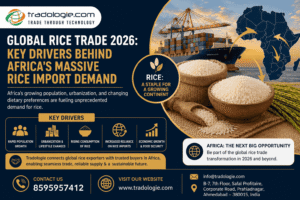

Agricultural demand across Africa is growing at an exceptionally fast pace, where some may say that it has moved on from being just a market to tap into to a ‘global demand engine.’ If you want to understand the demand drivers across Africa and how to tap into them, this blog might help you expand your knowledge, and with the right tools, you will not have to maneuver through the complexities of the modern rice trade.
Africa takes the stage in the global rice trade in 2026. It was once a growing import market, and it has turned into one of the most powerful demand engines influencing international rice flows, export strategies, and price trends.
Throughout the continent, domestic production of rice is not keeping up with the increase in consumption. Rice has emerged as a key staple in many African economies, driven by rapid urbanization, population growth, changing diets, and the rise of middle-income populations. Therefore, West, Central, and East African countries continue to heavily rely on imports to fill the increasing supply gap.
Rice importers in Sub-Saharan Africa imported around 22.3 million tonnes of rice in 2025, according to OSIRIZ estimates, a sharp increase year-on-year and underlining the continent’s position as one of the world’s largest rice-importing regions.
Industry reports also suggest that Africa now accounts for nearly one-third of all global rice imports, making it one of the most strategically important destinations for rice exporters globally.
Types of Imported Rice in Africa
Africa imports various types of rice according to regional consumption patterns, price sensitivity, and purchasing power.
Parboiled rice has taken over imports in all of West Africa because of its low price, long shelf life, and retention of nutrients. The big consumers of Indian parboiled rice are Nigeria, Senegal, Benin, Ghana, and Cote d’Ivoire.
Non-basmati white rice is a commodity of volume for mass consumption markets. It is preferred in several African countries, as it is a compromise between cost and availability of stable supply.
Broken rice imports are significant in price-sensitive markets and are used widely in food processing, brewing, and institutional supply systems.
Basmati Rice: The African market is mainly a volume-driven market, but premium rice categories are also growing. Basmati rice is increasingly marketed to urban middle-class consumers and the hospitality sectors, especially in the East African and high-income urban markets.
The Major Sources of Rice Imported into Africa
Rice exporters from Aisa are key to the African rice import ecosystem.
India remains the dominant supplier to African markets thanks to its large capacity, competitive prices, and diversified rice portfolio. The country supplies the whole continent mainly with non-basmati rice, broken rice, and basmati varieties, as well as parboiled rice.
Thailand still ships high-grade white and fragrant rice to Africa, mostly in the upper quality segments.
Vietnam is also a key supplier of competitively priced white rice to parts of Africa.
Pakistan continues to play a role in the Basmati and long-grain rice trade, especially in premium import markets.
Myanmar also plays a role in volume supply in some African markets, especially in lower-cost rice segments.
West Africa: The Core of Global Rice Imports
West Africa remains the single largest concentration of rice demand globally.
Countries such as Nigeria, Senegal, Côte d’Ivoire, Benin, and Ghana collectively account for massive annual import volumes.
Nigeria alone imported an estimated 3.4 million tonnes in 2025, while Côte d’Ivoire and Senegal together represented a significant share of regional demand growth.
Benin also plays a strategic role as a redistribution hub for rice entering neighboring West African markets.
Global Rice Prices Are Increasingly Linked to African Demand
African purchases are now directly influencing the international rice price trend. Rice exporters in India, Thailand, and Vietnam adjust pricing and shipment priorities as demand strengthens across West Africa.
Recent market reports suggest that increased African demand, coupled with large export volumes from India and the availability of global stocks, has had a significant impact on global price movements through 2025 and into 2026.
This means that exporters worldwide are looking more and more to Africa, not as a secondary destination, but as a key driver of long-term rice trade strategy.
The Procurement Challenge in Africa Rice Trade
Despite the scale of opportunity, the African rice trade ecosystem is still operationally complex.
Importers and exporters often find themselves in situations that hinder bulk rice trade operations.
- Price volatility
- Currency fluctuations
- Freight disruptions
- Fragmented supplier networks
- Inconsistent communication
- Documentation and compliance challenges
Traditional procurement methods include brokers and manual negotiations that often lack transparency and take longer to execute.
With rice volumes continuing to grow, the need for more structured systems of procurement is becoming ever more critical.
Why Digital Procurement Platforms Are Becoming Essential
The rice trade of the future is becoming more and more digital and system-driven.
AI-driven trade ecosystems like Tradologie.com are revolutionizing the commodity procurement space and connecting verified buyers and suppliers across the globe. Importers and exporters can digitally connect in a structured environment to negotiate transparently, communicate via a central platform, and discover prices in real time instead of going through different channels.
This gives exporters direct access to serious bulk buyers who want to tap into the continent’s growing demand for rice. For importers, it helps in finding suppliers and enhances procurement efficiency and trade transparency.
Tradologie.com, with over 1 million+ global B2B participants and billions of dollars in trade facilitated over the last decade, represents how global agro-trade is evolving towards scalable, technology-driven procurement infrastructure and the necessity of it.
Africa’s role in the global rice trade is not emerging—it is here to stay. This demand is forcing large rice-producing countries to change their export priorities.