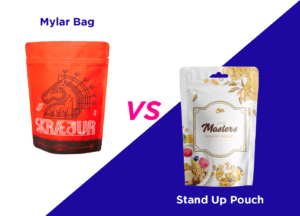

Flexible packaging has become one of the fastest-growing segments in U.S. retail and e-commerce packaging. Within that category, two formats dominate buyer inquiries: Mylar bags and Kraft pouches. They look superficially similar, both are pouch-format, both are customizable, yet they serve fundamentally different functions.
Choosing the wrong one can mean spoiled product, failed compliance audits, or a brand aesthetic that misses the mark with your target customer. This guide compares both formats across the dimensions that matter most to procurement managers and brand owners.
Understanding Mylar Bags
Mylar is the trade name for BoPET, biaxially-oriented polyethylene terephthalate, a polyester film manufactured through a stretching process that aligns its polymer chains, creating exceptional strength and barrier properties.
In packaging applications, Mylar film is laminated with additional layers (typically aluminum foil and polyethylene) to create a multi-layer structure with the following characteristics:
- Oxygen barrier: OTR (oxygen transmission rate) as low as 0.1 cc/m²/day in foil-laminate constructions
- Moisture barrier: MVTR (moisture vapor transmission rate) below 0.1 g/m²/day
- Light barrier: aluminum layer blocks UV and visible light completely
- Heat sealability: polyethylene inner layer enables hermetic sealing
These properties make Mylar the dominant choice for products where oxidation, moisture, or light exposure would degrade quality or safety, including dried foods, dietary supplements, cannabis, coffee, and pharmaceutical products.
Understanding Kraft Pouches
Kraft pouches are manufactured from kraft paper, unbleached wood pulp paper, often laminated with a thin polyethylene or PLA (polylactic acid) interior lining for minimal moisture resistance and heat sealability.
The defining characteristic is the natural brown paper aesthetic that signals sustainability and artisanal quality to consumers.
Kraft pouches are popular with coffee roasters, snack brands, tea companies, and natural product brands whose customer base values environmental responsibility.
The material is compostable (when certified) or recyclable (paper-only constructions), aligning with growing U.S. consumer expectations around packaging sustainability.
Here’s what most buyers overlook: standard Kraft pouches are not true barrier packaging. The paper layers are porous, and unless heavily laminated, they will not protect oxygen-sensitive products for extended shelf life.
Barrier Performance: Where Mylar Wins Decisively
If your product requires a meaningful shelf-life extension through packaging, anything beyond four to six weeks, Mylar wins this comparison categorically. The science is not close.
- Standard Kraft pouch OTR: 50–200+ cc/m²/day (varies by lamination)
- Foil Mylar pouch OTR: 0.1–0.5 cc/m²/day
For a supplement brand claiming a 24-month shelf life, or a cannabis brand whose state regulations require demonstrable product protection, standard Kraft is simply not a viable substrate.
Barrier-enhanced Kraft pouches (with aluminum foil laminates) exist, but they sacrifice the compostability and recyclability that make Kraft appealing in the first place.
For short shelf-life products, artisan baked goods sold within days of production, for example, standard Kraft is entirely adequate and carries lower cost.
Aesthetic and Brand Positioning
This is where the comparison becomes more nuanced. Mylar bags print brilliantly. Digital and rotogravure printing on Mylar substrates produce vivid, high-contrast graphics, metallic finishes, matte textures, and photographic-quality imagery are all achievable.
For cannabis brands, supplement companies, and premium snack brands competing in retail environments, high-impact Mylar graphics are a significant commercial lever.
Kraft pouches project a different signal: natural, artisanal, environmentally responsible. This is genuinely valuable positioning for the right brand. Farm-to-table coffee roasters, small-batch tea blenders, and organic snack companies have built strong brand equity specifically through Kraft packaging aesthetics.
The question is whether your brand story aligns with what each material communicates. A synthetic vitamin brand in Kraft packaging creates a cognitive dissonance; a wild-harvested herbal supplement in ultra-glossy Mylar may undermine its positioning with its core buyer.
Cost Comparison
On a per-unit basis, Kraft pouches generally cost less than comparable Mylar constructions at equivalent order volumes.
The raw material cost of kraft paper is lower than BoPET film, and Kraft supply chains are deeply established in the U.S. market.
However, total cost of ownership favors Mylar for products requiring barrier performance. If a Kraft pouch allows product to degrade faster, requiring shorter production runs, higher write-offs, or returns, the per-unit savings evaporate.
Mylar’s protection of product integrity reduces waste and supports the higher retail prices that justify premium packaging spend.
Both formats support similar customization: stand-up pouch (SUP) construction, zipper closures, tear notches, round-bottom gussets, and custom sizing.
If you’re sourcing either format at scale, Alpha Global Packaging offers custom Mylar bag options with flexible order quantities designed to work for emerging brands and established operations alike.
Regulatory and Compliance Factors
In regulated categories, material choice intersects directly with compliance requirements. Cannabis packaging in most U.S. states requires child-resistant construction per ASTM D3475, requirements that Mylar with appropriate closure systems can meet, while standard Kraft cannot without significant modification.
Food packaging for long-shelf-life products (anything claiming 12+ months) requires demonstrable barrier performance, again, Mylar’s domain. FDA 21 CFR Part 177 governs indirect food contact materials for both substrates; always verify your specific laminate construction meets applicable standards.
Note: Food-grade packaging must meet applicable food safety regulations. Confirm compliance requirements with your supplier before ordering.
Sustainability Considerations
U.S. consumer research consistently shows that packaging sustainability is a purchase-influencing factor, particularly in natural food, wellness, and personal care categories. Kraft pouches, especially those certified compostable to ASTM D6400, carry a genuine sustainability advantage.
Mylar bags, due to their multi-layer laminate construction, are generally not recyclable through standard U.S. municipal recycling streams.
Some brands offset this through take-back programs or by working with specialty flexible film recyclers (available through the How2Recycle program).
The honest answer is that neither format is without environmental trade-offs, and the right choice depends on how central sustainability positioning is to your brand.
Decision Framework
- Long shelf life required (6+ months) → Mylar
- Sustainability is central to brand identity → Kraft
- High retail visibility, premium graphics important → Mylar
- Short shelf life, artisan product → Kraft
- Regulated product (cannabis, supplements) → Mylar
- Budget constrained, barrier not critical → Kraft
Final Recommendation
Most product categories have a clear winner when barrier requirements are specified honestly. For anything that needs real protection against oxygen, moisture, or light, Mylar is the professional choice.
For short shelf-life products where brand sustainability positioning matters, Kraft is a strong and commercially smart option.
The worst outcome is choosing the aesthetically preferred option without validating it against your actual product protection requirements. Both materials are available in premium custom-printed formats.
The decision should be driven by what your product needs, not just what looks good in a brand deck.