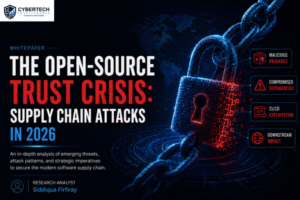

Why CISOs and DevSecOps Leaders Must Rethink Software Trust
Open source software powers today’s enterprise innovation — from cloud-native applications and AI-driven services to financial systems and critical infrastructure. But in 2026, the very ecosystems organizations trust most have become prime targets for cybercriminals.
Modern attackers are no longer breaching enterprises directly. Instead, they are exploiting the software supply chain itself through:
- Dependency confusion attacks
- Package injection campaigns
- Compromised maintainer accounts
- Poisoned CI/CD workflows
- Malicious GitHub Actions
- AI-assisted malware and social engineering
As organizations accelerate software delivery using public repositories like GitHub, npm, PyPI, and Maven Central, security teams are struggling to maintain visibility, governance, and trust across increasingly complex dependency chains.
This whitepaper explores how software supply chain threats are evolving and why conventional cybersecurity approaches are no longer sufficient.
Inside the Whitepaper
Key Insights Include:
- The growing risks of open source dependency sprawl
- How AI is amplifying software supply chain attacks
- Emerging attack techniques targeting CI/CD pipelines and automation workflows
- Real-world incidents involving GitHub repositories and build systems
- Why traditional perimeter defenses fail against trusted software threats
- The rise of software provenance verification and trust governance
Learn How to Strengthen Your Organization’s Resilience:
- Implement automated SBOM strategies
- Harden CI/CD pipelines against workflow compromise
- Establish dependency governance frameworks
- Detect malicious runtime behaviors in real time
- Validate software provenance using SLSA and OpenSSF controls
- Build executive-level accountability for software trust governance
Why This Matters
Software supply chain attacks now create systemic risks that impact not only development teams, but also:
- Financial institutions
- Manufacturing operations
- Critical infrastructure providers
- Healthcare systems
- Cloud-native enterprises
One compromised package can cascade across thousands of organizations, bypassing traditional security controls through trusted software relationships.
Who Should Read This Whitepaper?
- CISOs
- DevSecOps Leaders
- Security Architects
- Cloud Security Teams
- Engineering Executives
- Compliance & Risk Professionals
- Software Supply Chain Governance Teams
Gain a strategic framework for securing modern software ecosystems and defending against the next generation of software supply chain threats.
About Us
CyberTechnology Insights (CyberTech) is a trusted repository of high-quality IT and security news, insights, and trends analysis, founded in 2024. We curate research-based content across 1,500-plus IT and security categories to help CIOs, CISOs, and senior security professionals navigate the evolving cybersecurity landscape. Our mission is to empower enterprise security decision-makers with actionable intelligence, deliver in-depth analysis across risk management, network defense, fraud prevention, and data loss prevention, and build a community of ethical, compliant, and collaborative IT and security leaders committed to safeguarding digital organizations and online human rights.
Open Source Software Supply Chain Attacks in 2026
Visibility, Trust, and Resilience in the Age of AI-Driven Threats
Open source software is now the backbone of modern enterprise technology. From cloud-native applications to AI platforms and critical infrastructure systems, organizations rely heavily on third-party libraries, APIs, and automated CI/CD pipelines to accelerate innovation.
But in 2026, this dependency has become one of the most exploited attack surfaces in cybersecurity.
A New Era of Software Supply Chain Attacks
Cybercriminals are no longer focusing solely on breaking enterprise perimeters. Instead, they are increasingly targeting the software development ecosystem itself — where trust is implicit and automation is dominant.
Today’s attacks include:
- Dependency confusion attacks targeting internal package resolution
- Malicious package injections in public repositories like npm, PyPI, and Maven Central
- Compromised maintainer accounts through phishing and token theft
- Poisoned CI/CD pipelines manipulating build and deployment processes
- Malicious GitHub Actions used for secret exfiltration and persistence
- AI-powered attacks enabling faster reconnaissance, malware creation, and impersonation
A single compromised dependency can silently propagate across development, testing, and production environments — impacting entire digital ecosystems before detection.
The Growing Trust Crisis in Open Source
Modern software development depends on hundreds of direct and transitive dependencies. While this accelerates delivery, it also creates blind spots in security visibility.
Key challenges include:
- Limited visibility into transitive dependencies
- Abandoned or poorly maintained open source packages
- Lack of verification for package authenticity and maintainers
- Weak governance over third-party software usage
- Rapid AI-assisted development without proper security validation
Even widely trusted repositories are no longer immune, as attackers increasingly exploit social engineering, automation vulnerabilities, and build system weaknesses.
Why Traditional Security Models Are No Longer Enough
Conventional cybersecurity tools focus on endpoints, networks, and known vulnerabilities. However, software supply chain attacks bypass these defenses by infiltrating trusted development workflows.
As a result, organizations struggle with:
- Incomplete Software Bills of Materials (SBOMs)
- Insufficient Software Composition Analysis (SCA) coverage
- Lack of runtime visibility into package behavior
- Limited detection of build-time tampering
- Fragmented governance across engineering teams
Real-World Impact Across Industries
Software supply chain compromises now affect far more than engineering teams:
- Financial Services: Risk to digital payments, fraud systems, and customer data
- Manufacturing: Disruption of industrial control systems and IoT operations
- Critical Infrastructure: Threats to energy, telecom, transportation, and utilities
- Cloud & SaaS Providers: Cascading compromise across global customer environments
Building a Resilient Software Supply Chain
To counter these evolving threats, organizations must shift from reactive security to proactive trust governance.
Key strategies include:
- Automating SBOM generation across all pipelines
- Hardening CI/CD environments with isolation and least privilege
- Enforcing dependency governance and package allow-lists
- Implementing software provenance verification (SLSA, OpenSSF)
- Continuous runtime monitoring for suspicious behavior
- Establishing executive-level accountability for software trust
The Future of Software Security
The industry is rapidly shifting from vulnerability-centric security to trust-centric governance. In this new model, organizations must continuously verify:
- What software is running
- Where it came from
- Who built it
- How it behaves in runtime
Security is no longer just about preventing malicious code — it is about continuously validating software integrity across its entire lifecycle.
Final Thought
In an era of AI-driven development and hyper-automated pipelines, the software supply chain has become both the foundation and the weakest link of enterprise security.
Contact Us
1846 E Innovation Park Dr, Suite 100, Oro Valley, AZ 85755
Phone: +1 (845) 347-8894, +91 77760 9266