
In the world of engineering, manufacturing, and mechanical maintenance, precision is everything. One small miscalculation in thread measurement can lead to improper fitting, mechanical failure, or costly rework. Among the many parameters that define a thread, thread pitch plays a crucial role. Understanding thread pitch and how to measure it accurately using a Metric thread gauge is essential for professionals and beginners alike. Gaugestools, a trusted supplier of precision instruments, provides high-quality metric thread gauges designed to simplify this process while ensuring accuracy and reliability.
What Is Thread Pitch?
Thread pitch refers to the distance between two adjacent threads on a screw or bolt. In metric systems, this distance is measured in millimeters. For example, a bolt labeled M10 × 1.5 has a thread pitch of 1.5 mm, meaning the distance between each thread is 1.5 mm.
Thread pitch is a critical specification because it determines compatibility between threaded components. Even if two fasteners have the same diameter, a mismatch in pitch will prevent proper engagement. This is why accurate measurement tools like metric thread gauges are indispensable.
What Is a Metric Thread Gauge?
A metric thread gauge is a precision tool used to verify whether a threaded component meets specified standards. These gauges are typically available in two main types:
- Thread plug gauges – used to check internal threads
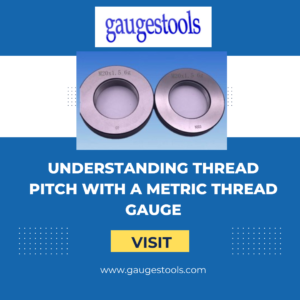
- Thread ring gauges – used to check external threads
According to Gaugestools, these gauges are commonly designed as GO/NO-GO tools, meaning they quickly determine whether a thread falls within acceptable tolerance limits rather than providing exact measurements.
The “GO” end should pass smoothly through the thread, confirming that the minimum tolerance is met, while the “NO-GO” end should not pass more than a couple of turns, ensuring the thread does not exceed maximum limits.
Why Thread Pitch Matters
Thread pitch directly affects how tightly or loosely components fit together. It influences:
- Strength of connection
- Load distribution
- Resistance to vibration
- Ease of assembly and disassembly
In industrial applications, even a slight variation in pitch can compromise safety and performance. That’s why thread pitch must be verified using reliable tools rather than visual estimation.
How Metric Thread Gauges Measure Pitch
Metric thread gauges do not measure pitch in the same way as a ruler or caliper. Instead, they verify whether the thread conforms to a predefined pitch standard.
When using a metric thread gauge:
- Select the appropriate gauge size (e.g., M8 × 1.25).
- Insert or apply the GO gauge to the threaded part.
- Ensure it passes smoothly without force.
- Test with the NO-GO gauge to confirm it does not pass beyond the allowed limit.
This process ensures that both the pitch and overall thread geometry are within acceptable tolerances. Thread gauges also check parameters like pitch diameter and thread angle deviations, not just spacing.
Standards Behind Metric Thread Gauges
Metric thread gauges are manufactured according to international standards to ensure consistency and interchangeability. Gaugestools produces gauges based on widely recognized standards such as:
- ISO 1502
- ASME B1.16M
- DIN and BS standards
These standards define thread dimensions, tolerances, and inspection methods, ensuring compatibility across industries and countries.
Key Features of Gaugestools Metric Thread Gauges
Gaugestools offers a wide range of metric thread gauges designed for durability and precision. Some of the notable features include:
- High-quality material: Made from hardened bearing steel (GCr15) for wear resistance
- Precision engineering: Ensures accurate verification of thread pitch and dimensions
- Wide size range: Available from M2 to M200 for various applications
- Custom options: Special pitch, diameter, and tolerance classes available
- Calibration support: Certification available from ISO-accredited labs
These features make them suitable for industries ranging from automotive and aerospace to general manufacturing.
Types of Thread Pitch in Metric Systems
Metric threads are generally categorized into:
- Coarse threads – Standard pitch, commonly used for general applications
- Fine threads – Smaller pitch, used for precision and high-strength applications
Thread gauges are designed to verify both types, ensuring that each component meets its intended design specification.
Practical Applications
Understanding and measuring thread pitch using a metric thread gauge is essential in many fields:
- Manufacturing – Ensures parts meet design specifications
- Quality control – Verifies product consistency and compliance
- Maintenance and repair – Identifies correct replacement parts
- Engineering design – Confirms compatibility of threaded components
Thread gauges are especially valuable in high-volume production environments, where quick and reliable inspection is critical.
Benefits of Using Metric Thread Gauges
Using a metric thread gauge offers several advantages:
- Accuracy – Eliminates guesswork in thread identification
- Speed – Provides instant GO/NO-GO results
- Reliability – Ensures consistent quality across components
- Cost savings – Prevents errors and reduces waste
As noted by Gaugestools, thread gauges are not meant to measure exact dimensions but to confirm whether threads fall within acceptable limits, making them ideal for quality assurance processes.
Common Mistakes to Avoid
When working with thread pitch and gauges, avoid these common errors:
- Using the wrong gauge size or type
- Applying excessive force during testing
- Ignoring tolerance classes (e.g., 6H, 6g)
- Assuming visual inspection is sufficient
Proper training and adherence to standards are essential for accurate results.
Conclusion
Thread pitch is a fundamental aspect of threaded components, and understanding it is key to ensuring proper fit, function, and safety. Metric thread gauges provide a simple yet highly effective way to verify thread pitch and overall thread quality.
With high-precision tools from Gaugestools, professionals can confidently measure and inspect threads according to international standards. Whether you are involved in manufacturing, maintenance, or engineering design, mastering the use of metric thread gauges will significantly enhance your accuracy and efficiency. Investing in the right tools and understanding how to use them ensures that every threaded connection performs exactly as intended.