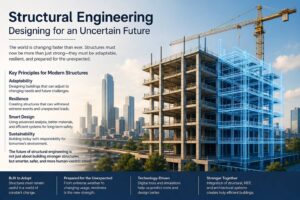

For decades, structural engineering has followed a clear goal: design buildings strong enough to handle expected loads—gravity, wind, earthquakes, and usage over time.
But today, that approach is quietly changing.
We are no longer designing only for what we know. We are starting to design for what we don’t know yet. From unpredictable climate patterns to changing urban demands, modern structures must be ready for uncertainty itself.
The Shift from Strength to Adaptability
Traditional structural design is based on calculations that assume:
- fixed load conditions
- predictable environmental forces
- stable usage patterns
But reality is becoming less predictable. Buildings today may face:
- extreme weather events beyond historical data
- changes in occupancy and function
- unexpected load variations due to urban growth
This is pushing structural engineering services toward a new idea:
adaptability is as important as strength.
What Does “Designing for the Unknown” Mean?
It doesn’t mean guessing blindly. Instead, it means creating structures that can:
- tolerate variations beyond standard limits
- respond to changing conditions
- maintain safety even when assumptions fail
This approach introduces a more flexible mindset into engineering—one that accepts uncertainty as part of design.
Redundancy: The Silent Safety Net
One of the most powerful yet underappreciated concepts in structural engineering is redundancy.
A redundant structure has multiple load paths. If one element fails, others take over.
Instead of relying on a single critical component, engineers design systems where:
- loads can redistribute
- localized damage doesn’t lead to collapse
- failure is gradual, not sudden
This principle has become increasingly important in a world where unexpected events are more common.
Overdesign vs Smart Design
In the past, engineers often responded to uncertainty by simply adding more material—making structures heavier and stronger.
But modern engineering is moving away from that idea.
Today, the goal is:
- not just stronger structures
- but smarter structures
This includes:
- optimizing geometry
- using advanced materials efficiently
- designing systems that behave intelligently under stress
The result is not just safety, but efficiency with resilience.
The Role of Digital Modeling and Simulation
One of the biggest changes in structural engineering is the use of advanced modeling tools.
Engineers can now simulate:
- extreme load scenarios
- progressive failure conditions
- long-term performance under varying environments
These simulations allow engineers to explore “what-if” situations that were impossible to test before.
Instead of relying only on past data, they can now design for future possibilities.
Structures That Age Gracefully
Another emerging idea is designing buildings that don’t just survive over time—but age intelligently.
This involves:
- anticipating material degradation
- planning for easy maintenance and retrofitting
- allowing structural upgrades without major disruption
In other words, a building is no longer a static object—it becomes something that evolves over its lifecycle.
Human Behavior: The Unpredictable Load
One of the least predictable factors in structural design is human behavior.
Buildings are often used in ways that engineers never originally intended:
- spaces get repurposed
- occupancy increases
- equipment loads change
Modern structural thinking considers these possibilities by designing with flexibility, ensuring that structures remain safe even when usage changes over time.
Where Coordination Becomes Critical
As structures become more complex and adaptable, coordination between disciplines becomes essential.
Structural systems must work seamlessly with:
- mechanical systems
- electrical layouts
- plumbing networks
Without proper coordination, even the best structural design can face real-world challenges during construction and operation.
This is where integrated engineering approaches, like those used by firms such as Engides, play a key role. By aligning structural design with MEP systems and using coordinated workflows, they help ensure that buildings are not only strong but also practical and efficient in real-world conditions.
The Future of Structural Engineering
The future isn’t about building stronger structures alone. It’s about building smarter, more responsive, and more resilient systems.
We are moving toward structures that:
- adapt to changing environments
- anticipate risks
- remain functional under uncertainty
This shift represents a deeper evolution in engineering thinking—one that goes beyond calculations and embraces complexity.
Conclusion
Structural engineering is no longer just about resisting forces.
It’s about understanding that the world is changing—and designing buildings that can change with it.
The most successful structures of the future won’t be the ones that are simply the strongest.
They will be the ones that are prepared, adaptable, and resilient in ways we are only beginning to understand.