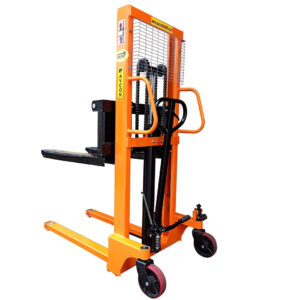

Most warehouses reach a point where manual lifting stops being practical. The loads get heavier, the racks get taller, and asking workers to carry goods to height is not a workforce management strategy — it is an injury waiting to happen. The gap between carrying things by hand and bringing in a full electric forklift is wider than most operations want to admit, and that gap is exactly where a manual stacker earns its place.
A manual stacker is not glamorous equipment. It does not come with software integration or a battery management system. What it does is lift palletised and non-palletised loads to height — reliably, repeatedly, and without requiring a power outlet, a charging schedule, or a certified forklift operator to run it. For a large portion of Indian manufacturing and warehousing operations, that combination is more useful than anything more complicated.
The Equipment Itself — How It Is Built and What It Does
A manual stacker operates through a hydraulic lifting system driven either by a foot pedal or a handle pump, depending on the model. The operator pumps to raise the forks, steers the unit to the required position, and uses a release valve on the handle to lower the load in a controlled descent. Three handle positions — lift, neutral, lower — cover the entire operating sequence.
The mast structure is what determines how high the forks travel. Single-mast configurations are standard for lift heights up to around 1.6 metres. Double-mast or duplex mast designs extend that range to 3 metres and beyond, depending on the specification. The mast runs on maintenance-free ball bearing cable and guide rollers, which is what keeps the lifting action smooth across thousands of operating cycles without requiring regular adjustment.
Load capacity across commercially available manual stackers in India runs from 500 kg at the lighter end to 2,000 kg on heavy-duty models. The wheels — typically polyurethane, nylon, or rubber — carry the combined weight of the unit and the load across the floor surface. Braking is built into the wheel system, and most models include a load backrest that prevents the load from shifting backward during travel.
The overall footprint is compact by design. A manual stacker can navigate aisles where a counterbalance forklift physically cannot go, which is one of the primary reasons it is specified for operations that share floor space between storage and production.
Three Types Worth Understanding
Not every manual stacker is the same piece of equipment. The category covers three distinct configurations, each suited to different floor-level requirements:
Straddle Manual Stacker — The most common configuration in Indian warehouses. Two outrigger legs extend forward from the base frame, straddling the pallet from both sides. This design provides stability without requiring a counterbalance weight at the rear, which keeps the overall footprint manageable. Straddle stackers are the standard choice for facilities handling standard-sized pallets on flat floors.
Counterbalanced Manual Stacker — Built without outrigger legs, which means the forks can enter a pallet from the front without the outriggers needing to clear the pallet base. This configuration is specified when the load type or pallet design makes straddling impractical — solid-base pallets, drums, or non-standard load configurations. The tradeoff is a longer wheelbase to maintain stability without the outriggers.
High-Mast Manual Stacker — A duplex or triplex mast configuration for operations that require lift heights above 2 metres. Retail back-end storage, multi-level racking systems, and mezzanine-level loading all generate requirements that a standard single-mast unit cannot meet. High-mast models address that vertical range while retaining the manual hydraulic operating principle.
Where Manual Stackers Work and Where They Do Not
Understanding where this equipment genuinely fits — and where it does not — is more useful than a general list of applications.
Where it fits:
A small manufacturing unit running one or two shifts with moderate pallet movement volume. The operation does not justify the capital outlay or maintenance overhead of an electric stacker, but workers lifting goods manually to rack height is neither safe nor sustainable. A manual stacker fills that gap precisely — lower capital cost, no charging infrastructure required, minimal maintenance between service intervals.
A warehouse with narrow aisle configurations where the aisle width between racking rows sits below the turning radius of a ride-on forklift. Manual stackers are compact enough to operate in aisles as tight as 1.5 metres, depending on the load width, which means the storage density of the facility does not have to be redesigned around the equipment.
A facility running in locations where power supply is inconsistent or unavailable at the point of use. Loading bays, temporary storage areas, outdoor dispatch zones — a manual stacker requires no power connection and no battery charge before operation. It is ready when the operator picks it up.
Cold storage environments where battery-operated equipment loses charge faster than in ambient conditions, and where charging infrastructure inside the cold zone is expensive to install and maintain.
Where it does not fit:
High-cycle operations where a single stacker is being used for 60 or more lifts per shift, every shift. At that frequency, operator fatigue becomes a genuine productivity and safety factor. The physical effort of pumping a manual hydraulic system across that volume of cycles adds up in a way that shows in error rates and physical strain by the end of the shift.
Lift heights consistently above 3 metres. Manual hydraulic systems work against increasing resistance as lift height rises. At heights above 3 metres, the effort required per pump stroke becomes impractical for sustained operation, and the stability margins on a tall mast narrow in ways that require very careful load and floor condition management.
Facilities handling loads consistently above 1,500 kg. Heavy-duty manual stackers exist at 2,000 kg capacity, but at that weight the physical effort of steering and positioning the loaded unit across a warehouse floor is significant. Above 1,500 kg and above 20 to 30 lifts per shift, the economics of a semi-electric or electric stacker begin to make more sense.
Key Technical Specifications to Understand Before Buying
Lift height — Measure the highest rack level your operation uses, then add clearance for the load height. The specification needs to place the bottom of the load at the rack level, not the top of the fork at the rack level. This calculation catches most undersizing errors before the equipment arrives.
Load capacity — The rated capacity is measured at a standard load centre distance, typically 500 mm from the face of the forks. If your loads are longer than standard — extended pallets, large drums, equipment on custom bases — the effective capacity reduces as the load centre moves further from the forks. Confirm the actual load centre for your heaviest load before specifying capacity.
Fork dimensions — Standard fork widths and lengths cover most pallet types, but non-standard pallets, machinery bases, and fabricated load carriers may require custom fork dimensions. Confirm fork outer spread against your pallet entry width before ordering.
Wheel type — Polyurethane wheels are the standard choice for smooth concrete floors and offer low rolling resistance. Nylon wheels carry higher loads but transmit more vibration. Rubber wheels are suited to rough or uneven floor surfaces. Specifying the wrong wheel type for the floor surface affects both maneuverability and floor protection.
Mast type — Single mast for lift heights up to 1.6 metres. Duplex mast for heights up to approximately 3 metres. The mast type also affects the lowered height of the forks, which matters when the stacker needs to pass through doorways or under overhead obstructions with a load in place.
Manual Stacker vs. Electric Stacker — The Honest Comparison
This comparison comes up in most procurement discussions, and the answer depends entirely on the specific operation rather than on which technology is generally superior.
The honest summary: a manual stacker is the right choice when cycle volumes are moderate, lift heights are within 3 metres, power access is limited, and capital expenditure needs to stay low. An electric stacker is the right choice when cycle volumes are high, lift heights exceed 3 metres, and the operation justifies the higher capital and infrastructure cost.
Neither is universally better. The operation determines the fit.
Safety: What the Equipment Requires From the Operator
A manual stacker is straightforward to operate, but straightforward does not mean risk-free. The incidents that occur with this equipment are almost always traceable to one of four situations:
Overloading — Operating above the rated capacity compromises both the hydraulic system and the structural integrity of the mast. The rated capacity plate on the equipment is a hard limit, not a guideline. Loads that regularly approach or exceed it should trigger a review of whether the specified capacity is correct for the operation.
Uneven floor surfaces — A loaded stacker on an uneven floor surface shifts the load centre away from the design position. At height, that shift amplifies. Facilities with cracked concrete, expansion joints, or sloped surfaces near racking areas need to confirm that the floor condition is within the equipment’s operating envelope.
Raising loads in transit — The forks should be lowered to travel height — typically 150 to 200 mm — before moving a loaded stacker across the floor. Travelling with a load raised increases the centre of gravity and reduces lateral stability, particularly during turns.
Unsecured loads — The load backrest prevents backward shift, but it does not secure the load against forward movement when the stacker decelerates. Unstable loads on the forks — unshrunk pallets, loose cartons, irregular shapes — need to be secured before lifting, not after.
Maintenance: What the Equipment Actually Needs
A manual stacker does not demand much. The hydraulic system is the component that matters most, and it requires the least complex attention.
Check hydraulic fluid level at regular intervals — monthly in moderate use, fortnightly in heavy daily use. Low fluid produces sluggish lifting response and, if left unaddressed, can introduce air into the system that causes uneven or jerky descent. Top up with the correct hydraulic oil grade as specified in the equipment documentation.
Inspect the mast channels and guide rollers monthly for debris accumulation. Grit and dust that works into the mast channel causes premature wear on the rollers and increases the physical effort required to lift. A clean mast with light lubrication on the running surfaces operates noticeably more smoothly than a neglected one.
Check the wheel condition quarterly. Polyurethane wheels develop flat spots when a loaded stacker is left stationary in the same position for extended periods. A wheel with a flat spot creates vibration that transfers through the load during travel. Replace wheels before the flat spot becomes large enough to affect steering control.
Test the braking system weekly. A stacker with degraded brake performance on a sloped surface or near a rack end is a safety exposure that shows up without warning. Brake adjustment is typically straightforward and should be part of any routine inspection schedule.
Closing Thought
A manual stacker occupies a specific and genuinely useful position in the material handling equipment landscape. It is not the right answer for every operation, but for the operations it fits, it delivers reliable, low-cost, low-complexity lifting performance that more sophisticated equipment cannot match on the economics. The facilities that get the most from it are the ones that spec it correctly for their actual load, height, and cycle requirements — and maintain it consistently enough that it performs the same on day 500 as it did on day one.