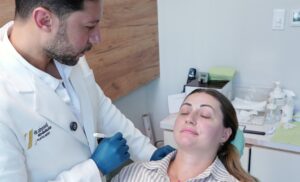

Ultrasound in aesthetic medicine refers to the use of medical ultrasound imaging to examine selected structures beneath the skin and, in appropriate circumstances, support clinical assessment or treatment planning. As aesthetic procedures become increasingly varied, imaging may provide additional information in certain cases where understanding the underlying anatomy is important.
For patients researching ultrasound in aesthetic medicine in Sheikh Zayed, it is useful to understand what the technology can do, when it may be relevant and why it does not replace professional clinical judgment.
Z Clinic provides information about ultrasound in aesthetic medicine through its dedicated service page in Sheikh Zayed, Egypt.
What Is Ultrasound Imaging?
Ultrasound is an imaging method that uses high-frequency sound waves to create images of internal structures. Unlike imaging techniques that use ionizing radiation, diagnostic ultrasound uses sound waves.
The images produced depend on the equipment, the area being examined and the operator’s technique and experience. Ultrasound can be useful for examining certain soft-tissue structures, but it cannot visualize every structure equally well or answer every clinical question.
In aesthetic medicine, its relevance depends on the specific concern being assessed.
How Can Ultrasound Support Aesthetic Assessment?
Aesthetic procedures may involve facial and other soft tissues where anatomical details are important. In selected situations, ultrasound may help a trained practitioner examine these structures and obtain additional information before deciding on an appropriate approach.
The technology may also be considered when evaluating certain concerns following injectable treatments, including questions about the location of previously injected materials.
However, ultrasound is not automatically necessary before every aesthetic procedure. Its usefulness depends on the clinical question, the patient’s circumstances and whether the findings are likely to influence the next decision.
Ultrasound and Injectable Treatments
Injectable procedures require an understanding of anatomy, appropriate product selection and careful technique. In some situations, ultrasound may help a trained practitioner visualize relevant soft tissues or assess previously injected material.
The information obtained can support clinical reasoning, but it does not independently determine the correct treatment. Findings must be considered alongside the patient’s history, symptoms, physical examination and the details of previous procedures.
Patients should ask why imaging is being recommended and how the results may affect the proposed plan.
Potential Benefits and Important Limitations
One potential advantage of ultrasound is that it can provide real-time images of selected structures beneath the skin. In suitable cases, this additional information may help clarify an anatomical question or support more informed planning.
There are also important limitations. Image quality and interpretation depend on the equipment, the area being examined and the practitioner’s training. Not every structure or complication can be assessed reliably with ultrasound alone.
The presence of imaging does not guarantee a particular outcome or eliminate procedural risks. It should be viewed as a tool that may support appropriate clinical decision-making rather than a replacement for medical expertise.
Why Professional Training Matters
Obtaining an ultrasound image is only one part of the process. Interpreting the image correctly and relating it to the patient’s clinical situation requires relevant knowledge and training.
Patients can ask who will perform the examination, what the assessment is intended to establish and how the findings will influence the treatment decision.
They should also receive an explanation of any uncertainty, limitations or need for further evaluation. Clear communication helps ensure that imaging is used for a defined clinical purpose rather than simply because the technology is available.
Is Ultrasound Necessary for Every Aesthetic Treatment?
No. The need for ultrasound depends on the procedure, the patient’s circumstances and the clinical question.
Some aesthetic treatments may be assessed adequately through consultation and physical examination. In other situations, additional imaging may be considered if it can provide relevant information.
A qualified professional can determine whether ultrasound is appropriate and explain the alternatives. Patients should not assume that every treatment requires imaging or that an ultrasound examination makes a procedure risk-free.
Ultrasound in Aesthetic Medicine at Z Clinic
For people exploring aesthetic medicine in Sheikh Zayed and West Cairo, Z Clinic’s dedicated ultrasound service page provides a starting point for learning about this area of care.
The relevance of ultrasound depends on the individual clinical situation. A consultation with the appropriate qualified medical professional can help clarify whether imaging may be useful, what it can reasonably establish and how the findings may inform the next step.
Learn More About Ultrasound in Aesthetic Medicine
Explore the official Z Clinic page to learn more about its ultrasound in aesthetic medicine service and discuss your questions with the appropriate medical professional.
https://zcliniceg.com/ultrasound-in-aesthetic-medicine/?lang=en