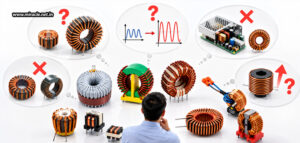

Inductors are widely used in electronic and electrical systems, but misconceptions about their size, performance, applications, and design can affect component selection. The performance of inductor coils depends on factors such as inductance, current capacity, frequency, core material, thermal behaviour, and construction. They support applications including power conversion, filtering, signal processing, and electromagnetic interference suppression. Their construction varies according to operating conditions, space limitations, and efficiency requirements. Understanding common myths can help engineers and designers evaluate inductors more accurately and choose components that meet the specific electrical, thermal, and physical requirements of their applications.
Myth 1: Bigger inductor coils mean better performance
One common assumption is that a larger inductor will automatically provide better performance because it can accommodate more winding or a larger magnetic core. However, a larger component may provide advantages in certain applications, such as higher current-handling capability, improved thermal performance, or greater energy storage, but these benefits depend on the component’s actual design. Increasing size without considering the magnetic circuit, winding arrangement, core material, and electrical requirements does not necessarily improve performance. The required inductance, rated current, saturation current, DC resistance, operating frequency, and allowable temperature rise must all be considered together. In some applications, a compact inductor may provide the required performance more efficiently than a larger component.
Myth 2: Higher inductance always means better performance
Another misconception is that a higher inductance value automatically makes an inductor more effective. But, this is not always true. The required inductance is determined by the electrical function the component must perform. Increasing inductance beyond what the circuit requires can change current response, filtering behaviour, transient performance, and physical component requirements. Depending on the construction, achieving a higher value can also require additional turns, a different core, a larger component, or changes in the magnetic path. These changes can affect winding resistance, parasitic effects, physical size, and losses.
Myth 3: Inductor coils are used only in power circuits
Inductors are strongly associated with power supplies and converters, but they are relevant only to power electronics. In reality, their applications extend well beyond power circuits. In power conversion systems, inductors are used for energy storage, current smoothing, ripple reduction, and filtering. However, they are also important in signal and communication circuits, audio equipment, RF systems, EMI filtering, and various electronic control systems. Therefore, inductor coils are not limited to only high-current power applications, but can also play important roles in circuits where signal integrity and frequency behaviour are critical.
Myth 4: All inductor coils perform in the same way
Inductors may look similar externally, but their internal construction and electrical characteristics can differ significantly. Core material is a key factor: air-core designs avoid core saturation, while ferrite and powdered iron cores offer different combinations of frequency performance, energy storage, and DC bias capability. Winding construction also affects performance, with turns, conductor size, insulation, spacing, and arrangement influencing resistance, heat generation, parasitic capacitance, and frequency response. Therefore, selecting an inductor requires more than matching its nominal inductance. Electrical, thermal, frequency, current, and physical requirements should all be evaluated to ensure reliable circuit performance.
Myth 5: More turns always improve inductor performance
Adding more turns to an inductor winding generally increases inductance, but that does not mean more turns will always produce a better component. Additional turns increase the length of conductor used in the winding, which can increase DC resistance and copper losses. More turns can also increase parasitic capacitance between winding sections, which may influence high-frequency performance. The additional winding may further increase the physical size of the component or make heat removal more difficult. In some designs, these effects can outweigh the benefit of achieving higher inductance. The winding must therefore be optimized according to the required inductance, current, frequency, resistance, thermal conditions, and available space. An efficient design uses an appropriate number of turns rather than simply maximizing the winding count.
Moving beyond common inductor myths
The performance of an inductor cannot be judged by size, inductance value, or winding count alone. Each of these characteristics interacts with other electrical, magnetic, thermal, and mechanical factors. Understanding these relationships is particularly important when inductor coils are being designed or selected for demanding applications. A component intended for a high-frequency circuit may require very different characteristics from one designed for high-current power conversion, even if their nominal inductance values are similar. Rather than relying on general assumptions, designers should evaluate the complete operating requirements of the application. This helps ensure that the selected inductor provides the required performance, efficiency, thermal stability, and reliability while maintaining consistent operation under expected load, frequency, temperature, and environmental conditions throughout its service life.
Choosing the right inductor coil for an application
Selecting an appropriate inductor begins with understanding its role within the circuit. Designers should consider inductance, current, voltage, operating frequency, ripple, temperature range, and physical limitations. Core material should match the required magnetic characteristics and frequency, while the winding must handle the expected current without excessive resistance or losses. Thermal performance is also important, particularly during continuous high-current operation. For specialized applications, custom-designed inductor coils can address specific requirements for inductance, dimensions, mounting, frequency, insulation, and heat management. Manufacturing precision and quality control further help maintain consistent electrical and physical characteristics, ensuring reliable performance throughout the component’s intended operating conditions. For application-specific requirements, Miracle Electronics provides custom-designed inductors engineered to meet defined electrical and physical specifications. As an inductor coil manufacturer exporter from India to USA, Miracle Electronics supports diverse applications with precision manufacturing, consistent quality, and solutions tailored to specific inductance, winding, dimensional, and operating requirements.
Inductors may be simple passive components in principle, but their real-world performance depends on careful design and application-specific selection. Larger size does not automatically mean better performance, higher inductance is not always preferable, and more winding turns do not guarantee greater efficiency. Similarly, inductor coils are used far beyond power circuits, and matching the inductance value alone does not guarantee that a component will perform correctly. Core material, winding construction, current handling, frequency characteristics, losses, thermal behaviour, and operating conditions all influence the final result. Understanding these common misconceptions allows designers to evaluate inductors more accurately and select or develop components that meet the actual requirements of modern electrical and electronic systems.