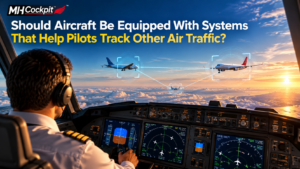

Aircraft safety has improved considerably with the introduction of modern navigation, communication, and surveillance technologies. One important question in aviation is whether every aircraft should be equipped with systems that help commercial pilot identify and track other aircraft in the surrounding airspace. In my opinion, these systems play an important role in preventing mid-air collisions, improving situational awareness, and helping pilots make informed decisions during flight.
As air traffic continues to grow, pilots need reliable information about nearby aircraft. Although air traffic controllers guide aircraft through designated routes and maintain separation, additional traffic awareness systems can provide another layer of protection.
Why Is Air Traffic Awareness Important?
During a flight, pilots must continuously monitor their aircraft’s position, altitude, speed, and surrounding environment. In busy airspace, several aircraft may be operating at different altitudes and following intersecting routes. Without suitable traffic information, identifying a potential conflict can be difficult, particularly when visibility is limited or an aircraft is approaching from an unexpected direction.
Air traffic awareness systems help pilots understand where other aircraft are located and whether their flight paths could create a safety concern. This information gives pilots more time to assess a situation and respond appropriately.
These systems can be particularly useful during instrument meteorological conditions, when pilots cannot rely on visual contact to identify nearby traffic. They also support safer operations around busy airports, where aircraft frequently climb, descend, and change direction.
Technologies That Help Pilots Track Other Aircraft
Modern aviation already uses several technologies to improve traffic awareness. Two important examples are the Traffic Collision Avoidance System (TCAS) and Automatic Dependent Surveillance-Broadcast (ADS-B).
TCAS monitors nearby aircraft using transponder signals and assesses whether another aircraft could present a collision threat. Depending on the situation, it can issue a traffic advisory to alert the flight crew or a resolution advisory that directs pilots to take specific vertical action to increase separation. Pilots are trained to respond appropriately to these alerts.
ADS-B works differently. An aircraft equipped with ADS-B broadcasts information such as its position, altitude, velocity, and identification. This information can be received by ground-based surveillance stations and other suitably equipped aircraft. It helps air traffic controllers monitor traffic and can provide pilots with a clearer picture of nearby aircraft when the appropriate equipment is installed.
Although these technologies serve different purposes, they both contribute to safer flight operations. Their effectiveness depends on equipment compatibility, signal availability, correct installation, and the operational environment.
Should Every Aircraft Have These Systems?
I believe traffic awareness technology should be used as widely as reasonably practical, with equipment requirements based on aircraft type, operating environment, and applicable aviation regulations.
Commercial aircraft operating in busy airspace have established requirements for collision avoidance and surveillance equipment. Smaller aircraft, including some general aviation aircraft, may have different equipment requirements depending on the jurisdiction and type of operation.
Expanding access to reliable traffic information could help pilots operating smaller aircraft become more aware of surrounding traffic. This may be especially useful in areas where commercial flights, private aircraft, helicopters, and training aircraft share the same airspace.
However, installing advanced equipment on every aircraft can involve costs, maintenance requirements, and technical limitations. Smaller aircraft operators may face financial challenges when upgrading existing avionics. Any broader equipment mandate would therefore need to consider practical costs, compatibility, and the safety benefits expected from the upgrade.
Can Technology Replace Air Traffic Controllers?
Traffic tracking systems should support pilots and air traffic controllers rather than replace them. Controllers remain responsible for providing separation services where applicable, issuing instructions, and coordinating aircraft movements within their assigned airspace.
Likewise, pilots must continue to maintain situational awareness and follow established procedures. Electronic traffic displays cannot guarantee that every aircraft will be detected. Some aircraft may lack compatible equipment, and surveillance coverage can vary depending on the system and location.
Another concern is how pilots respond to alerts. Incorrect interpretation or an unnecessary manoeuvre can create additional risks. This is why equipment upgrades must be accompanied by proper training, clear procedures, and regular maintenance.
At MH Cockpit, discussions about pilot training and aviation safety often bring attention to the relationship between technology and human decision-making. Understanding how cockpit systems work is just as important as knowing when to rely on their warnings.
The Role of Pilot Training
Even the most advanced traffic awareness equipment is useful only when pilots know how to interpret its information. Training helps pilots understand traffic advisories, collision warnings, display limitations, and the correct response to conflicting instructions.
Pilots also need to understand how to coordinate with air traffic control when a potential conflict develops. Clear communication and timely decisions remain essential, particularly when an unexpected alert occurs during a busy phase of flight.
As aviation technology continues to develop, recurrent training can help pilots stay familiar with updated systems and procedures. This combination of technical knowledge and sound judgement supports safer operations.
Conclusion
Aircraft should be equipped with suitable systems that help pilots identify and track surrounding air traffic wherever practical and required by the nature of their operations. Technologies such as TCAS and ADS-B already demonstrate how better traffic awareness can support collision prevention and improve flight safety.
However, technology alone cannot eliminate every risk. Reliable equipment, proper maintenance, effective communication with air traffic control, and well-trained pilots must work together.
The objective should not simply be to install more technology in aircraft. It should be to ensure that pilots receive accurate, timely information and know how to use it correctly. By combining traffic awareness systems with sound training and established safety procedures, the aviation industry can continue working towards safer skies for everyone.