
Healthcare providers are under steady pressure to go digital. Patients expect online appointments and quick access to their reports. Regulators and insurers expect clean, traceable records. Behind all of it sits one decision that many practices make without fully understanding it: should we use an EMR or an EHR?
The two acronyms look alike and are often used as synonyms, but they describe different systems with different business implications. Here is a practical breakdown.
What is an EMR?
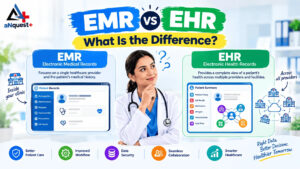
An electronic medical record (EMR) is the digital version of a patient’s chart inside a single practice. It typically stores:
- Diagnoses and treatment notes
- Prescriptions and allergy information
- Test results and vaccination history
- Visit dates and follow-up schedules
The main benefit is internal efficiency. Staff stop hunting for paper files, handwriting errors disappear, and doctors can review a patient’s history in seconds. The limitation is that the record stays within the practice. If the patient is referred elsewhere, the data does not automatically follow.
What is an EHR?
An electronic health record (EHR) holds the same clinical information but is built to be shared securely with other authorised providers, such as hospitals, laboratories, pharmacies, and specialists. It can also give patients direct access to their own information.
The US Office of the National Coordinator for Health IT makes this distinction clearly in its explanation of the difference between EMR and EHR. In short, an EMR serves one practice, while an EHR is designed to follow the patient across care settings.
The business impact of choosing one over the other
This is more than a technical choice. It affects daily operations.
- Referral workflow. If you send many patients to labs or specialists, an EHR cuts the back-and-forth of faxes, phone calls, and re-entered data. If most care happens inside your clinic, that connectivity may add cost without adding value.
- Staff time. Every manual step, such as re-typing reports or chasing a lab for results, takes time away from patients. Count how many of these steps your team handles each week before deciding.
- Patient experience. Patients increasingly want to see test results, prescriptions, and appointment details on their phones. Portals are usually part of the EHR approach.
- Cost and complexity. Connected systems need more setup, integration, staff training, and security review. A focused single-clinic practice may be better served by a simpler tool done well.
- Future flexibility. Switching systems later means migrating years of patient data. A system that can grow with you is cheaper than one you outgrow.
A simple way to decide
Ask these questions:
- Do most of my patients receive all their care in my clinic?
- How often do I need results from outside labs or hospitals?
- Do I run, or plan to open, more than one location?
- Will patients expect online access to their records?
- Can my current staff manage the system without constant outside help?
If your answers lean toward single-location, self-contained care, an EMR is often the practical starting point. If they lean toward referrals, multiple branches, or patient-facing digital services, an EHR deserves serious consideration.
A side-by-side look at both options, with examples for different practice types, is available in this EMR vs EHR comparison.
Why India’s direction of travel matters
India’s national digital health push, led by the Ayushman Bharat Digital Mission, aims to let patients link their health records through a digital health ID and share them with providers by consent. For clinics, the practical takeaway is simple: records captured today in a clean, structured format will be much easier to connect to that wider ecosystem tomorrow. Practices that stay on paper or in scattered files will have more catching up to do.
Common mistakes to avoid
- Buying on the label alone. Some products called “EHR” are really EMRs with a few sharing features. Ask for a demonstration of the exact workflow you need.
- Ignoring staff training. The best software fails if the front desk finds it confusing.
- Overlooking data security. Patient records are sensitive. Check how access is controlled, logged, and backed up.
- Choosing only for today. Think about where your practice will be in three years, not only this month.
Conclusion
An EMR keeps a single practice organised. An EHR keeps the patient’s wider care connected. Neither is automatically better. The right choice depends on how your patients move through the healthcare system, how big you plan to grow, and how much integration you can realistically manage.
Start with your real workflow, not the vendor’s feature list. A system that fits how your team works will save hours every week and give patients a smoother experience. One that does not fit will quietly become another task your staff work around.