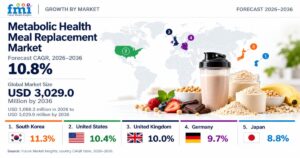

The global metabolic health meal replacement market is projected to increase from USD 1,086.2 million in 2026 to USD 3,029.0 million by 2036, expanding at a compound annual growth rate (CAGR) of 10.8%, according to Future Market Insights (FMI).
Get detailed market forecasts, competitive benchmarking, and pricing trends:
https://www.futuremarketinsights.com/reports/sample/rep-gb-35699
Demand is being supported by the use of shakes, bars, soups and portioned meals in structured weight-management routines. Products with defined calorie content and clearly specified nutritional profiles can serve different needs, from partial meal replacement to clinician-supervised dietary programs. Manufacturers, however, must distinguish complete meal replacements from protein drinks and standalone supplements while addressing taste, convenience and long-term adherence.
Structured weight management creates a clear commercial opportunity
The growing need for weight-management support is bringing greater attention to products designed around measured portions and defined nutritional intake. The World Health Organization’s December 1, 2025, publication on GLP-1 medicines for treating obesity reported that obesity affects more than one billion people worldwide.
For food manufacturers, this creates an opportunity to develop products suited to different dietary routines without presenting meal replacements as substitutes for prescribed treatment. High-protein formulations, clearly stated calorie levels and complete nutrient profiles can help buyers understand how a product fits into a defined eating plan.
Regulatory and clinical guidance also shapes product positioning. The National Institute for Health and Care Excellence (NICE), in guidance issued on January 14, 2025, addresses the use of very-low-energy diets within supported services and defined periods. Products intended for intensive dietary programs therefore need to be positioned according to their intended use and the relevant supervision requirements.
Where growth is fastest
FMI’s country forecasts show that South Korea is expected to record the fastest growth among the five profiled markets between 2026 and 2036.
- South Korea — 11.3% CAGR: Digital purchasing and active weight-management behavior support opportunities for convenient, portion-controlled products. The Korea Disease Control and Prevention Agency reported on November 25, 2025, that one in three Korean adults had obesity.
- United States — 10.4% CAGR: Demand spans clinical programs, pharmacies, grocery retail and direct-to-consumer subscriptions. Manufacturers must explain whether products replace a meal, support a structured program or provide supplemental nutrition.
- United Kingdom — 10.0% CAGR: Structured dietary services and consumer weight-management demand support market development. Products need clear calorie information, nutritional profiles and intended-use instructions.
- Germany — 9.7% CAGR: Interest in weight management creates opportunities for measured meal formats, while ingredient transparency, evidence behind product claims and appropriate guidance remain important.
- Japan — 8.8% CAGR: Insurer-led metabolic-risk screening and dietary counseling provide routes for introducing structured nutrition products. Local meal patterns, flavor preferences and professional guidance influence product suitability.
These forecasts reflect expected growth rates rather than the absolute size of each country’s market.
What leads the market
Three segments account for substantial projected shares in 2026, according to FMI.
- Clinically supervised VLCD/LCD programs — 41.8%: Screening and monitoring requirements support demand for meal replacements used within supervised dietary plans.
- Shakes — 49.3%: Fixed servings simplify preparation and portion control, making shakes suitable for both structured programs and partial meal replacement.
- Very-low-calorie diet (VLCD) programs — 49.0%: Defined daily energy limits support their use in intensive, supervised weight-management pathways.
FMI also projects self-directed consumers to account for 49.4% of the end-user segment and online/direct-to-consumer channels to represent 40.1% of sales-channel demand in 2026.
The hurdle: keeping consumers engaged
Long-term adherence remains a central challenge for the metabolic health meal replacement market. Intensive dietary programs require screening, support and sustained changes in routine. Taste fatigue, preparation preferences and disruption to daily habits can lead consumers to stop using a product before completing a planned program.
For manufacturers, the challenge extends beyond developing a nutritionally specified formula. Products must fit real consumption routines, offer acceptable flavor and communicate serving instructions clearly. Companies also need to distinguish between products intended for supervised dietary programs and those sold to consumers for partial meal replacement.
FMI identifies GLP-1-related nutrition as an opportunity for manufacturers developing smaller, protein-rich and fiber-rich meal formats. Such products may address practical meal-planning needs when appetite or eating patterns change, without replacing prescribed medicines or individualized clinical advice.
Recent developments and industry investment
Developments across meal replacement and nutrition businesses illustrate continuing investment in product development, clinical nutrition and established consumer distribution.
- July 17, 2026: Medifast introduced Trilivy, a metabolic health system featuring newly formulated meal replacements and a three-phase program.
- February 2026: Abbott filed its 2025 annual report, documenting its continuing global nutrition operations and product investment.
- September 2025: Glanbia agreed to sell SlimFast in the United States and other jurisdictions to Heartland Food Products Group.
These developments relate to broader business and product strategies; they do not establish market share or demonstrate that every company has introduced a new standalone metabolic health meal replacement.
FMI profiles the following companies in the market: Nestlé Health Science, Medifast, Abbott, Herbalife, Robard, HLTH Code, Supergut and SlimFast.
The competitive environment spans clinician-integrated nutrition, coach-guided consumer programs and direct-to-consumer specialists. Competition depends on program fit, formulation clarity, product-format options, distribution and the ability to explain the intended role of a product.
Analyst perspective
“I expect smaller complete meals to gain use beside drug-assisted weight care. Brands that explain the meal role clearly will retain buyer trust.”— Nandini Roy Choudhury, Principal Consultant, Future Market Insights.
What this means for food and beverage manufacturers
- Define the product’s intended role before selecting a formulation. Decide whether the product is designed for complete meal replacement, partial replacement or use within a supervised dietary program. Align serving instructions and nutritional information with that purpose.
- Evaluate repeat-use performance, not just initial demand. Assess flavor acceptance, preparation requirements, portion consistency and convenience during product trials. These factors can influence whether consumers maintain a routine over time.
- Adapt distribution and communication to the target buyer. Direct-to-consumer channels can support repeat ordering and product education, while pharmacies and supervised programs may require clearer guidance on appropriate use. Keep product descriptions factual and avoid implying that a meal replacement treats obesity or replaces prescribed medicines.
For detailed market forecasts, segment shares, country-level growth rates and competitive analysis, read Future Market Insights’ Metabolic Health Meal Replacement Market Report:
https://www.futuremarketinsights.com/reports/metabolic-health-meal-replacement-market
Explore More Research Reports by FMI
Hepatic Sarcopenia Nutrition Market –
https://www.futuremarketinsights.com/reports/hepatic-sarcopenia-nutrition-market
Dumping Syndrome Nutrition Market –
https://www.futuremarketinsights.com/reports/dumping-syndrome-nutrition-market
Pet Food Ingredients & Sustainable Protein Market –
https://www.newstrail.com/pet-food-ingredients-sustainable-protein-market/
About Future Market Insights (FMI)
Future Market Insights, Inc. (FMI) is an ESOMAR-certified, ISO 9001:2015 market research and consulting organization, trusted by Fortune 500 clients and global enterprises. With operations in the U.S., UK, India, and Dubai, FMI provides data-backed insights and strategic intelligence across 30+ industries and 1200 markets worldwide.
For Press & Corporate Inquiries
Rahul Singh AVP – Marketing and Growth Strategy
Future Market Insights, Inc.
+91 8600020075
For Sales: sales@futuremarketinsights.com
For Media: Rahul.singh@futuremarketinsights.com
For Web: https://www.futuremarketinsights.com/